


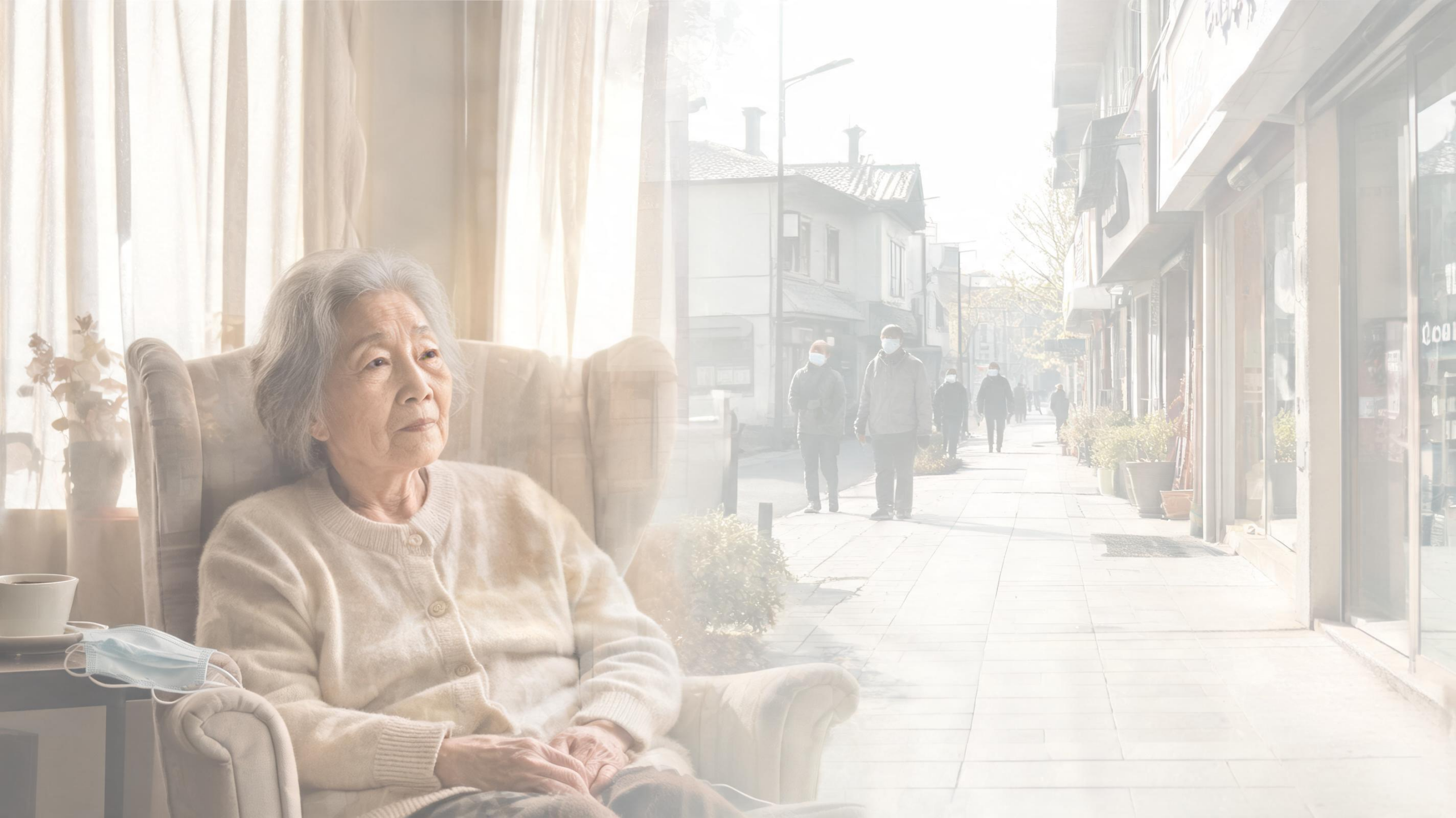
When the Covid-19 pandemic swept through the world in early 2020, few groups felt its consequences as profoundly as frail older people. In Sweden, where people aged 70 and older were urged to restrict their social contacts and avoid gatherings, a new qualitative study has now documented in unusual depth how this advice played out in the daily lives of the most vulnerable members of that population. Published in the Scandinavian Journal of Occupational Therapy, the research reveals that frail older people experienced the pandemic not as a single burden but as a form of double exposure, in which their own age-related vulnerabilities intersected with external restrictions to constrain nearly every dimension of everyday life. The findings offer a technical and deeply human picture of what isolation does to people whose capacity to adapt is already diminished, and they carry lessons that extend far beyond any single public health crisis.
The study, conducted within the framework of the larger Swedish randomized controlled CGA Swed trial, set out to explore how frail older people managed everyday life in quarantine during the first year of the pandemic. Frailty, in the clinical sense, refers to a state of reduced bodily function, increased vulnerability, and diminished ability to handle stressors, often assessed through criteria such as general weakness, reduced endurance, weight loss, low physical activity, and slow walking speed. Because frailty markedly increases after the age of 80 and is associated with reduced quality of life, impaired cognition, and heightened risk of depression and pain, the researchers reasoned that this group would experience pandemic restrictions differently from healthier older adults. Yet, until now, in-depth knowledge about the consequences for frail older people specifically remained scarce, leaving a gap in both gerontology and occupational therapy research.
Twenty participants, aged 78 to 100 years and including 11 women and 9 men, were recruited through strategic sampling designed to capture heterogeneity in age, illness, functional ability, and dependence in activities of daily living. Almost all depended on home-help services, two lived in nursing homes, and seven rated their health as good while the rest described it as fair or poor. Because meeting in person posed an unacceptable infection risk, the researchers conducted semi-structured telephone interviews between October 2020 and February 2021, lasting from 11 to 33 minutes with a median of 23 minutes. Notably, recruitment and data collection never occurred digitally, an advantage the researchers highlight given that digital exclusion is itself a barrier for this population. The interviews were transcribed verbatim and analyzed using the qualitative content analysis method described by Graneheim and Lundman, in which meaning units are coded, grouped into categories, and distilled into themes, ultimately yielding one overarching theme and four subthemes.
That overarching theme, everyday life in double exposure, captures the central insight of the study: even before the pandemic, limitations already existed across multiple domains of these participants’ lives as consequences of ageing and illness. Dependence on elder care services could negatively affect control over daily routines, and most participants had already adapted their leisure activities to a reduced capacity. The loss of friends to old age had narrowed social interactions, and reliance on relatives for support had heightened dependence. The restrictions then compounded every one of these pre-existing limitations. Rather than confronting the pandemic from a baseline of healthy autonomy, these older people faced a crisis that amplified vulnerabilities they were already struggling to manage, and their diminished capacity to generate new coping strategies made the disruption especially destabilizing.
The first subtheme, powerlessness under the restrictions, describes the tension between adhering to public health guidance and struggling with its suffocating impact. Participants spoke of the pandemic period as a lost year, a time of living unnaturally under a new set of rules about how to exist. The constraints heightened their awareness of life’s finite nature and intensified the desire to engage in meaningful occupations, while simultaneously undermining their sense of autonomy and occupational identity. For those in care homes, limitations were particularly severe, with periods when residents could not move through common areas or meet relatives, and when fellow residents died from the virus. One participant described a common room where only three grieving residents remained after many others had died at the same time. Relatives’ opinions also shaped what activities participants felt permitted to pursue, an external control that reinforced feelings of limited agency and left some waiting for something to change without knowing how to influence their situation.
To manage this powerlessness, participants adopted a strategy the researchers termed acceptance and trust in the restrictions. Accepting the necessity and effectiveness of the measures became a way to cope with double exposure, allowing participants to focus on external factors such as vaccination prospects or changing seasons. Strict adherence, including avoiding all social contact, provided a sense of security for some, while others balanced precautions such as masks, sanitizers, and physical distance with continued essential activities. Healthcare was still sought when needed, and routine visits continued. Yet the study uncovered a novel and troubling finding: inconsistent adherence to safety measures among elder care staff, such as variable use of protective equipment, undermined participants’ sense of security and even led some to cancel support services they clearly needed, despite having extensive care needs that limited that option. Over time, pandemic behaviors like distancing and abstaining from handshakes became routine, but adherence occasionally relaxed, with some participants prioritizing physical contact with close relatives over fear of infection, weighing emotional needs against physical risk.
The third subtheme, limitations in everyday life beyond control, documents how the pandemic profoundly restricted activities and deepened boredom. The inability to meet relatives, socialize with friends, or leave the home for everyday societal activities such as shopping, using public transport, or simply sitting on a bench was experienced as particularly restrictive. Shifting social and religious activities to digital platforms was often impossible due to limited technological skills or resources, meaning that lost participation also meant lost routines, health benefits, and intellectual engagement. Dependence on family members introduced further constraints, as feelings of being a burden inhibited participants from expressing their own needs. Practical frictions multiplied; one participant described the difficulty of coordinating a hairdresser visit with home care schedules that had themselves become unpredictable because of pandemic staffing uncertainties. One participant, asked what she did when spontaneous meetings were no longer possible, responded through tears that she simply lay down in bed and fell asleep, calling the situation awful.
Against these losses, the final subtheme, striving for meaningfulness in everyday life, reveals remarkable resilience. Participants adapted leisure activities to fit within restrictions, meeting friends outdoors when weather permitted, maintaining phone contact, and turning to solitary hobbies such as reading, puzzles, radio, crosswords, and television. Some expanded their use of smartphones and tablets to access social media or games, while others relied on relatives for basic digital tasks, but for many, technology remained inaccessible due to lack of access or competence. Crucially, even participants with digital tools did not perceive online interaction as a true replacement for in-person contact, consistent with prior research on occupational disruption. In care settings, the social interaction provided by care staff grew increasingly important, and some participants supported peers facing greater challenges, demonstrating solidarity, such as one resident who gave fruit to and talked with two women who died the very same night.
The authors conclude that frail older people may have limited capability to adapt to new circumstances, make active decisions to influence their situation, and proactively manage their health, which underscores the central role of occupational therapy in mitigating the impact of disrupted everyday life. Occupational therapists, the study argues, are uniquely positioned to identify how frailty constrains activity performance and participation, to co-create modified routines, to enable safe engagement in daily activities, to strengthen social participation through both digital and non-digital means, and to work with families and care staff to stabilize expectations around daily roles. Addressing digital exclusion, ensuring stable and predictable care environments, and strengthening continuity in primary care through designated contact persons emerge as concrete priorities. Perhaps most significantly, the mechanisms identified here, including reduced activity opportunities, disrupted roles, and weakened belonging, operate not only during pandemics but also in ordinary circumstances where illness, mobility limitations, or restricted social networks chronically isolate frail older people. The study’s findings thus serve as both a record of a lost year and a blueprint for sustaining leisure, connection, and wellbeing in future disruptive events.
Subject of Research: Managing Everyday Life in Double Exposure: Frail Older People’s Experiences During a Pandemic
Article Title: Managing Everyday Life in Double Exposure: Frail Older People’s Experiences During a Pandemic
Article References: Sjöberg, K., Dahlin-Ivanoff, S., Wilhelmson, K., & Andersson Hammar, I. (2026). Managing Everyday Life in Double Exposure: Frail Older People’s Experiences During a Pandemic. Scandinavian Journal of Occupational Therapy, 33(1), Article 1. https://doi.org/10.1007/s44474-026-00001-7
Image Credits: AI Generated
DOI: 10.1007/s44474-026-00001-7
Keywords: Managing, Everyday, Life, Double, Exposure, Frail, Older, People, Experiences, During, Pandemic, scientific research
Cite Scienmag News
Kristina Jarvis. (September 3, 2026). Managing Everyday Life in Double Exposure: Frail Older People’s Experiences During a Pandemic. Scienmag. https://scienmag.com/managing-everyday-life-in-double-exposure-frail-older-peoples-experiences-during-a-pandemic/
Kristina Jarvis. "Managing Everyday Life in Double Exposure: Frail Older People’s Experiences During a Pandemic." Scienmag, 3 September 2026, https://scienmag.com/managing-everyday-life-in-double-exposure-frail-older-peoples-experiences-during-a-pandemic/. Accessed 4 October 2026.
Kristina Jarvis. "Managing Everyday Life in Double Exposure: Frail Older People’s Experiences During a Pandemic." Scienmag. September 3, 2026. https://scienmag.com/managing-everyday-life-in-double-exposure-frail-older-peoples-experiences-during-a-pandemic/


