


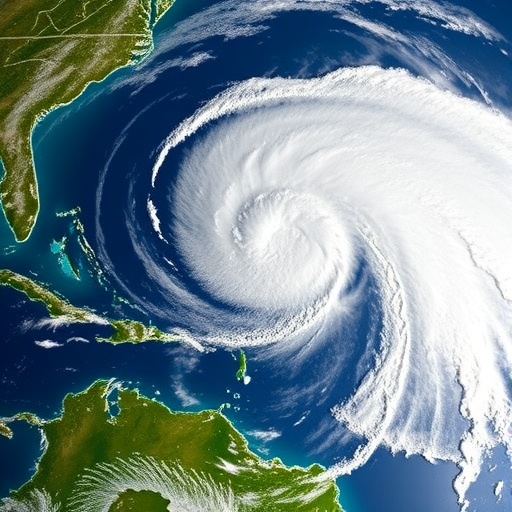
Tropical cyclones (TCs) stand as some of the most devastating natural phenomena on Earth, wreaking havoc through violent winds, torrential rains, and widespread flooding. As global temperatures climb due to anthropogenic climate change, scientists critically seek to unravel the complex ways in which these storms might evolve. While significant advances have been made in understanding future shifts in cyclone intensity, size, and rainfall, an area that has remained shrouded in uncertainty is how the vertical structure of tropical cyclones—their internal atmospheric configurations—will respond to a warming world.
A groundbreaking new study, recently published in Nature Communications, confronts this knowledge gap head-on. Led by a research team at the Institute of Atmospheric Physics of the Chinese Academy of Sciences, the study leverages an ingenious synthesis of model simulations and paleoclimate proxy data to illuminate an unexpected aspect of cyclone behavior under extreme warm climate scenarios. The authors discovered that, as the atmosphere warms substantially, the incidence of shallow tropical cyclones—storms confined mainly to the lower troposphere—surges dramatically in tropical regions, surpassing the traditional deep, vertically extensive cyclones.
Shallow cyclones, as defined in this investigation, are characterized by convective updraft maxima and low-pressure anomalies restricted predominantly to lower atmospheric layers. This structural distinction implies divergent storm dynamics and associated hazards compared to classic deep cyclones, which have storm activity extending well into the mid and upper troposphere. Understanding the prevalence and implications of these shallow systems is pivotal, as prevailing meteorological paradigms and risk assessment protocols have historically centered on deep, highly vertically developed cyclones.
To peer millions of years into Earth’s climatic past, the research team focused on the Early Eocene Climatic Optimum (EECO), a period from approximately 56 to 48 million years ago marked by some of the warmest global climates in the Cenozoic era. This epoch serves as a natural analogue for potential future climates, with atmospheric CO₂ concentrations estimated to be severalfold higher than preindustrial levels. Analysis revealed that during the EECO, the proportion of shallow tropical cyclones in the tropics rose to an unprecedented 51.83%, tipping the balance away from deep cyclone dominance that characterizes today’s regime.
Crucial drivers underlying this radical shift appear to be the elevated greenhouse gases, which foster a more thermally stable atmospheric column. The study highlights two key atmospheric mechanisms: increased mid-level ventilation and enhanced atmospheric stability. Together, these factors inhibit deep convective development and facilitate storm structures confined to the lower troposphere, effectively suppressing the formation of deep cyclones while allowing shallow systems to flourish.
The implications for cyclone-related hazards are complex and challenge conventional assumptions. It might be tempting to infer that the dominance of shallower cyclones equates to reduced risk, given their typically weaker wind fields. However, the study’s findings paint a more nuanced picture. Despite their reduced wind intensity, shallow cyclones exhibit rainfall rates during the EECO comparable to their deep counterparts. This apparent paradox arises from microphysical and dynamical processes decoupling surface wind speed from precipitation intensity, particularly the prevalence of strong warm-rain microphysics driven by intense low-level convection.
First author Tingyu Zhang emphasized that “the decoupling of rainfall from wind speed in shallow cyclones is probably driven by the intense warm-rain processes.” These processes—which rely less on the cold cloud mechanisms dominating deep cyclones—underscore the potential for extreme hydrological impacts even in the absence of catastrophic winds. This insight challenges prevailing risk assessment frameworks predominantly anchored to maximum wind speed metrics.
Corresponding author Tianjun Zhou stresses the practical ramifications: “This study highlights the necessity of reassessing future cyclone-related hydrological hazards.” The authors note that current predictive tools and hazard assessments prioritize upper-atmospheric indicators that effectively identify deep cyclones but routinely overlook the shallow cyclones that fall outside such criteria. Furthermore, reliance on wind speed alone can underestimate the true potential for flooding and rainfall-induced disasters.
The study calls for the scientific community, urban planners, and policymakers to broaden the lens through which tropical cyclone risks are evaluated and managed in a warming world. With climate change poised to push atmospheric conditions toward those seen during the EECO, the paradigm shift to more prevalent, rainfall-intense shallow cyclones demands enhanced observational strategies, refined climate models, and updated early warning systems tuned to these structural changes.
From a theoretical standpoint, this research pioneers a more comprehensive understanding of tropical cyclone vertical structure as an essential dimension of climate change impacts. It also bridges paleoclimate insights with modern atmospheric science, demonstrating the invaluable context provided by ancient analogues for anticipating future phenomena.
The findings underscore how the dynamics of convection, wind, moisture transport, and microphysics interplay in complex ways that cannot be fully captured by traditional cyclone classification schemes based on maximum wind speed or cloud height alone. Consequently, future investigations into tropical storms will likely need to address vertical storm morphology with equal rigor to intensity, frequency, and track forecasting.
The dramatic rise in shallow tropical cyclones under elevated CO₂ also suggests broader implications for the distribution and severity of cyclone-associated hazards globally. Regions that may historically have been vulnerable primarily to wind damage could face enhanced flooding and landslide risks. Therefore, resilience and adaptation efforts must consider these multifaceted outcomes to safeguard communities effectively.
In conclusion, this research presents a paradigm-transforming vision of how tropical cyclones may morph structurally within a world warming beyond the climatic extremes of recent millennia. The increased prevalence of shallow cyclones with a decoupling of rainfall from wind challenges conventional wisdom and risk metrics, calling for a suite of integrated scientific, technological, and policy responses to anticipate and mitigate the complex hazards of future tropical storms.
News Publication Date: 28-Apr-2026
Web References:
https://doi.org/10.1038/s41467-026-72386-9
Cite Scienmag News
Russell Cooper. (May 15, 2026). Rising Temperatures Promote Shallower Cyclones, Undermining Existing Risk Models. Scienmag. https://scienmag.com/rising-temperatures-promote-shallower-cyclones-undermining-existing-risk-models/
Russell Cooper. "Rising Temperatures Promote Shallower Cyclones, Undermining Existing Risk Models." Scienmag, 15 May 2026, https://scienmag.com/rising-temperatures-promote-shallower-cyclones-undermining-existing-risk-models/. Accessed 3 September 2026.
Russell Cooper. "Rising Temperatures Promote Shallower Cyclones, Undermining Existing Risk Models." Scienmag. May 15, 2026. https://scienmag.com/rising-temperatures-promote-shallower-cyclones-undermining-existing-risk-models/


