


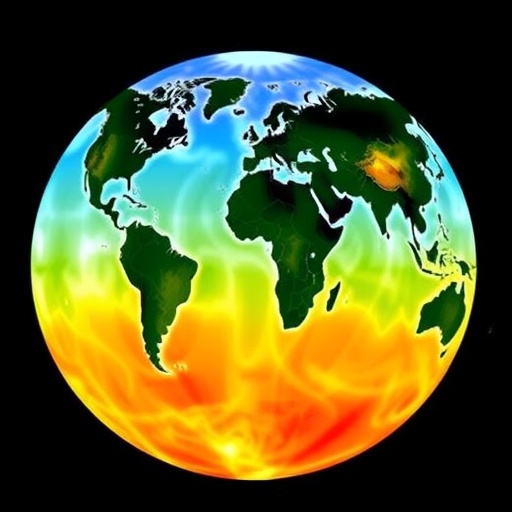
Atmospheric methane concentrations have escalated to unprecedented levels in recent years, eliciting urgent concern from climate scientists worldwide. A recent illuminating study, published on May 4, 2026, in the prestigious journal Nature Communications, reveals groundbreaking insights gleaned from an innovative approach using methane isotopologues to map and analyze global methane emissions between 2019 and 2021. This advancement not only refines previous emission estimates but also uncovers critical regional variations, challenging long-standing assumptions about methane sources and their evolving dynamics.
Methane, a potent greenhouse gas with a global warming potential many times that of carbon dioxide, plays a pivotal role in driving climate change. Its atmospheric abundance has been rising at an alarming rate due to both natural processes and anthropogenic activities. Traditional observational methods have provided limited resolution in distinguishing the relative contributions of these sources. The new study spearheaded by Xueying Yu and an international consortium of atmospheric scientists bridges this knowledge gap by leveraging the unique properties of methane isotopologues—molecules of methane containing atoms of differing isotopic masses—to serve as molecular fingerprints for tracing emission sources.
Isotopologues vary subtly in their atomic composition: for instance, methane molecules can incorporate heavier or lighter variants of carbon or hydrogen atoms. Although these isotopologues share identical chemical behavior in the atmosphere, their slight mass differences allow researchers to differentiate among them using sophisticated isotope ratio mass spectrometry and satellite spectroscopic data. This differentiation offers critical clues, enabling scientists to unravel the complex interplay of methane emissions from wetlands, agriculture, fossil fuel extraction, and other sources with greater specificity than ever before.
The pioneering model developed in this study integrates isotopologue data directly into a comprehensive three-dimensional Earth system model, simulating atmospheric transport, chemical interactions, and mixing processes with unprecedented fidelity. Unlike earlier box models, which oversimplified atmospheric dynamics and lacked spatial and temporal resolution, this technique provides a dynamically consistent framework for interpreting satellite-derived methane concentrations alongside ground-based isotope measurements. This synergy has yielded a more nuanced and physically realistic representation of global methane fluxes.
One of the study’s striking revelations is the underappreciated role of anthropogenic sources in recent methane surges. The refined estimates suggest that human-derived emissions—especially from fossil fuel exploitation in densely populated and industrialized regions such as East Asia (notably China) and South Asia (particularly India)—are more significant than previously quantified. This finding has profound implications for climate mitigation strategies, emphasizing the urgency of addressing methane leakage within the fossil fuel supply chain and expanding regulatory scrutiny over industrial methane outputs.
Conversely, the study also challenges prior assumptions about natural methane sources. The emissions originating from tropical wetlands in the Amazon Basin appear substantially lower than earlier assessments had suggested. This correction stems from the isotopologue signature analysis, which differentiates biogenic emissions in wetlands from fossil fuel signals more effectively. Understanding these natural variances sharpens the accuracy of global methane budgets, thereby empowering policymakers and scientists to target interventions more judiciously.
Incorporating isotopologue data within a dynamic atmospheric transport model also helps reconcile discrepancies between satellite observations—which have improved spatial coverage but limited isotopic sensitivity—and ground-based measurements that provide precise isotopic ratios but limited spatial scope. The integrated approach facilitates continuous and consistent monitoring across both space and time, paving the way for enhanced real-time surveillance of methane emission hotspots and temporal trends.
The collaboration harnessed expertise from six countries, including the United States, Australia, Japan, France, Denmark, and the Netherlands, illustrating the multinational commitment to tackling pressing climate challenges through scientific innovation. Such global scientific networks are critical, given the transboundary nature of atmospheric methane and its profound impact on global climate systems.
Looking ahead, the research team, led by Yu at the University at Albany, plans to further refine their methane isotopologue modeling capabilities. This work is supported by the university’s Center for Emerging Artificial Intelligence Systems in partnership with IBM, which has pledged $20 million in research funding. The integration of artificial intelligence and machine learning techniques promises to expedite data processing and improve predictive accuracy, enhancing the detection and attribution of methane emissions worldwide.
Recognizing methane’s outsized influence on short-term climate forcing underscores the importance of precise emission quantification for effective mitigation. The innovative isotopologue approach introduces a new paradigm in atmospheric chemistry by coupling molecular-level insights to large-scale environmental dynamics. As global methane concentrations continue to climb, such advanced monitoring and modeling tools become indispensable in the scientific arsenal to combat climate change.
In summary, this landmark study transforms our understanding of the methane cycle by revealing that human activities, particularly fossil fuel emissions, contribute more heavily to recent increases than previously recognized, while natural tropical wetland emissions are comparatively lower. The integration of methane isotopologues within a fully 3D atmospheric framework elevates emission estimation to a new level of precision and realism. These findings not only sharpen the scientific community’s ability to track and mitigate methane emissions but also highlight the vital role of international cooperation and technological innovation in addressing environmental crises.
Cite Scienmag News
Marcus Vaughn. (May 14, 2026). Tracking Global Methane Emissions: Researchers Decode Methane ‘Fingerprints’ for Enhanced Monitoring. Scienmag. https://scienmag.com/tracking-global-methane-emissions-researchers-decode-methane-fingerprints-for-enhanced-monitoring/
Marcus Vaughn. "Tracking Global Methane Emissions: Researchers Decode Methane ‘Fingerprints’ for Enhanced Monitoring." Scienmag, 14 May 2026, https://scienmag.com/tracking-global-methane-emissions-researchers-decode-methane-fingerprints-for-enhanced-monitoring/. Accessed 6 September 2026.
Marcus Vaughn. "Tracking Global Methane Emissions: Researchers Decode Methane ‘Fingerprints’ for Enhanced Monitoring." Scienmag. May 14, 2026. https://scienmag.com/tracking-global-methane-emissions-researchers-decode-methane-fingerprints-for-enhanced-monitoring/


