


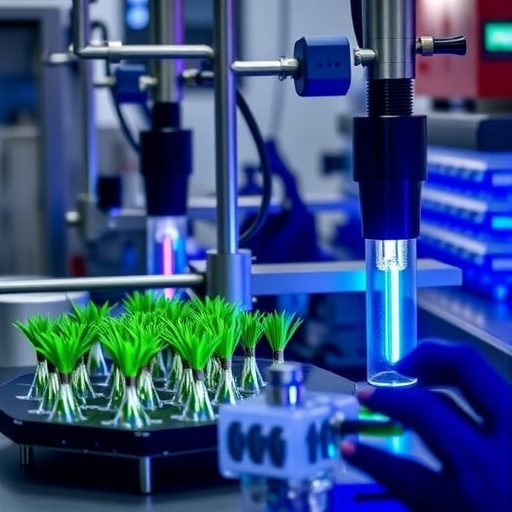
The University of North Carolina at Greensboro (UNCG) has embarked on a transformative initiative with the launch of NC BioMISSION, a $2 million bioindustrial workforce training and research program poised to reshape North Carolina’s position in the burgeoning bioindustrial sector. This program responds to an escalating demand for skilled professionals in biotechnology, a field anticipated to generate over one million jobs across the United States by 2030. The initiative’s targeted approach aims to close the gap between industry supply and the workforce’s technical proficiency, positioning students to meet the needs of an economy rapidly transitioning toward sustainable, bio-based manufacturing.
NC BioMISSION represents a strategic collaboration that intertwines academia, industry, and government support. Funded by BioMADE—a Manufacturing Innovation Institute under the U.S. Department of Defense—the program aligns with national priorities to secure global leadership in industrial biotechnology. BioMADE’s vision encompasses the utilization of biological systems for manufacturing a spectrum of products, including chemicals, advanced materials, textiles, fuels, and bioplastics, often capitalizing on renewable agricultural feedstocks and waste streams. This shift not only fosters economic growth but also contributes to sustainable supply chains and reduces the environmental footprint associated with traditional manufacturing.
At its core, NC BioMISSION is designed as a self-paced certificate program set to open enrollment in January 2027 to students across all academic majors. This inclusivity reflects UNCG’s commitment to a diverse learner population, including adult learners and military-affiliated students. The curriculum integrates in-person instruction with online modules and cutting-edge immersive virtual reality experiences, harnessing technology to cultivate practical skills and deepen understanding of bioindustrial processes. The innovative delivery format ensures accessibility while maintaining rigorous technical standards aligned with industry needs.
Crucially, the program’s development is guided by an industry advisory board, underscoring a workforce-centric philosophy. This collaborative model dissolves the traditional academic silo by inviting input directly from employers regarding the competencies sought in new hires. As Dr. Sherine Obare, Vice Chancellor for Research and Engagement at UNCG, emphasizes, this ensures that graduates possess not only foundational scientific knowledge but also applied skills tuned to real-world bioindustrial manufacturing challenges and innovations.
A distinctive feature of NC BioMISSION is its inclusion of capstone projects in partnership with bioindustrial companies. These projects provide students with hands-on experiences managing industrial reactors, optimizing biomass conversion, and scaling up processes from laboratory settings to pilot and commercial manufacturing. Such experiential learning fosters critical thinking and problem-solving abilities, positioning graduates for immediate workforce integration with the professional maturity required to tackle complex industrial scenarios.
Beyond traditional bioprocessing skills, the curriculum embraces data analytics, data science, and machine learning, reflecting the technological convergence within modern manufacturing. These disciplines empower students to employ computational tools for process optimization, predictive maintenance, and quality control in bioindustrial production lines. As manufacturing grows increasingly data-driven, such capabilities will be indispensable in ensuring efficiency, product consistency, and rapid innovation cycles.
Complementing educational objectives, the NC BioMISSION research agenda focuses on identifying the most effective pedagogical strategies for imparting bioindustrial competencies. This includes exploring multimedia tools, virtual reality simulations, and collaborative learning techniques aimed at diverse learner groups. The research findings are expected to yield scalable and replicable models for bioindustrial workforce development applicable nationwide, thereby amplifying the program’s impact beyond North Carolina.
This project is situated within UNCG’s iCOMMAND institute, a hub dedicated to military advances and national defense technologies. Leveraging this infrastructure supports interdisciplinary collaboration and technical sophistication throughout NC BioMISSION’s offerings. The leadership team includes Drs. Sherine Obare, Chartanay Bonner, and Charlene Mello, who bring complementary expertise spanning chemical engineering, biotechnology, and educational methodologies, ensuring a robust program foundation.
The launch of NC BioMISSION aligns with a broader surge of investment and innovation in U.S. biotechnology, spurred in part by strategic competition with China, which has rapidly advanced in key areas of the bioeconomy. BioMADE’s funding of six national educational and workforce development initiatives this year reflects a concerted federal effort to reclaim and extend American leadership in industrial biotechnology, a field foundational to future economic competitiveness and sustainability.
North Carolina’s abundant agricultural resources serve as a natural feedstock base for bioindustrial manufacturing, further enhancing the state’s strategic advantage. By synergizing academic training with the specific skill requirements of regional bioindustrial companies, NC BioMISSION not only prepares students for careers in emerging sectors but also stimulates local economies, drives innovation clusters, and encourages sustainable practices in industrial supply chains.
Ultimately, NC BioMISSION exemplifies a transformative educational paradigm, marrying cutting-edge science and technology with pragmatic workforce development. Through a blend of interdisciplinary training, industry engagement, and advanced research, the program is set to cultivate a generation of professionals adept at navigating and advancing the complexities of bioindustrial manufacturing. It is an investment in the future of sustainable industry and a testament to UNCG’s commitment to driving economic growth through education and innovation.
News Publication Date: Not specified in the source content.
Web References:
– BioMADE: https://www.biomade.org/
– Bioindustrial Workforce Development: https://www.biomade.org/education-workforce-development
– Bioindustrial Manufacturing Overview: https://www.biomade.org/bioindustrial-manufacturing
– UNCG Military-Friendly School Recognition: https://www.uncg.edu/news/uncg-recognized-as-top-10-military-friendly-school/
– BioMADE Funding Announcement: https://www.biomade.org/news/biomade-announces-214-million-invested-in-14-projects
– Biotechnology Federal Investment Report: https://www.biotech.senate.gov/final-report/chapters/
– UNCG iCOMMAND Institute: https://command.uncg.edu/
Cite Scienmag News
Denise Maddox. (May 14, 2026). UNCG Secures $2 Million to Expand Bioindustrial Manufacturing Workforce Statewide in North Carolina. Scienmag. https://scienmag.com/uncg-secures-2-million-to-expand-bioindustrial-manufacturing-workforce-statewide-in-north-carolina/
Denise Maddox. "UNCG Secures $2 Million to Expand Bioindustrial Manufacturing Workforce Statewide in North Carolina." Scienmag, 14 May 2026, https://scienmag.com/uncg-secures-2-million-to-expand-bioindustrial-manufacturing-workforce-statewide-in-north-carolina/. Accessed 5 September 2026.
Denise Maddox. "UNCG Secures $2 Million to Expand Bioindustrial Manufacturing Workforce Statewide in North Carolina." Scienmag. May 14, 2026. https://scienmag.com/uncg-secures-2-million-to-expand-bioindustrial-manufacturing-workforce-statewide-in-north-carolina/


