


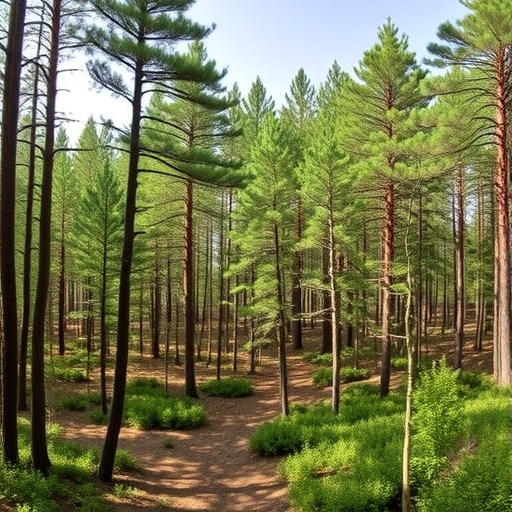
In the relentless quest to curb global carbon emissions and mitigate climate change, the role of tropical forests as carbon sinks has never been more crucial. Recent groundbreaking research reveals a previously underestimated contributor to this essential ecological service—natural forest expansion across the moist tropics. A comprehensive study, combining cutting-edge satellite imagery with sophisticated spaceborne LiDAR technology to measure biomass, has uncovered that natural forest expansion holds a carbon sequestration potential even greater than that of widely studied secondary forests.
Historically, much of the focus regarding tropical forest carbon sinks has centered on secondary and degraded forests. Secondary forests emerge naturally after an original old-growth forest has been cleared and left to regenerate on previously forested land. In contrast, degraded forests refer to areas with partial structural and functional losses, often as a result of human interference or natural disturbances. Both these forest types play pivotal roles in regaining biodiversity and storing carbon, yet the role of natural forest expansion—forests growing into areas previously devoid of forest cover—has not been thoroughly quantified until now.
The study in question, conducted by Zhang, Heinrich, Bourgoin, and colleagues, leverages extensive data of tropical moist forest dynamics along with biomass measurements obtained via spaceborne Light Detection and Ranging (LiDAR) sensors. This fusion of datasets enabled researchers to quantify the above-ground carbon sink capacities of three key forest categories: natural forest expansion, secondary forests, and degraded forests. Strikingly, the results demonstrate that natural forest expansion, which spans 6% more area than secondary forests in the moist tropics, sequesters more carbon annually than the latter.
Across the tropical moist zones, natural forest expansion accounted for an above-ground carbon accumulation of approximately 795 ± 132 teragrams of carbon (TgC), slightly surpassing the 754 ± 105 TgC contributed by secondary forests. These numbers are not only statistically significant but bear considerable implications for global carbon budgets and climate policy. In other words, young forests colonizing previously unforested lands represent a burgeoning, robust carbon sink with the power to offset nearly half of the carbon emissions currently attributed to deforestation and forest degradation.
The sensitivity of natural forest expansion to concomitant climatic and environmental variables emerged as a noteworthy finding. Particularly in the Americas, where natural forest expansion’s carbon uptake rivals that of secondary forests, its sequestration rates fluctuate more markedly depending on shifts in precipitation, temperature, and topographic factors. This heightened sensitivity suggests that while natural expansion has immense remediation potential, its future viability will closely hinge on climatic stability and environmental management.
Moreover, the analysis deconvoluted the specific contributions of these forest categories toward counterbalancing carbon emissions from ongoing deforestation and degradation. Natural forest expansion offset approximately 2.4 ± 0.6% of these emissions, which is marginally higher than the 2.3 ± 0.5% offset by secondary forests. Degraded forests, however, were shown to compensate for a more pronounced 13.6 ± 2.1% of carbon emissions, emphasizing the critical ecological value of restoring even partially compromised forest landscapes.
These nuanced insights paint a multifaceted picture of tropical forest carbon dynamics. While the preservation of old-growth forests remains an undisputed priority due to their irreplaceable biodiversity and immense carbon stocks, the capacity of regenerating forests and expanding natural woodlands to serve as carbon sinks presents complementary avenues for climate mitigation. By integrating sustainable forest management with conservation efforts, policymakers can harness these natural processes to further curb atmospheric CO2 concentrations.
The study’s use of satellite-based optical data combined with LiDAR-derived biomass metrics represents a methodological advancement in ecological monitoring. LiDAR scanning provides unprecedented three-dimensional structural details of forests, enabling precise estimations of above-ground biomass, which correlates strongly with carbon sequestered. By measuring changes in canopy height, density, and volume across vast tracts of the moist tropics, the researchers established a robust framework that captures both spatial and temporal forest dynamics comprehensively.
Furthermore, the research underscores the urgency of recognizing and incorporating natural forest expansion into global carbon accounting frameworks. Current international climate agreements and offset mechanisms often emphasize avoiding deforestation and promoting secondary forest regrowth but principally overlook the role of forests spreading into novel areas. These new forests constitute a vital, natural mechanism for carbon storage whose inclusion could refine carbon budgets and enhance the accuracy of carbon offset programs.
The implications extend beyond climate mitigation. As natural forest expansion entails colonization of previously unforested terrains—often abandoned agricultural land or marginal areas—it signals opportunities for landscape restoration without competing directly with agricultural productivity. This spatial complementarity offers a win-win scenario: bolstering carbon sequestration while preserving food production and human livelihoods.
Despite the promising carbon sink potential unveiled herein, researchers caution that natural forest expansion’s success is contingent on careful stewardship. Unregulated expansion could lead to other ecological or social challenges, including invasive species proliferation, biodiversity homogenization, or land tenure conflicts. Sustainable investment frameworks, emphasizing local community involvement and biodiversity preservation, are paramount to maximizing this sink’s climate benefits responsibly.
This revelation also dovetails with growing global reforestation and afforestation initiatives. It suggests that alongside active planting projects, allowing natural processes of forest expansion to proceed unchecked—where ecologically viable—could demonstrably boost carbon capture cost-effectively. Enhanced monitoring and reporting systems utilizing remote sensing technologies will be key in tracking these dynamics over time.
Finally, the study serves as a poignant reminder that the forest carbon cycle is a complex, intertwined system influenced by anthropogenic activity and natural processes. Beyond protecting existing forests, enabling and encouraging forest regeneration in its various forms—including natural expansion—is essential for achieving ambitious climate targets outlined in accords like the Paris Agreement. As global stakeholders push toward net-zero emissions, incorporating the carbon sequestration power of expanding forests offers an overlooked but potent lever in the climate fight.
In sum, today’s forests are not only invaluable carbon reservoirs but dynamic entities exhibiting impressive recovery and expansion potential. By embracing a more holistic understanding of tropical forests that includes the vital contributions of natural forest expansion, humanity can enhance its toolkit for combating climate change. This landmark research advances ecological forecasting and climate science, urging both policymakers and society at large to harness and protect these emerging, green frontiers.
Cite Scienmag News
Violet Maxwell. (June 4, 2026). Natural Forests Outpace Secondary Ones as Carbon Sinks. Scienmag. https://scienmag.com/natural-forests-outpace-secondary-ones-as-carbon-sinks/
Violet Maxwell. "Natural Forests Outpace Secondary Ones as Carbon Sinks." Scienmag, 4 June 2026, https://scienmag.com/natural-forests-outpace-secondary-ones-as-carbon-sinks/. Accessed 5 September 2026.
Violet Maxwell. "Natural Forests Outpace Secondary Ones as Carbon Sinks." Scienmag. June 4, 2026. https://scienmag.com/natural-forests-outpace-secondary-ones-as-carbon-sinks/


