


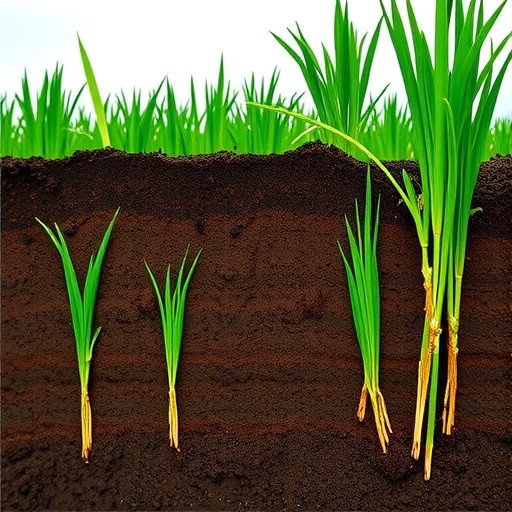
In the vast swaths of the Earth dedicated to rice cultivation, an invisible chemical and microbial drama unfolds daily beneath the roots of the plants. Arsenic, a notorious toxic element, is pervasive within paddy soils globally, posing a silent threat not only to environmental quality but also to food security and human health. Recent groundbreaking research has uncovered that this toxic element’s behavior is intimately linked to the diurnal rhythms of the rice rhizosphere, a dynamic ecosystem influenced by the natural cycle of day and night.
Traditionally, the mobilization of arsenic in soils has been attributed primarily to static environmental factors, such as soil composition and water management. However, a revolutionary study led by Yu, Wang, Tong, and colleagues uncovers a critical yet overlooked layer of complexity: the rhythmic daily oscillations driven by microbial activity and chemical transformations within the rhizosphere. This research highlights the intricate interplay between biogeochemical cycles and microbial life, emphasizing that arsenic concentrations do not remain constant but fluctuate predictably over a 24-hour cycle.
At the core of this study lies the rice rhizosphere, the region of soil surrounding rice roots, which experiences dramatic chemical shifts between day and night. During daylight, photosynthesis and oxygen release influence redox conditions, while nighttime fosters more reduced, anaerobic environments. Through sophisticated metatranscriptomic analyses, which decode the active gene expression profiles of microbial communities, the researchers identified significant increases in arsenite (As(III)) concentrations at night, rising from approximately 1.8 to 2.9 milligrams per liter. Concurrently, there was a notable 24.9% increase in ferrous iron (Fe(II)).
These chemical transformations are closely tied to a decline in redox potential to near 100 millivolts during nighttime, creating conditions conducive to arsenic and iron reduction. The microbial players responsible for these changes belong to key functional genera such as Geomobilimonas and Geobacter, known for their dynamic roles in dissimilatory reduction processes. Intriguingly, the transcriptomic data reveal increased transcriptional activity of genes associated with reduction pathways—arrA, omcS, omcZ, and mtrC—around nightfall without a corresponding increase in the relative abundance of these microbial populations. This suggests that existing microbes modulate their activity levels rather than increasing in number.
Parallel investigations conducted in natural rice paddy field conditions validated the diurnal patterns observed in the greenhouse experiments. The consistency of these findings across controlled and open environments underscores the ecological relevance of the daily shifts in arsenic and iron cycling. Perhaps most strikingly, when plants and soil microbial communities were subjected to continuous darkness, these diel fluctuations vanished, illuminating the profound influence of natural light cycles on biogeochemical processes in the rhizosphere.
This research signifies a paradigm shift in our understanding of arsenic mobilization. By elucidating the intrinsic link between microbial activity and diurnal biochemical shifts, it opens new avenues to mitigate contamination risks associated with rice cultivation. Current agricultural practices, often blind to the natural rhythms of microbial ecosystems, may inadvertently exacerbate arsenic uptake by rice plants, intensifying food safety concerns. Aligning irrigation and soil management strategies with these diel cycles could offer smart, sustainable solutions for arsenic mitigation.
The findings also speak to broader ecological and environmental themes. They highlight a sophisticated microbial responsiveness to environmental cues, enabling microbes to optimize their metabolic processes over a daily cycle. This temporal niche partitioning has significant implications for nutrient cycling, soil health, and the resilience of agroecosystems in the face of changing climate and land use patterns. Future research may probe deeper into how other toxic or nutrient elements fluctuate alongside arsenic in rhythmic concert with microbial gene expression.
Moreover, the methodological approach integrating metatranscriptomics with precise chemical measurements sets a new standard for investigating soil biogeochemistry. This multi-dimensional framework enables researchers to link functional gene expression directly to observable chemical transformations in real-time, offering unparalleled insights into the microscopic mechanisms underpinning macroscopic environmental phenomena.
The translational potential of these discoveries is compelling. Developing cultivation techniques that respect microbial diurnal activity—such as timing fertilizer application or water management to periods of minimal arsenic mobilization—could significantly reduce the uptake of harmful elements by rice crops. By harnessing naturally occurring microbial rhythms, farmers may enhance crop safety and yield without relying on costly or harmful chemical interventions.
In an era where sustainable agriculture is paramount, understanding and leveraging the timing of microbial processes could yield transformative impacts. The intricate redox chemistry and microbial genomics underlying the mobility of arsenic and iron in rice paddies remind us that the invisible world beneath our feet is marked by vibrant cycles of renewal and change. This research exquisitely captures the pulse of this underground ecosystem, inviting us to rethink how daily natural rhythms shape the safety and sustainability of global food supplies.
As the scientific community continues to unravel the complex relationships between microbes, chemistry, and plant health, this study stands out for revealing the critical importance of timing. Future investigations might explore how manipulating light exposure or other environmental factors could further influence arsenic dynamics. Understanding such temporal biogeochemical coupling could also enhance remediation efforts in contaminated soils worldwide.
Ultimately, this pioneering work advocates for a symbiotic approach to agriculture—one that respects the natural diurnal cycles of microbial communities. It encourages interdisciplinary collaborations among microbiologists, soil scientists, agronomists, and environmental health experts to develop innovative strategies addressing the enduring challenge of arsenic contamination in rice, a staple food for billions. Integrating genetic insights with field-level management, informed by daily microbial rhythms, may pave the way toward a safer, more nutritious future.
This discovery also pushes the frontier of environmental microbiology by demonstrating how microbial gene expression patterns are directly tied to ecosystem function on a previously unrecognized temporal scale. It raises exciting questions about how other pollutants or essential nutrients might be regulated through microbial diurnal activity. The approach could revolutionize monitoring and management practices, broadening our capacity to safeguard not only rice paddies but ecosystems in general.
In conclusion, the study by Yu, Wang, Tong, and colleagues reveals that arsenic and iron concentrations in rice rhizosphere soils fluctuate predictably in tune with daily microbial cycles. These diel variations stem from temporally coordinated shifts in microbial gene expression linked to dissimilatory reduction processes. Understanding these rhythms is key to mitigating toxic element uptake and optimizing agricultural sustainability. This work stands as a landmark contribution to soil biogeochemistry and environmental genomics, promising to reshape rice cultivation practices worldwide and enhance global food security in the face of environmental challenges.
Cite Scienmag News
Alan Morgan. (June 4, 2026). Microbial Day-Night Shifts Impact Rice Rhizosphere Iron, Arsenic. Scienmag. https://scienmag.com/microbial-day-night-shifts-impact-rice-rhizosphere-iron-arsenic/
Alan Morgan. "Microbial Day-Night Shifts Impact Rice Rhizosphere Iron, Arsenic." Scienmag, 4 June 2026, https://scienmag.com/microbial-day-night-shifts-impact-rice-rhizosphere-iron-arsenic/. Accessed 4 September 2026.
Alan Morgan. "Microbial Day-Night Shifts Impact Rice Rhizosphere Iron, Arsenic." Scienmag. June 4, 2026. https://scienmag.com/microbial-day-night-shifts-impact-rice-rhizosphere-iron-arsenic/


