


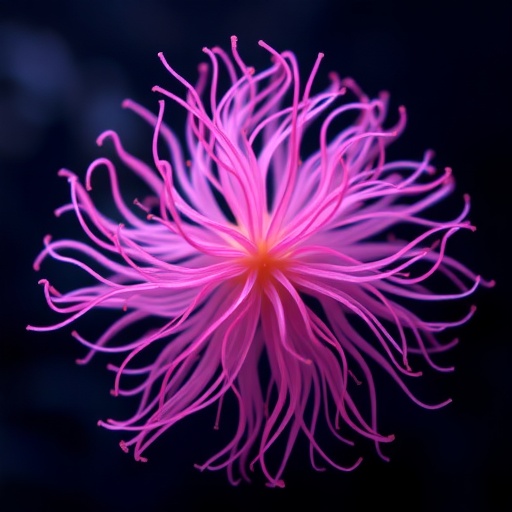
A survival strategy hidden inside one of the ocean’s most important microbial organisms has been revealed in a new study of Trichodesmium, a filamentous cyanobacterium that helps fertilize vast regions of the open sea. Researchers report that nutrient starvation and the ability to consume phosphonates work together to control both the organism’s position in the water column and its resistance to intense sunlight. The findings suggest that Trichodesmium does not respond to environmental stress through a single pathway. Instead, it integrates information about nutrient availability, buoyancy and light exposure to remain productive in some of the ocean’s most nutrient-poor habitats.
Trichodesmium is widely known for its capacity to fix atmospheric nitrogen, converting nitrogen gas into biologically useful forms that can support marine ecosystems. This process is energetically expensive and depends on sunlight, yet the waters where Trichodesmium thrives are often depleted of essential nutrients such as phosphorus. The organism therefore faces a difficult biological trade-off: it must capture enough light to power metabolism while avoiding light levels so intense that they damage its photosynthetic machinery. At the same time, it must locate or exploit scarce chemical resources in an environment where nutrients are unevenly distributed.
The new research focuses on how nutrient deprivation changes the behavior and physiology of Trichodesmium. Like other cyanobacteria, the organism can regulate its buoyancy through gas vesicles, microscopic protein structures that act as internal flotation devices. By adjusting its position in the water column, a colony can move toward zones with favorable light or nutrient conditions. This vertical movement is especially important in the tropical and subtropical oceans, where conditions can shift sharply over relatively short distances. A cell near the surface may receive abundant light but experience severe oxidative stress, while a deeper cell may face insufficient energy for photosynthesis.
The study indicates that starvation is not simply a passive condition in Trichodesmium. When nutrients become scarce, the organism can alter cellular processes linked to buoyancy, allowing it to reposition itself in response to changing environmental pressures. Such movement could help colonies balance the competing demands of light capture and nutrient acquisition. The ability to regulate depth may also determine whether a colony remains within a productive layer or sinks away from the conditions required for growth. In this way, physical movement becomes part of the organism’s metabolic survival program.
A central element of the findings is phosphonate utilization. Phosphonates are organic phosphorus compounds that contain a chemically stable carbon–phosphorus bond. Because that bond is difficult to break, phosphonates were once viewed as forms of phosphorus that many organisms could not readily use. Some marine microbes, however, possess specialized enzymes capable of accessing this phosphorus. The study shows that Trichodesmium can draw on phosphonates under nutrient-stressed conditions, linking the breakdown of these compounds to the organism’s broader response to starvation.
This capability may be particularly important in the oligotrophic ocean, where dissolved inorganic phosphate can be extremely scarce. Phosphonates represent a chemically distinct reservoir of phosphorus, and their availability could provide a critical alternative when conventional phosphate sources are exhausted. By using phosphonate-derived phosphorus, Trichodesmium may sustain essential cellular functions, including the production and repair of photosynthetic components. Phosphorus is required for nucleic acids, membrane molecules and energy-transfer compounds, so access to even a difficult-to-use phosphorus pool could make a major difference to survival.
The researchers also connect nutrient stress with tolerance to high light. Excess illumination can overwhelm the photosynthetic electron-transport system, generating reactive oxygen species that damage proteins, membranes and pigments. Photosynthetic organisms must therefore dissipate surplus energy, repair damaged reaction centers and maintain antioxidant defenses. In Trichodesmium, phosphonate utilization appears to be associated with the physiological adjustments that help the cells withstand intense light. The result is a coordinated response in which nutrient acquisition supports the machinery needed to prevent or repair photodamage.
That connection is significant because high-light tolerance is not merely a laboratory trait. Trichodesmium colonies often inhabit surface waters where sunlight is strongest, especially during periods when water-column mixing is weak. Their survival depends on keeping photosynthesis productive without allowing light-driven chemical damage to outpace repair. If phosphonate metabolism helps preserve this balance, then the availability and chemical composition of dissolved organic phosphorus could influence where Trichodesmium blooms form and how long they persist.
The findings broaden the ecological significance of Trichodesmium beyond nitrogen fixation alone. By adding nitrogen to surface waters, these cyanobacteria can stimulate biological production and influence the movement of carbon through marine food webs. Their growth is controlled by multiple resources, however, and the new work emphasizes that phosphorus chemistry, vertical positioning and light stress must be considered together. A change in one factor may alter the others: nutrient scarcity can affect buoyancy, buoyancy can change light exposure, and light exposure can determine whether photosynthesis continues to supply the energy needed for nutrient acquisition.
The study also offers a potential clue for understanding how marine microbial communities may respond to a changing ocean. Warming, stratification and shifts in nutrient delivery are expected to modify the depth and intensity of light, as well as the chemical forms of phosphorus available to microorganisms. Organisms capable of exploiting alternative nutrients while adjusting their position in the water column could gain an advantage under some future conditions. The work by Zou, Gao, Lin and colleagues therefore presents Trichodesmium as a highly integrated environmental responder—one that uses biochemical flexibility and physical control of buoyancy to navigate the ocean’s most demanding habitats. By revealing how phosphonate utilization, starvation responses and light protection intersect, the research provides a more complete picture of the mechanisms that allow an oceanic cyanobacterium to remain active where nutrients are scarce and sunlight is overwhelming.
Cite Scienmag News
Violet Maxwell. (August 5, 2026). Nutrient Starvation and Phosphonate Use Help Trichodesmium Control Buoyancy and Tolerate Bright Light. Scienmag. https://scienmag.com/nutrient-starvation-and-phosphonate-use-help-trichodesmium-control-buoyancy-and-tolerate-bright-light/
Violet Maxwell. "Nutrient Starvation and Phosphonate Use Help Trichodesmium Control Buoyancy and Tolerate Bright Light." Scienmag, 5 August 2026, https://scienmag.com/nutrient-starvation-and-phosphonate-use-help-trichodesmium-control-buoyancy-and-tolerate-bright-light/. Accessed 3 September 2026.
Violet Maxwell. "Nutrient Starvation and Phosphonate Use Help Trichodesmium Control Buoyancy and Tolerate Bright Light." Scienmag. August 5, 2026. https://scienmag.com/nutrient-starvation-and-phosphonate-use-help-trichodesmium-control-buoyancy-and-tolerate-bright-light/


