


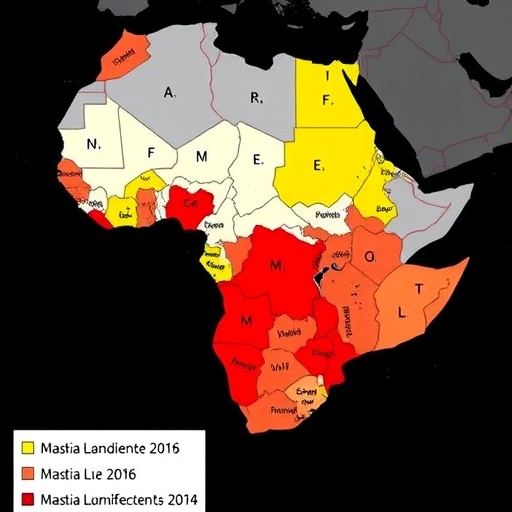
Malaria parasites in Ethiopia are carrying a more complex portfolio of drug-resistance mutations than surveillance systems based only on treatment outcomes can reveal, according to a study published in Nature Microbiology. By examining the genomes of Plasmodium falciparum parasites collected from areas with different levels of malaria transmission, researchers found that resistance-associated variants can occur together across the country’s varied ecological and epidemiological settings. The finding highlights how quickly the parasite population can assemble genetic combinations that threaten the durability of antimalarial therapies.
P. falciparum is the most lethal human malaria parasite and remains a major public-health concern in sub-Saharan Africa. Its ability to evolve resistance is driven by genetic variation and natural selection. When a drug eliminates susceptible parasites, those carrying mutations that reduce the drug’s effectiveness may survive, reproduce and become more common. The process can be accelerated when medicines are used widely, taken incorrectly, or deployed in settings where parasites are repeatedly exposed to the same compounds.
The Ethiopian study used genomic surveillance to investigate this evolutionary process at a level that conventional monitoring cannot provide. Instead of relying solely on clinical treatment failure or laboratory testing of parasite sensitivity, genomic surveillance examines the DNA of parasite populations. Researchers can identify specific variants associated with resistance, determine whether they are increasing in frequency and assess whether different resistance-related changes are appearing in the same parasite population. This creates a molecular map of malaria’s changing vulnerabilities.
The significance of the work lies in its focus on co-occurrence. A parasite may carry one variant that reduces susceptibility to one drug and another variant that affects a different component of treatment. When such variants are found together, they can create a more complicated therapeutic landscape than any single mutation would suggest. Co-occurring variants may arise through independent evolutionary events, movement of parasites between regions or the recombination of parasite genomes inside mosquitoes. Their distribution can therefore provide clues about how resistance is spreading and assembling.
Ethiopia offers an especially important setting for this type of analysis because malaria transmission is not uniform across the country. Altitude, rainfall, temperature, mosquito ecology and patterns of human movement divide the country into regions where transmission intensity can differ sharply. In some areas, infections occur frequently and maintain large parasite populations; in others, transmission is more sporadic. These differences influence how much genetic diversity exists in local parasite populations and how strongly drug pressure shapes their evolution.
The researchers’ comparison across diverse transmission settings showed that resistance-associated variants are not confined to a single epidemiological environment. Their presence across contrasting settings suggests that surveillance cannot be limited to places with the highest number of malaria cases. Lower-transmission regions may also harbor important genetic changes, including variants that could expand if transmission patterns shift or if resistant parasites are introduced through travel and population movement.
Genomic data can also help distinguish between resistance that develops locally and resistance that arrives from elsewhere. By comparing stretches of DNA surrounding a resistance-associated mutation, scientists can examine whether the variant appears on a common genetic background, a clue that it may have spread from a shared origin, or on several distinct backgrounds, which may indicate repeated evolution. These analyses are valuable because resistance is not simply a chemical problem; it is also a population-genetics problem involving migration, reproduction and selection.
The findings carry direct implications for malaria-control policy. Antimalarial treatment recommendations depend on drugs remaining effective against circulating parasites, yet resistance can emerge before widespread clinical failure becomes obvious. Routine sequencing could provide an early-warning system, allowing health authorities to detect dangerous combinations of variants and adjust treatment strategies before resistant parasites become dominant. Such data could complement therapeutic efficacy studies, which remain essential but are often slower, more expensive and limited to selected locations.
The study also underscores the need to interpret resistance mutations in their genetic and epidemiological context. The detection of a variant does not automatically mean that a treatment will fail in every patient, because the effect can depend on the mutation itself, the parasite’s broader genetic background, drug concentrations and the immune status of the infected person. Nevertheless, the accumulation of multiple resistance-associated changes is a warning that future treatment policies may need to account for combinations rather than isolated markers.
For Ethiopia and other malaria-endemic countries, the message is both urgent and practical: protecting the effectiveness of antimalarial medicines will require surveillance systems capable of following parasite evolution in near real time. Expanding genomic monitoring, linking DNA data with clinical outcomes and sampling regions with different transmission patterns could reveal resistance before it becomes visible through rising treatment failures. As malaria-control programs push toward lower transmission, understanding how P. falciparum populations adapt may be as important as counting infections. The Ethiopian findings show that the parasite’s next threat may emerge not from one mutation alone, but from the convergence of several genetic changes across a changing landscape.
Cite Scienmag News
Juliet Wilcox. (August 5, 2026). Genomic surveillance maps shared Plasmodium falciparum drug-resistance variants across Ethiopia’s transmission settings. Scienmag. https://scienmag.com/genomic-surveillance-maps-shared-plasmodium-falciparum-drug-resistance-variants-across-ethiopias-transmission-settings/
Juliet Wilcox. "Genomic surveillance maps shared Plasmodium falciparum drug-resistance variants across Ethiopia’s transmission settings." Scienmag, 5 August 2026, https://scienmag.com/genomic-surveillance-maps-shared-plasmodium-falciparum-drug-resistance-variants-across-ethiopias-transmission-settings/. Accessed 4 September 2026.
Juliet Wilcox. "Genomic surveillance maps shared Plasmodium falciparum drug-resistance variants across Ethiopia’s transmission settings." Scienmag. August 5, 2026. https://scienmag.com/genomic-surveillance-maps-shared-plasmodium-falciparum-drug-resistance-variants-across-ethiopias-transmission-settings/


