


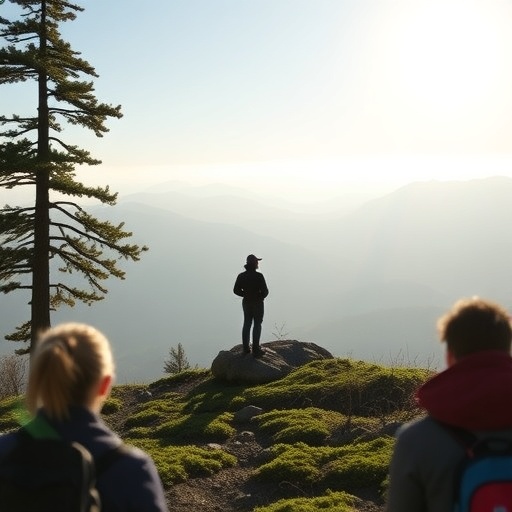
Every morning, students walking into environmental studies classrooms around the world carry an invisible weight alongside their notebooks and laptops. They arrive having scrolled through headlines about record-breaking heatwaves, collapsing insect populations, melting ice sheets and bleached coral reefs. For many of them, the subject they have chosen to study—the fate of the living world—feels less like an academic pursuit and more like an ongoing emergency. A newly published reflection in the Journal of Environmental Studies and Sciences argues that this emotional burden has become a central pedagogical challenge, and that the way educators respond to it may shape not only student wellbeing but the future of environmental action itself.
The article, written by H. Carolyn Peach Brown of the Environmental Studies program at the University of Prince Edward Island, draws on fifteen years of classroom experience to describe practical strategies for balancing hope and despair in environmental education. Published as a “Practitioner Voices” contribution, the piece is not a conventional research study with datasets and statistical models. Instead, it is a candid account of what one experienced educator has learned about teaching a subject that can leave students anxious, grieving and paralyzed—and about how classrooms can be transformed into what Brown calls learning communities of hope and optimism.
The psychological toll of environmental education is well documented in the scientific literature. Researchers have described “ecological grief” as a legitimate mental health response to climate change-related loss, with a landmark 2018 paper in Nature Climate Change by Ashlee Cunsolo and Neville Ellis framing sorrow over ecosystem transformation as an emerging field of study. Follow-up work published in The Lancet Planetary Health in 2020 argued that ecological grief and anxiety may actually mark the start of a healthy response to climate change, provided they are acknowledged and channeled rather than suppressed. More recent research has quantified the scale of the problem among young people. A 2024 study in the Journal of Environmental Education, examining students at three European universities, found that students expect their education to address climate anxiety, not just deliver technical content. And a 2025 study in PLoS ONE added a crucial nuance: social support appears to mediate the relationship between eco-anxiety and pro-environmental behavior, meaning that the way people cope with environmental distress—with others, rather than alone—determines whether that distress translates into action or into withdrawal.
Brown’s reflection enters precisely at this intersection of emotion, pedagogy and action. She notes that those teaching, studying and working in the environmental field are confronted on a daily basis with bad news about the state of the world, and that constant bombardment by reports of a changing climate, biodiversity loss and ecosystem collapse leaves many students and faculty alike feeling anxious and fearful about the future. The problem is not confined to students. Instructors, too, must process the same relentless stream of troubling findings, often while feeling responsible for guiding young people through it. Earlier work in the same journal, by Wallace, Greenburg and Clark in 2020, confronted anxiety and despair in environmental studies and sciences head-on, offering an analysis and guide for students and faculty, and a 2026 open-access article advanced the discussion by asking how instructors teaching university courses on the environment are addressing eco-anxiety among their students.
One of the most important threads running through Brown’s reflection is a warning against what mental health practitioners call toxic positivity—a concept highlighted by the Centre for Innovation in Campus Mental Health in Ontario. The answer to despair, in other words, is not to pretend that the crisis is manageable with a smile, or to dilute the science until it becomes comforting. Brown is explicit that her strategies must not neglect the reality of the challenges the world faces. The goal is not to replace grim data with cheerful slogans but to hold two truths at once: the situation is genuinely serious, and meaningful action is still genuinely possible. This dual framing echoes the work of scholars such as Rebecca Solnit, who has argued that grounds for hope are found not in optimism about outcomes but in the uncertainty of the future itself—the fact that nobody knows how the story ends is precisely why effort matters. It also resonates with climate scientist Katharine Hayhoe’s argument in Saving Us that hope and healing in a divided world come through connection and constructive engagement rather than denial or resignation.
So what does fostering hope look like in practice? Brown describes three broad families of strategies that she has woven into various courses over her fifteen years of teaching. The first involves featuring examples of art and artists inspired by the natural world. This may seem like an unlikely tool for a science-adjacent discipline, but the rationale is psychologically sound: encounters with beauty, creativity and human expression reconnect students to what is worth protecting, counteracting the numbness that can set in after months of abstract statistics. Art reframes the natural world not merely as a system in decline but as a source of wonder, meaning and cultural significance. Brown’s own scholarly interests span literature and the environment, environmental communication and environmental psychology, and the arts-based approach reflects a growing recognition that environmental studies cannot be taught through data alone. A 2024 paper in Environmental Education Research, arising from an interdisciplinary group of scholars in the humanities and social sciences, similarly called for a teaching agenda for the climate crisis that goes beyond technical instruction and embraces the interpretive, ethical and emotional dimensions of the crisis.
The second strategy involves calling attention to inspiring examples of environmental action, both past and present. Brown points to figures whose stories demonstrate that individuals and communities can change the trajectory of environmental destruction. Among those she references are Autumn Peltier, the Anishinaabe water advocate from Canada who has addressed international bodies about the protection of water; Sheila Watt-Cloutier, whose book The Right to Be Cold links Arctic climate change to Inuit human rights; the late David Suzuki, whose decades of science communication have shaped Canadian environmental consciousness; and the Green Belt Movement founded by Wangari Maathai, which mobilized communities to plant tens of millions of trees while empowering women in Kenya. She also highlights hyper-local successes, such as the story of a young person cleaning up the LaHave River in Nova Scotia—a reminder that transformative environmental work does not require global fame or vast resources. Conservation communicators have argued that success stories are not a luxury but a necessity, providing evidence that effort produces results and counteracting the learned helplessness that doom-heavy messaging can induce.
The third strategy—and arguably the one with the strongest empirical grounding—is creating opportunities for students to become engaged in personal action to address environmental challenges. Brown’s own earlier research, published in this same journal in 2023, examined student perspectives on course-based experiential learning in Environmental Studies, finding that students value opportunities to apply their learning in real-world contexts. The PLoS ONE finding that social support channels eco-anxiety into pro-environmental behavior suggests why classroom community matters so much: when students act together, anxiety becomes a motivator rather than a debilitator. Brown’s approaches include course-based projects that connect students to local environmental issues, giving them a tangible sense of agency. The underlying pedagogical philosophy draws on thinkers such as Paulo Freire, whose Pedagogy of Hope framed education as an act of imagination and struggle rather than passive transmission, and Parker Palmer, who has written about teaching as an inwardly grounded, communal practice. Scholars theorizing hope in education have distinguished hope from mere wishful thinking: genuine hope involves agency and pathways—a belief that one’s actions matter and that routes toward goals exist, even under uncertainty.
Brown’s reflection also joins a growing body of work examining the emotional dimensions of climate education across disciplines. Research on hope and grief in the human geography classroom, published in the Journal of Geography in Higher Education, has documented how instructors navigate these emotions in field-based and discussion-based settings. Together with Brown’s contribution, these studies signal a shift in higher education: the recognition that emotional literacy is not separate from scientific literacy but intertwined with it. A student who is paralyzed by despair cannot learn effectively, and a student who is sheltered from reality cannot act effectively. The craft of teaching environmental studies, on this view, lies in calibrating the balance.
The timing of the article is significant. Eco-anxiety and climate anxiety have moved from the margins of psychology into mainstream public conversation, with bestselling books such as Britt Wray’s Generation Dread exploring how to find purpose in an age of climate crisis. Universities are increasingly being asked—by students themselves—what role they should play in supporting mental health while confronting planetary crises. Brown’s answer, grounded in her own institutional context at the University of Prince Edward Island in Charlottetown, offers a template that other instructors can adapt: acknowledge the grief, feature the beauty, celebrate the changemakers, and above all create structured opportunities for action.
Perhaps the most enduring insight from Brown’s fifteen-year reflection is that hope is not a feeling that instructors can simply install in their students. It is something that emerges, gradually and collectively, from a learning community that faces hard truths together while refusing to let those truths be the whole story. Environmental education, at its best, does not choose between honesty and hope. It insists that honesty about the crisis is the very foundation on which durable, realistic hope must be built—and that classrooms, when designed with care, can be places where young people learn not only what is being lost, but what can still be saved.
Cite Scienmag News
Sloane Callahan. (September 3, 2026). Building hope in environmental studies classrooms: a reflective approach. Scienmag. https://scienmag.com/building-hope-in-environmental-studies-classrooms-a-reflective-approach/
Sloane Callahan. "Building hope in environmental studies classrooms: a reflective approach." Scienmag, 3 September 2026, https://scienmag.com/building-hope-in-environmental-studies-classrooms-a-reflective-approach/. Accessed 3 September 2026.
Sloane Callahan. "Building hope in environmental studies classrooms: a reflective approach." Scienmag. September 3, 2026. https://scienmag.com/building-hope-in-environmental-studies-classrooms-a-reflective-approach/


