


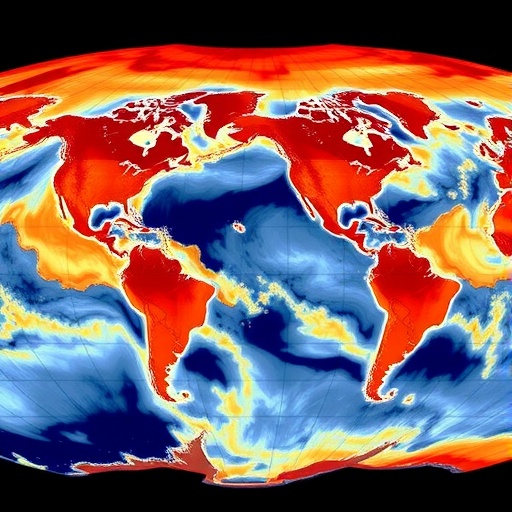
Compound disasters that pair blistering heat with punishing drought have become one of the defining climate hazards of the modern era, and a sweeping new analysis argues that the world’s most influential climate oscillation — the El Niño–Southern Oscillation, or ENSO — has been quietly choreographing much of that escalation. In a study published on 28 August 2026 in the journal Climate Dynamics, Xiaolan Xie of Guizhou Normal University, together with Fangyu Ding and Dong Jiang of the Institute of Geographic Sciences and Natural Resources Research at the Chinese Academy of Sciences and Yu Chen of Southwest Computer Co., assembled the most globally consistent record yet of compound heatwave–drought events, known to researchers as CDHWs. Drawing on 44 years of data spanning 1981 through 2024, the team dissected five regions where ENSO’s fingerprint runs deepest — South Asia, Southeast Asia, tropical South America, Australia, and southern Africa — and quantified how the frequency, duration, and severity of these overlapping extremes have evolved, and how tightly they remain bound to the tropical Pacific’s rhythmic swings between warm and cold states.
The scientific case for treating heatwave–drought combinations as a distinct hazard class rests on a self-reinforcing feedback loop between the land surface and the atmosphere. When rainfall fails, soils dry; a parched surface can no longer dissipate incoming solar energy through evaporation, so a larger share converts directly into sensible heat, pushing air temperatures even higher. The added heat, in turn, raises evaporative demand — the atmosphere’s thirst — pulling more moisture from already-stressed soils and vegetation and deepening the drought, a mechanism that prior research has shown to suppress vegetation growth across large regions. This positive feedback, formalized in landmark land–atmosphere coupling studies of the mid-2000s, means droughts sharpen heatwaves and heatwaves sharpen droughts. Earlier analyses have traced the consequences: a century-long observational record reveals a rising likelihood of continental-scale dry-hot extremes, compound drought and heatwaves have intensified across a warming world, and a 2024 assessment concluded that anthropogenic climate change has roughly doubled the frequency of these events in low-income regions. The impacts cascade through agriculture, hydropower generation, cooling water for thermal power plants, ecosystem carbon uptake, and human health — losses that single-hazard risk assessments systematically underestimate.
The new study confronts a stubborn obstacle in this field: most previous inventories of compound extremes were built with regional definitions, differing drought metrics, or mismatched time windows, making global comparisons unreliable. Xie and colleagues therefore constructed a globally consistent CDHW dataset spanning 1981–2024, flagging compound events wherever heatwave conditions — extended spells of anomalously high temperatures measured against local climatological norms — coincide with drought conditions marked by sustained deficits in water availability. For every region, the team tracked three pillars of hazard: frequency, how often compound events struck; duration, how long they persisted; and severity, a composite measure combining intensity and persistence into a gauge of cumulative stress on ecosystems, reservoirs, and infrastructure. The analysis rests on long-term observational and reanalysis records — datasets that fuse station measurements with physics-based modeling to fill gaps where instruments are sparse — and the authors drew on published evaluations of reanalysis temperature reliability to guard against region-specific biases that could otherwise distort event detection in data-poor areas.
The atlas that emerges is one of broad worsening, but with sharp regional contrast. Across the 44-year record, the researchers document a global intensification of compound heatwave–drought events alongside marked heterogeneity: some of the planet’s most vulnerable regions absorbed a disproportionate share of the increase, while others shifted toward different combinations of more frequent events, longer events, or higher peak severity. That heterogeneity is not a statistical curiosity. Food systems, reservoirs, power grids, and hospitals experience hazard locally, so a global average conceals exactly the information that adaptation planners need. The team’s decision to concentrate its deepest analysis on five ENSO-sensitive hotspots reflects that logic, allowing them to ask not merely whether compound extremes are worsening, but how much of their year-to-year rhythm can be attributed to the single largest source of interannual climate variability on Earth — an oscillation whose reach extends, through atmospheric bridges, to nearly every tropical and subtropical continent.
Understanding those teleconnections requires a brief detour into ENSO mechanics. Every few years the tropical Pacific swings between two states: El Niño, when unusually warm sea-surface temperatures spread across the central and eastern equatorial Pacific — monitored in the benchmark Niño3.4 region — and La Niña, its cold-water counterpart. The oscillation is sustained by the Bjerknes feedback: a warm anomaly weakens the easterly trade winds that normally pile warm water against the western Pacific, allowing warm water to slide back east and shallow the eastern thermocline, which weakens the winds further. Because atmospheric convection follows the warm water, El Niño relocates the towering zones of rising air that drive the Walker circulation, redistributing rainfall across the tropics and, through planetary-scale Rossby waves, nudging jet streams far beyond the Pacific basin. South Asia’s monsoon, the rainfall regimes of maritime Southeast Asia, the convection over Amazonia, Australian precipitation, and the rains feeding southern Africa are all tethered to this machinery — which is exactly why the study’s five hotspots were chosen.
Decades of research have sketched the canonical response patterns. During El Niño, Southeast Asia and Australia typically dry out as convection migrates eastward; the Indian summer monsoon often weakens; large parts of the Amazon lean toward drought, a tendency dramatized by the record-breaking heat and dryness that struck the rainforest during the 2015–2016 El Niño; and southern Africa frequently endures suppressed rainfall. La Niña tends to flip many of these tendencies, wetting Australia and parts of Southeast Asia while reshaping temperature regimes elsewhere. Prior work has tied individual disasters to these phases — Australia’s catastrophic 2019–20 fire season unfolded against drought and heat conditions shaped by ENSO — and regional studies across China, Southeast Asia, and Australia have linked compound dry-hot episodes to sea-surface temperature modes, sometimes jointly with the Indian Ocean Dipole. Yet earlier global assessments largely treated the ENSO–compound-extremes relationship as a fixed dial, an assumption the new study set out to stress-test.
The headline result is that ENSO’s modulation of compound heatwave–drought events is real but globally asymmetric. Across the hotspots, El Niño generally acts as an amplifier, stacking the odds toward more frequent, longer, and more severe compound extremes — a signature consistent with the land–surface feedback that converts a warm-phase rainfall deficit into synchronized heat and drought. But “generally” carries considerable weight. The strength of that amplification varies substantially from region to region, and the coupling is not locked in place: when the authors examined correlations decade by decade, the ENSO–CDHW association waxed and waned across the 1981–2024 record, differing both between regions and through time. The leash connecting the tropical Pacific to the world’s compound-extremes hotspots behaves like an elastic cord — sometimes taut, sometimes slack — and its tension has shifted as the background climate has warmed. For risk managers, that means yesterday’s correlation coefficients are a guide rather than a guarantee, and single-snapshot studies of ENSO’s influence may quietly mislead.
Among the study’s most operationally valuable contributions are its lagged-correlation diagnostics. Rather than asking only whether ENSO and compound extremes coincide, the team shifted the two time series against each other across lags of 0 to 12 months, probing how far ahead an ENSO signal can anticipate compound extremes on the ground. The clearest short-lag relationships emerged in Southeast Asia and tropical South America, where the association between ENSO state and subsequent CDHW activity peaks at lags of one to three months; elsewhere, the signal proved weaker or less consistent across the lag range. The window is physically sensible: ENSO anomalies tend to mature in boreal winter, while the land surface’s moisture memory lets a wintertime precipitation deficit propagate into the following season, priming soils for the heat–drought feedback just as the warm months arrive. For forecasters, a one-to-three-month lead is the difference between reacting to a disaster and preparing for one — enough horizon to reposition water supplies, adjust planting schedules, and pre-stage public-health responses.
The decadal sliding-window analysis adds a cautionary layer. By computing correlations within successive moving windows, the authors show that the ENSO–CDHW linkage is non-stationary: relationships that are robust in one era can weaken in the next, and the hotspots do not change in step. The finding echoes a growing body of evidence that warming is reshaping ENSO itself — projections point to faster El Niño onset and slower decay in the twenty-first century, the emergence of changing Central-Pacific and Eastern-Pacific event flavors, a potentially rising rate of extreme El Niño occurrences supported by reconstructions of past glacial climates, and systematically altered teleconnection strength in the latest generation of climate-model ensembles. If the teleconnection architecture is drifting, historical correlations cannot simply be extrapolated forward. The authors treat this non-stationarity not as a footnote but as a core result, underscoring that any early-warning system built on ENSO must be recalibrated continually against evolving observations.
The practical payoff is a blueprint for ENSO-informed early-warning systems and regional adaptation planning. Because El Niño and La Niña states are now forecast skillfully months in advance, knowing which regions convert that oceanic signal into compound-extremes risk — and how long the conversion takes — turns a sea-surface temperature anomaly into actionable foresight. Seasonal outlooks could flag elevated compound heatwave–drought risk in Southeast Asia and tropical South America one to three months ahead, giving water managers, agricultural agencies, and health authorities a head start that trend extrapolation alone cannot provide, while regions where the signal is weaker can be steered toward complementary indicators. The study, funded through the Youth Innovation Promotion Association and the Kezhen-Bingwei Young Talent Program of the Chinese Academy of Sciences, also leaves questions open: the contribution of companion modes such as the Indian Ocean Dipole, the character of La Niña’s influence on compound extremes, and how the diagnosed relationships will bend under continued warming. With compound events doubling in some of the world’s poorest regions and extreme El Niño projected to grow more common, decoding ENSO’s uneven grip on the planet’s hottest, driest compound disasters is fast becoming a forecasting priority — and this new global atlas supplies the baseline against which that skill can now be measured.
Cite Scienmag News
Sloane Callahan. (August 30, 2026). How ENSO Shapes the Global Evolution of Compound Heatwave-Drought Events. Scienmag. https://scienmag.com/how-enso-shapes-the-global-evolution-of-compound-heatwave-drought-events/
Sloane Callahan. "How ENSO Shapes the Global Evolution of Compound Heatwave-Drought Events." Scienmag, 30 August 2026, https://scienmag.com/how-enso-shapes-the-global-evolution-of-compound-heatwave-drought-events/. Accessed 3 September 2026.
Sloane Callahan. "How ENSO Shapes the Global Evolution of Compound Heatwave-Drought Events." Scienmag. August 30, 2026. https://scienmag.com/how-enso-shapes-the-global-evolution-of-compound-heatwave-drought-events/


