


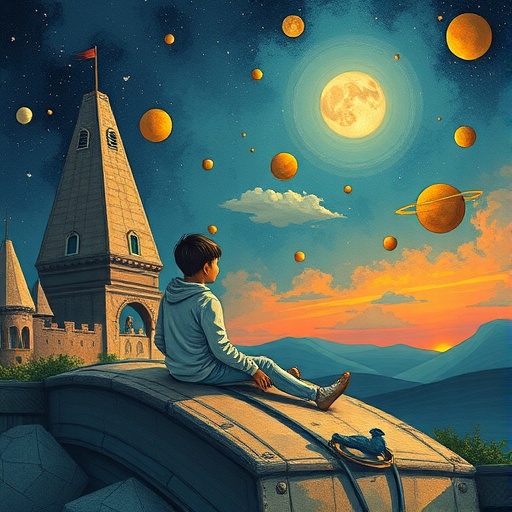
A new volume of the history-of-science journal Osiris is asking a question with consequences far beyond the classroom or the laboratory: What does science owe children, and how can the history of science help repay that debt? The 2026 volume, titled “Histories of Science and Childhoods,” brings together historians, scholars of childhood, and researchers from related disciplines to examine how scientific knowledge has shaped children’s lives—and how children themselves have influenced science, medicine, technology, and public policy.
Edited by Andrea Graus, Violeta Ruiz, and Elisabeth M. Yang, the volume challenges a familiar model in which adults produce knowledge about children while children remain passive subjects. The editors argue that much existing scholarship has focused on Europe, North America, and other parts of the Global North, often presenting childhood from the perspective of institutions, experts, parents, or governments. This “top-down” approach can obscure children’s own experiences, actions, and interpretations of the scientific systems built around them.
The volume uses childhood studies as a theoretical framework for rethinking the history of science. In technical terms, this approach treats childhood not as a fixed biological stage but as a historically produced category shaped by law, medicine, education, family structures, economics, and cultural expectations. The editors emphasize that the meaning of childhood changes across time and place. It is also influenced by assumptions about ability, gender, sexuality, race, and age. As a result, the category cannot be treated as universal or politically neutral.
This argument is important because scientific classifications often become embedded in real-world systems. Medical measurements, developmental benchmarks, educational testing, nutritional standards, and psychological theories can determine how children are diagnosed, taught, disciplined, protected, or excluded. Scientific knowledge about growth and development has therefore never been merely descriptive. It has helped define what counts as normal childhood, identify supposed deviations from that norm, and justify interventions ranging from public-health programs to institutional care and social policy.
At the same time, the contributors to Osiris 41 reject the idea that science acts only upon children. The volume presents children as historical actors who can affect the production, circulation, and interpretation of knowledge. Their behavior, testimony, resistance, cooperation, play, illness, and everyday interactions have helped shape scientific practices. The editors summarize this relationship by arguing that “child and childhood create and act in and upon science and those who practice it.” This formulation shifts attention from children as research objects to children as participants in knowledge-making processes.
The volume is organized around three major areas of inquiry. The first examines children’s agency, a concept that is widely used in contemporary history and social science but can be difficult to define. Agency does not necessarily mean complete independence or freedom from adult authority. Instead, the articles investigate how children act within systems that constrain them, using letters, oral histories, institutional records, visual materials, medical documents, and other sources to recover forms of participation that conventional archives often overlook.
A second group of articles explores the technologies and politics of child health. These studies consider how medical devices, diagnostic methods, public-health programs, and other technologies have influenced the treatment and management of children. They also examine the political decisions behind those technologies, including which children receive care, whose bodies become standards for measurement, and how health interventions can reproduce social inequalities. By connecting technical systems with institutions and power, the volume shows that child health is never only a biomedical issue.
The third section investigates how ideas about childhood have shaped scientific thought itself. Concepts such as innocence, dependency, curiosity, development, and cognitive immaturity have influenced theories of human behavior and knowledge. Children have frequently been used to represent an earlier stage of humanity or a supposedly pure form of reasoning. The contributors question these assumptions and show how scientific claims about children can reveal broader beliefs about progress, civilization, intelligence, and social order.
The volume concludes with an essay examining the statement that “every child is a scientist.” The phrase is popular in science education and public outreach because it presents children as naturally curious observers who form hypotheses through play and experimentation. Yet the claim also requires scrutiny. It may celebrate children’s intellectual abilities, while simultaneously reducing them to symbols of curiosity or treating scientific thinking as a universal developmental trait. By unpacking the phrase, the final essay encourages readers to ask who gets recognized as a producer of knowledge and what kinds of knowledge are valued as scientific.
Taken together, the essays present childhood as a “relational category,” defined partly through contrast with adulthood and other social identities. This perspective encourages historians to reconsider not only how they study children but also how they select evidence, define expertise, and interpret historical change. The editors hope the volume will help establish a more interdisciplinary, and ultimately transdisciplinary, field joining the histories of science and childhood studies. Its broader message is that understanding science requires attention to the people who have often been treated as its subjects rather than its participants—including children, whose lives have been shaped by scientific authority and whose actions have helped shape science in return.
News Publication Date: 2026
Web References: https://www.journals.uchicago.edu/toc/osiris/2026/41 ; https://www.journals.uchicago.edu/toc/osiris/current ; https://hssonline.org/
References: Osiris, volume 41, “Histories of Science and Childhoods,” edited by Andrea Graus, Violeta Ruiz, and Elisabeth M. Yang.
Cite Scienmag News
Courtney Benton. (August 5, 2026). Osiris 41 Connects the Histories of Science and Childhood Studies. Scienmag. https://scienmag.com/osiris-41-connects-the-histories-of-science-and-childhood-studies/
Courtney Benton. "Osiris 41 Connects the Histories of Science and Childhood Studies." Scienmag, 5 August 2026, https://scienmag.com/osiris-41-connects-the-histories-of-science-and-childhood-studies/. Accessed 3 September 2026.
Courtney Benton. "Osiris 41 Connects the Histories of Science and Childhood Studies." Scienmag. August 5, 2026. https://scienmag.com/osiris-41-connects-the-histories-of-science-and-childhood-studies/


