


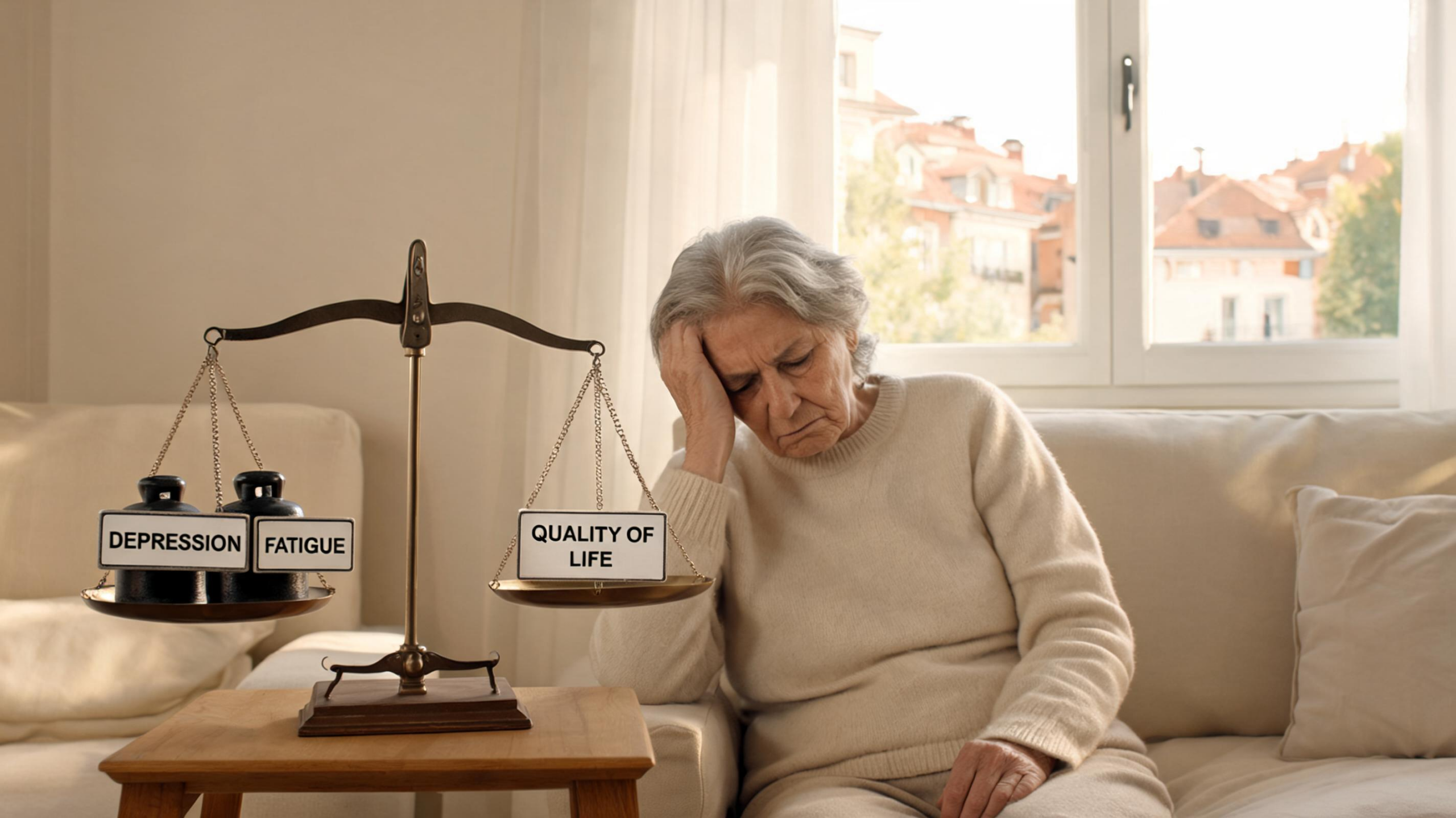
A sweeping analysis of more than 11,000 older adults across 13 European countries has revealed that the most powerful predictors of whether an older person’s quality of life rises or falls over a two-year period are not the obvious markers of physical decline, but rather the quieter signals of psychological distress and persistent fatigue. The study, led by Rafael Llorens-Ortega of the Autonomous University of Barcelona and colleagues at the University of Girona, draws on the Survey of Health, Ageing and Retirement in Europe, known as SHARE, and offers one of the most granular portraits yet of how intrinsic capacity, a World Health Organization framework for healthy aging, translates into lived experience. The findings, published as an open-access article in Discover Social Science and Health, carry an unmistakable policy message: interventions targeting mood and mobility may deliver outsized returns for the well-being of aging populations.
Intrinsic capacity is a concept that has steadily gained traction in gerontology since the World Health Organization’s Decade of Healthy Ageing placed it at the center of its global strategy. Rather than viewing aging through the narrow lens of disease, intrinsic capacity assembles all of a person’s physical and mental capacities into a single multidimensional construct. In this study, the researchers operationalized it across five distinct domains: mobility, cognition, psychological well-being, sensory function, and vitality. Each domain captures a facet of what an older adult can actually do in daily life, from walking and gripping to remembering, seeing, hearing, maintaining nutrition, and sustaining emotional equilibrium. The central question was deceptively simple: which of these domains matter most when it comes to how older Europeans evaluate their own quality of life, and do those relationships hold equally for men and women, and across the continent’s north-south and east-west divides?
To answer it, the team analyzed longitudinal data from 11,493 adults aged 50 and older who participated in SHARE Waves 5 and 6, covering the years 2013 to 2015. Quality of life was measured using the CASP-12 scale, a validated instrument that assesses four core dimensions of self-reported well-being in later life: control, autonomy, self-realization, and pleasure. The researchers first employed exploratory factor analysis to confirm that the five intrinsic capacity domains genuinely cluster together as a coherent multidimensional construct rather than behaving as isolated traits. They then turned to network analysis, a statistical technique that maps the web of interconnections among variables, to examine how the domains relate to one another and to quality of life, before stratifying results by sex and region to expose hidden disparities.
The statistical architecture of the study is worth appreciating because it reflects a broader shift in how aging research is conducted. Factor analysis served as a gatekeeper, validating that the underlying structure of intrinsic capacity behaved as theorized. Network analysis then went beyond traditional regression by revealing the direct edges between individual indicators and the CASP-12 score, allowing the team to see, for example, that depressive symptoms measured by the European Depression Scale correlated negatively with quality of life at a coefficient of −0.284, while fatigue correlated at −0.324, both highly significant at p below 0.001. These two indicators, nested within the psychological and vitality domains respectively, emerged as the strongest negative correlates of quality of life in the entire network. Cognitive performance and mobility showed weaker but still significant associations, while sensory function played a comparatively modest role.
Over the two-year window between survey waves, the researchers observed a pattern that is both sobering and unsurprising: modest declines in intrinsic capacity paralleled measurable changes in quality of life. The trajectory is important precisely because it is longitudinal. Cross-sectional studies can only show that capacity and well-being travel together at a single moment, leaving open the question of direction. By tracking the same individuals across time, this analysis strengthens the case that deterioration in intrinsic capacity contributes to declining quality of life, and conversely, that preserving capacity may buffer well-being against the inevitable erosion of age. For geriatricians and public health planners, that temporal link is the difference between a correlation worth noting and a lever worth pulling.
Perhaps the most consequential findings concern who bears the greatest burden. Women in the sample exhibited greater deficits in intrinsic capacity and lower quality of life than men, a result consistent with a substantial body of literature documenting the compounding disadvantages that accrue to women over the life course, from higher rates of chronic disease and disability to steeper trajectories of depressive symptoms in old age. Just as striking were the regional patterns. Older adults living in Southern and Eastern Europe showed greater capacity deficits and lower quality of life than their counterparts elsewhere on the continent. The study did not disentangle the full causal web behind these geographic gradients, but the authors frame them within the broader literature on social determinants of health, pointing to differences in income security, health care access, social protection systems, and living arrangements that vary systematically across European welfare regimes.
The regional divide deserves particular scrutiny because it transforms a psychological finding into a political one. If fatigue and depressive symptoms are the strongest correlates of poor quality of life, and if those symptoms cluster disproportionately in regions with weaker social safety nets, then the implication is that mood and energy in old age are not merely private experiences but barometers of policy environments. Pension adequacy, access to mental health services for older adults, community-based support structures, and the availability of preventive care all shape the daily conditions under which intrinsic capacity is maintained or lost. The authors argue explicitly that addressing sex and regional disparities in intrinsic capacity could improve well-being and reduce inequalities across aging populations, an argument that lands with force as European demographics tilt steadily older. Across the continent, the share of people over 65 continues to climb, and the sustainability of health systems will depend increasingly on keeping older adults capable and engaged rather than merely alive.
From an intervention standpoint, the identification of psychological well-being and mobility as priority domains is a call to sharpen existing tools. Depression in later life is chronically underdiagnosed and undertreated, partly because its presentation is often mistaken for a normal feature of aging or masked by physical complaints. The study’s finding that depressive symptoms carry one of the strongest negative associations with quality of life suggests that screening for mood disorders in primary care settings serving older adults, and integrating psychological support into standard geriatric assessment, could yield benefits disproportionate to their cost. Similarly, mobility interventions, from structured physical activity programs to environmental modifications that reduce fall risk and preserve independence, align directly with the second key domain. Fatigue, the single strongest negative correlate at −0.324, is more elusive, but it frequently flags underlying nutritional deficits, anemia, sleep disturbance, or sedentary deconditioning, all of which are modifiable when detected early.
The study is not without limitations, and the authors are careful about the scope of their claims. The data derive from self-reported instruments and span a comparatively short two-year period, and the analysis of secondary data precludes the experimental control needed to establish definitive causation. Yet the sheer scale and geographic breadth of SHARE, together with the methodological rigor of combining factor analysis, network analysis, and stratified comparisons, gives the findings a weight that smaller, single-country studies cannot match. What emerges is a clear and actionable picture of aging in Europe: intrinsic capacity functions as an integrated system whose psychological and mobility components anchor its connection to quality of life, women and residents of Southern and Eastern Europe face systematic disadvantages that demand targeted policy attention, and even modest preservation of capacity over short horizons tracks with better lived experience. As the World Health Organization’s Decade of Healthy Ageing presses toward 2030, this research supplies precisely the kind of evidence needed to move the healthy aging agenda from aspiration to measurement, and from measurement to intervention.
The choice of SHARE as the data backbone of the study merits a brief note for readers unfamiliar with the infrastructure behind such findings. SHARE is a panel survey that interviews the same households repeatedly, harmonizing questions across participating countries so that measures of health, cognition, and economic circumstances remain comparable from Sweden to Spain. That harmonization is what makes a stratified comparison of Northern and Southern Europe statistically meaningful rather than anecdotal, and it explains why the dataset has become a standard resource for cross-national aging research since its first wave in 2004.
The CASP-12 instrument also deserves attention, because it shapes what the study can and cannot say about well-being. Unlike satisfaction measures that ask people to evaluate their lives against a standard, CASP-12 probes whether respondents feel they control their own lives, can act autonomously, pursue self-realization, and experience pleasure. This orientation means the scale is sensitive to the everyday capacities that intrinsic capacity frameworks aim to capture, which may partly explain why psychological and mobility indicators register such clear associations with the score.
The network-analytic approach used by the authors reflects a methodological trend worth understanding. Rather than treating latent constructs as causes of observed symptoms, network models depict symptoms and capacities as mutually reinforcing elements of a system. In such a view, fatigue can erode activity, reduced activity can deepen low mood, and low mood can further drain energy, creating feedback loops that a single regression coefficient would obscure. The correlations reported here, such as the negative links between depressive symptoms and quality of life, are best read as edges in that system rather than isolated effects.
Finally, the two-year horizon of the analysis is both a strength and a boundary on interpretation. Short intervals capture change before cohort effects and survivorship distort the sample, yet they cannot speak to how capacity and quality of life co-evolve over decades. Longer panel follow-up will be needed to test whether early deficits in psychological well-being foreshadow steeper declines later in life.
Subject of Research: The relationship between intrinsic capacity domains and two-year changes in quality of life among older Europeans, including sex and regional differences, analyzed using SHARE data
Article Title: Intrinsic capacity and changes in quality of life among older Europeans by sex and region using SHARE data
Article References: Llorens-Ortega, R., Bertran-Noguer, C., Juvinyà-Canal, D., Garre-Olmo, J., & Bosch-Farré, C. (2026). Intrinsic capacity and changes in quality of life among older Europeans by sex and region using SHARE data. Discover Social Science and Health. https://doi.org/10.1007/s44155-026-00484-6
Image Credits: AI Generated
DOI: 10.1007/s44155-026-00484-6
Keywords: intrinsic capacity, quality of life, aging, older adults, SHARE, sex differences, regional disparities, depressive symptoms, mobility, CASP-12, healthy aging, Europe
Cite Scienmag News
Glenn Wilkins. (September 3, 2026). Depression and Fatigue Emerge as Strongest Drivers of Quality of Life in Aging Europeans. Scienmag. https://scienmag.com/depression-and-fatigue-emerge-as-strongest-drivers-of-quality-of-life-in-aging-europeans/
Glenn Wilkins. "Depression and Fatigue Emerge as Strongest Drivers of Quality of Life in Aging Europeans." Scienmag, 3 September 2026, https://scienmag.com/depression-and-fatigue-emerge-as-strongest-drivers-of-quality-of-life-in-aging-europeans/. Accessed 4 October 2026.
Glenn Wilkins. "Depression and Fatigue Emerge as Strongest Drivers of Quality of Life in Aging Europeans." Scienmag. September 3, 2026. https://scienmag.com/depression-and-fatigue-emerge-as-strongest-drivers-of-quality-of-life-in-aging-europeans/


