


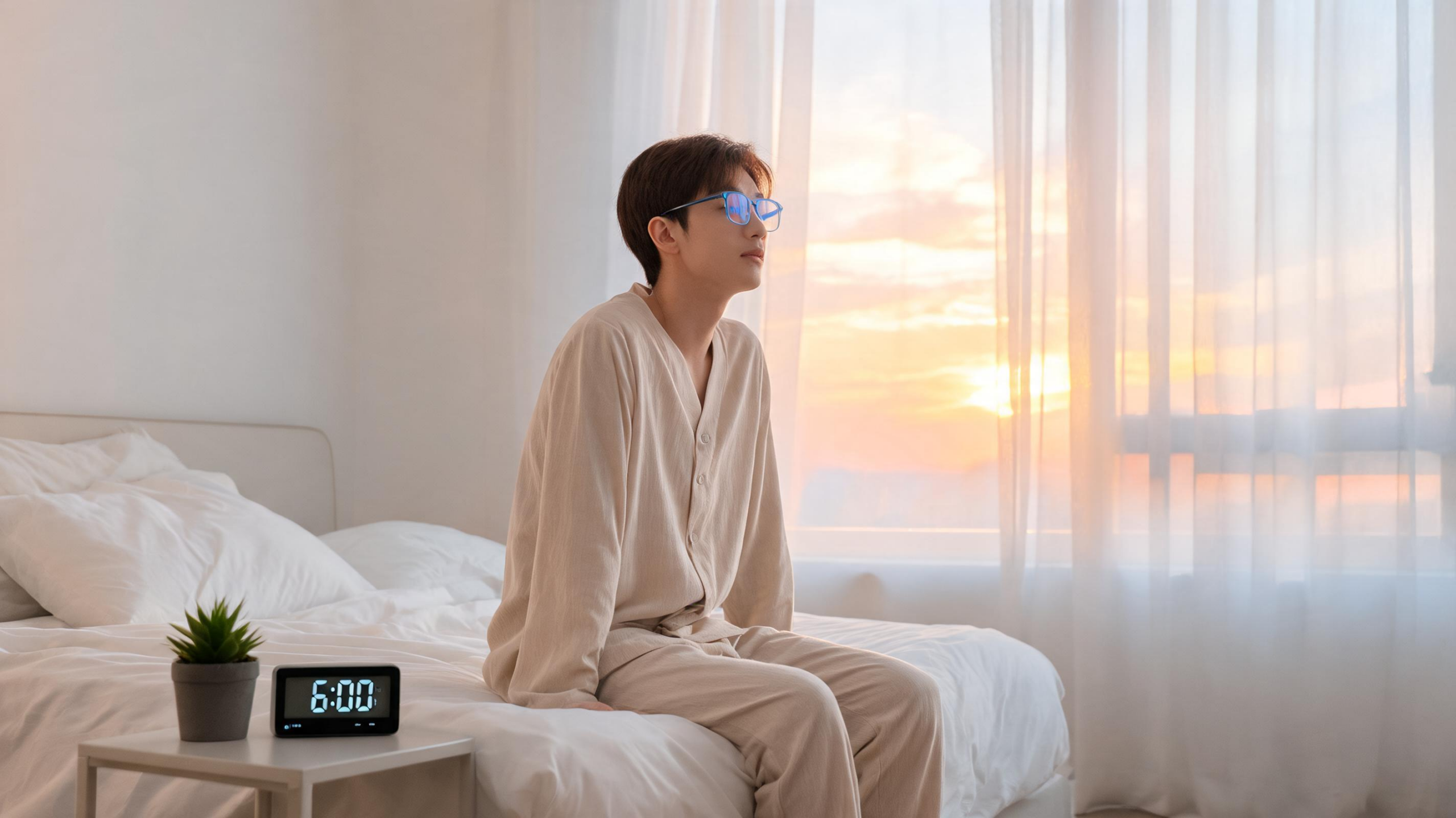
For millions of young adults, falling asleep at a reasonable hour feels less like a choice and more like a biological impossibility. Between the ages of 18 and 25, the human circadian system reaches its developmental peak for delayed sleep timing, pushing the internal clock later and later just as life demands early lectures, entry-level jobs, and commutes. A new research letter published in the Journal of Clinical Sleep Medicine suggests that the solution may not be a single clever trick but a carefully stacked combination of them — and that the difference between an intervention that works and one that fizzles may be as simple as a pair of amber-tinted glasses.
The study, led by Delainey L. Wescott of the Department of Psychiatry at the University of Pittsburgh School of Medicine, together with colleagues including Alison M. Klevens, Maddison L. Taylor, Kathryn A. Roecklein, and Brant P. Hasler, compared two chronotherapeutic interventions aimed at pulling delayed sleep timing earlier in emerging adults with no-to-moderate depression. The first approach relied on a well-established tool: two weeks of morning bright light therapy. The second took the same bright light protocol and layered on additional components — a personalized sleep-wake timing advance and blue-light blocking glasses worn for two hours before bedtime. The results, while preliminary, reveal a striking gap between the two strategies.
In Study 1, which enrolled 21 participants between the ages of 18 and 22, roughly 43 percent of whom were women, the morning bright light intervention alone produced no statistically significant change. Circadian phase, measured objectively, essentially stayed put over the two-week period, with the analysis reporting a coefficient near zero and a p-value of 0.46. Depression symptoms showed a trend toward improvement that just barely missed conventional significance thresholds, edging toward a small decrease but leaving the researchers cautious. For an intervention with decades of laboratory evidence behind it, the outcome was a humbling reminder that what works under controlled conditions does not always translate cleanly into the messy rhythms of real life.
Study 2 told a very different story. In this group of 15 participants, ages 18 to 25 and 86 percent women, the same two weeks of morning bright light was supplemented with a personalized sleep-wake timing advance and blue-light blocking glasses worn in the two hours prior to bedtime. After two weeks, circadian phase had advanced by approximately 35 minutes, a change the researchers report as statistically significant. Even more compelling, depression symptoms decreased significantly, with the analysis yielding a p-value below 0.001. The effect on mood, observed in a sample without severe depression, hints at the mechanistic link between circadian alignment and emotional wellbeing that has animated this field for years.
The science behind why this matters begins with the master clock in the brain. The suprachiasmatic nucleus, a small cluster of neurons in the hypothalamus, keeps the body’s internal time synchronized to the 24-hour day largely through signals relayed from specialized light-sensitive cells in the retina. Light is the most powerful timing cue for this system, but the direction of its effect depends critically on when it arrives. Bright light delivered in the early morning hours shifts the circadian clock earlier, a phenomenon known as a phase advance, while the same light delivered in the evening pushes the clock later. For people whose clocks already run late, the arithmetic seems simple: flood the eyes with bright light soon after waking.
Yet the real world conspires against that arithmetic. Evening ambient light exposure, particularly the short-wavelength blue light emitted by smartphones, laptops, and LED lighting, exerts a phase-delaying influence that can directly counteract the benefits of morning light. Prior research has demonstrated that evening room light can substantially reduce the phase-advancing power of a morning bright light session, essentially canceling out the therapy. This is where the blue-light blocking glasses in Study 2 become more than a wellness accessory. By filtering the wavelengths that most strongly suppress melatonin and signal the circadian system to stay awake, the glasses effectively lowered the counterweight on the other side of the scale, allowing the morning light to do its work unopposed.
The personalized sleep-wake timing advance added a third, behavioral dimension. Rather than asking participants to abruptly adopt an unrealistically early schedule, the intervention prescribed a gradual, individualized shift in when participants went to bed and woke up. Timing matters here for reasons that go beyond habit formation: the circadian system’s sensitivity to light varies across the internal day, and anchoring the sleep window earlier helps ensure that the morning light exposure falls at the point in the phase response curve where it produces maximal advance. In effect, the multicomponent design aligned three levers at once — more advance-driving light in the morning, less delay-driving light at night, and a sleep schedule positioned to let both work optimally.
The connection between circadian timing and depression is not incidental. A growing body of work describes circadian misalignment — the disconnect between internal biological timing and externally imposed sleep-wake behavior — as a transdiagnostic risk factor for psychopathology, with emerging adulthood representing the developmental window where both delayed circadian phase and the onset of mood disorders converge. Prior clinical trials in evening-type adolescents have shown that improving the alignment between circadian biology and sleep-wake behavior can mediate improvements in depressive symptoms, and the current findings extend that logic into the young adult years. If a 35-minute advance in circadian phase is accompanied by a measurable drop in depressive symptom scores, it strengthens the case that the sleep-circadian interface is a genuine, modifiable target for early intervention in mental health.
The authors are appropriately measured in their conclusions. Both studies were small, uncontrolled pilot investigations rather than randomized controlled trials, and the researchers explicitly note that future work in larger samples with rigorous adherence monitoring is needed to confirm the effectiveness of these interventions. Adherence is no trivial concern: interventions that ask young adults to wear glasses, follow a personalized schedule, and sit in front of a light box every morning for two weeks live or die by whether people actually do them. The researchers also emphasize that data and materials will be made available upon reasonable request, reflecting a commitment to transparency as the work moves forward. The research was supported by the Sleep Research Society Small Research Grant and the University of Pittsburgh Physicians Foundation Pilot Grant.
Still, the implications are difficult to ignore. If the multicomponent approach replicates in larger trials, it could offer an accessible, low-risk strategy for one of the most pervasive and undertreated sleep problems of young adulthood — one that may simultaneously buffer against the early seeds of depression. The study was approved by the University of Pittsburgh’s Institutional Review Board in compliance with the Declaration of Helsinki, with informed consent obtained from all participants, and the authors report no financial interests to disclose. What remains is the harder scientific work of scaling up, randomizing, and tracking whether young adults can sustain these changes in their natural environments. But the pilot data suggest that when morning light is protected from the evening’s glowing screens, the young circadian clock can, in fact, be coaxed back on schedule — and the mind may thank it for the effort.
Beyond the headline findings, the methodological scaffolding of the two pilots offers useful context for interpreting the results. Circadian phase in such studies is typically indexed by the dim light melatonin onset, the evening rise of the sleep-promoting hormone melatonin measured under carefully controlled low-light conditions, which is widely regarded as one of the most reliable markers of internal clock time in humans. Because the timing of this marker shifts with age and differs between morning- and evening-oriented individuals, researchers in this area often pair objective phase measures with validated chronotype questionnaires to characterize where each participant sits on the morningness-eveningness spectrum before treatment begins.
The choice of depression outcome measures also matters. The field commonly relies on instruments such as the 16-item Quick Inventory of Depressive Symptomatology, which exists in both clinician-rated and self-report versions and has well-documented psychometric properties in depressed populations, allowing even modest symptom changes to be quantified consistently across studies. In samples like these, where participants report no-to-moderate symptoms rather than severe clinical depression, the room for measurable improvement is narrower, which makes the statistically robust symptom decrease in the multicomponent arm noteworthy.
The findings also fit into a broader research trajectory from the same investigative community. A recent randomized clinical trial targeting insufficient and late sleep in adolescents demonstrated that chronotherapeutic packages can be delivered successfully in younger populations, while open trials of morning bright light in other adult groups, including military veterans with chronic pain, have explored the mood and functional benefits of phase-advancing light exposure outside traditional psychiatric settings. Work on portable light devices has further shown that phase advances can be achieved in the home environment rather than the laboratory, a prerequisite for any scalable real-world intervention.
One additional consideration is the composition of the samples themselves. The markedly different proportions of women across the two pilots, 43 percent versus 86 percent, complicate direct comparison of the interventions, since sex differences in circadian period, phase, and melatonin timing are well documented. Larger trials with balanced samples will help disentangle whether the multicomponent advantage holds uniformly across demographic groups, and whether adherence patterns, which likely differed between the simpler and more demanding protocols, explain part of the observed gap in effectiveness.
Subject of Research: Multicomponent chronotherapeutic interventions for delayed sleep timing in emerging adults
Article Title: Developing multicomponent chronotherapeutic interventions for emerging adults with delayed sleep timing
Article References: Wescott, D. L., Klevens, A. M., Taylor, M. L., Roecklein, K. A., & Hasler, B. P. (2026). Developing multicomponent chronotherapeutic interventions for emerging adults with delayed sleep timing. Journal of Clinical Sleep Medicine, 22(1), Article 156. https://doi.org/10.1007/s44470-026-00171-y
Image Credits: AI Generated
DOI: 10.1007/s44470-026-00171-y
Keywords: circadian phase, delayed sleep timing, emerging adults, bright light therapy, blue-light blocking glasses, chronotherapy, circadian misalignment, depression symptoms, sleep-wake schedule, melatonin, sleep medicine, Developing
Cite Scienmag News
Ophelia Keating. (September 3, 2026). Blue-Light Blocking Glasses and Morning Light Shift Young Adults’ Body Clocks Earlier. Scienmag. https://scienmag.com/blue-light-blocking-glasses-and-morning-light-shift-young-adults-body-clocks-earlier/
Ophelia Keating. "Blue-Light Blocking Glasses and Morning Light Shift Young Adults’ Body Clocks Earlier." Scienmag, 3 September 2026, https://scienmag.com/blue-light-blocking-glasses-and-morning-light-shift-young-adults-body-clocks-earlier/. Accessed 4 October 2026.
Ophelia Keating. "Blue-Light Blocking Glasses and Morning Light Shift Young Adults’ Body Clocks Earlier." Scienmag. September 3, 2026. https://scienmag.com/blue-light-blocking-glasses-and-morning-light-shift-young-adults-body-clocks-earlier/


