


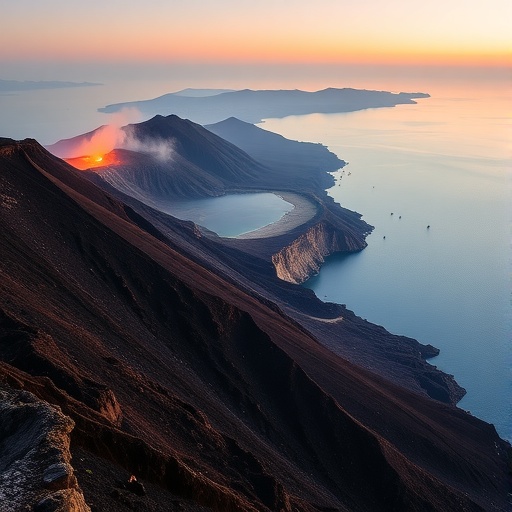
Santorini’s spectacular volcanic landscape may be only the latest chapter in a much longer story of heat, fluids and microbial life beneath the Aegean Sea. A new study published in Nature Communications reports that sediments from the Santorini Caldera preserve chemical and biological evidence of a prolonged hydrothermal past—an ancient period when hot, mineral-rich fluids circulated through the volcanic seafloor and created conditions capable of sustaining specialized microbial communities.
The research, led by Sara Della Sala, Vasiliki Papadimitriou and Panagiota Polymenakou, focuses on two kinds of clues locked inside marine sediments: trace metals and microbial signatures. Together, these indicators can reveal how volcanic systems behaved long after dramatic eruptions had ended. Rather than treating the caldera as a static geological structure, the study presents it as a changing subterranean environment in which heat, seawater, minerals and microorganisms interacted over extended periods.
Hydrothermal systems form when seawater penetrates cracks in the ocean floor or volcanic rock, becomes heated by an underlying magma body or hot geological material, and rises again carrying dissolved chemical elements. When these fluids mix with colder seawater, metals and minerals can precipitate, becoming concentrated in the surrounding sediments. Elements such as iron, manganese, copper, zinc and other trace metals can therefore act as geochemical fingerprints of past fluid circulation, even when the original hydrothermal activity is no longer visible at the surface.
The sediments of Santorini are particularly valuable because the caldera is one of the world’s best-known volcanic systems and has experienced repeated geological upheaval. Its modern landscape was shaped by explosive eruptions, collapses and renewed volcanic activity, but the deeper sedimentary record can preserve signals from less dramatic episodes that unfolded between major events. Layers of mud and volcanic material can trap chemical particles, organic compounds and microscopic remains, creating a natural archive of environmental change.
The microbial evidence adds another dimension to that archive. In dark sediments where sunlight cannot penetrate, microorganisms rely on chemical reactions rather than photosynthesis to obtain energy. Some microbes can use sulfur compounds, iron or manganese minerals, hydrogen and other molecules associated with volcanic and hydrothermal processes. Their biological residues, including characteristic molecular compounds and patterns of microbial activity, can remain detectable long after the organisms themselves have disappeared.
By examining these biological signatures alongside the distribution of trace metals, the researchers were able to identify evidence consistent with sustained hydrothermal influence in the caldera’s past. The significance of the finding lies not simply in confirming that Santorini has been hydrothermally active—volcanic environments commonly generate heat-driven fluid circulation—but in showing that the process left a prolonged and integrated imprint in both the inorganic and biological parts of the sediment record.
This combination of evidence is important because trace metals alone can have multiple sources. Metals may arrive through volcanic ash, erosion, atmospheric deposition or ordinary chemical reactions in sediments. Microbial signals can also be difficult to interpret in isolation because microorganisms respond to changes in oxygen, organic matter and nutrient availability. When geochemical and microbiological indicators point toward the same type of environment, however, scientists can build a stronger case for reconstructing past conditions and separating hydrothermal signals from other processes.
The study also highlights how volcanic calderas can function as long-lived ecological laboratories. Their subsurface heat does not merely drive geological reactions; it can create chemical energy gradients that support microbial ecosystems under conditions hostile to most familiar forms of life. These environments are of interest far beyond Santorini because they resemble settings that may have existed on the early Earth, when life was developing in a planet dominated by volcanism and chemical instability. They also provide analogues for potentially habitable environments on ocean worlds and icy moons, where water may interact with warm rock beneath the surface.
For Santorini itself, the findings offer a new perspective on volcanic hazard and environmental history. Hydrothermal circulation is not equivalent to an imminent eruption, and the study does not by itself predict future volcanic activity. However, understanding how heat and fluids moved through the caldera in the past can improve broader models of how volcanic systems evolve. The sedimentary record may reveal phases of hidden or low-intensity activity that are not captured by the visible landscape or by historical observations alone.
The discovery is likely to attract attention because it transforms ordinary seafloor mud into a record of an invisible world. Beneath the famous cliffs and blue waters of Santorini, sediments have preserved the chemical traces of heated fluids and the molecular echoes of microbes that exploited them. The research demonstrates that the history of a volcano is written not only in lava flows and ash layers, but also in microscopic reactions taking place within sediment. As scientists continue to decode those reactions, Santorini’s caldera may become an important natural laboratory for understanding how geological heat, metal cycling and life remain connected across deep time.
Cite Scienmag News
Violet Maxwell. (August 5, 2026). Sediment Metals and Microbes Reveal Santorini Caldera’s Prolonged Hydrothermal History. Scienmag. https://scienmag.com/sediment-metals-and-microbes-reveal-santorini-calderas-prolonged-hydrothermal-history/
Violet Maxwell. "Sediment Metals and Microbes Reveal Santorini Caldera’s Prolonged Hydrothermal History." Scienmag, 5 August 2026, https://scienmag.com/sediment-metals-and-microbes-reveal-santorini-calderas-prolonged-hydrothermal-history/. Accessed 3 September 2026.
Violet Maxwell. "Sediment Metals and Microbes Reveal Santorini Caldera’s Prolonged Hydrothermal History." Scienmag. August 5, 2026. https://scienmag.com/sediment-metals-and-microbes-reveal-santorini-calderas-prolonged-hydrothermal-history/


