


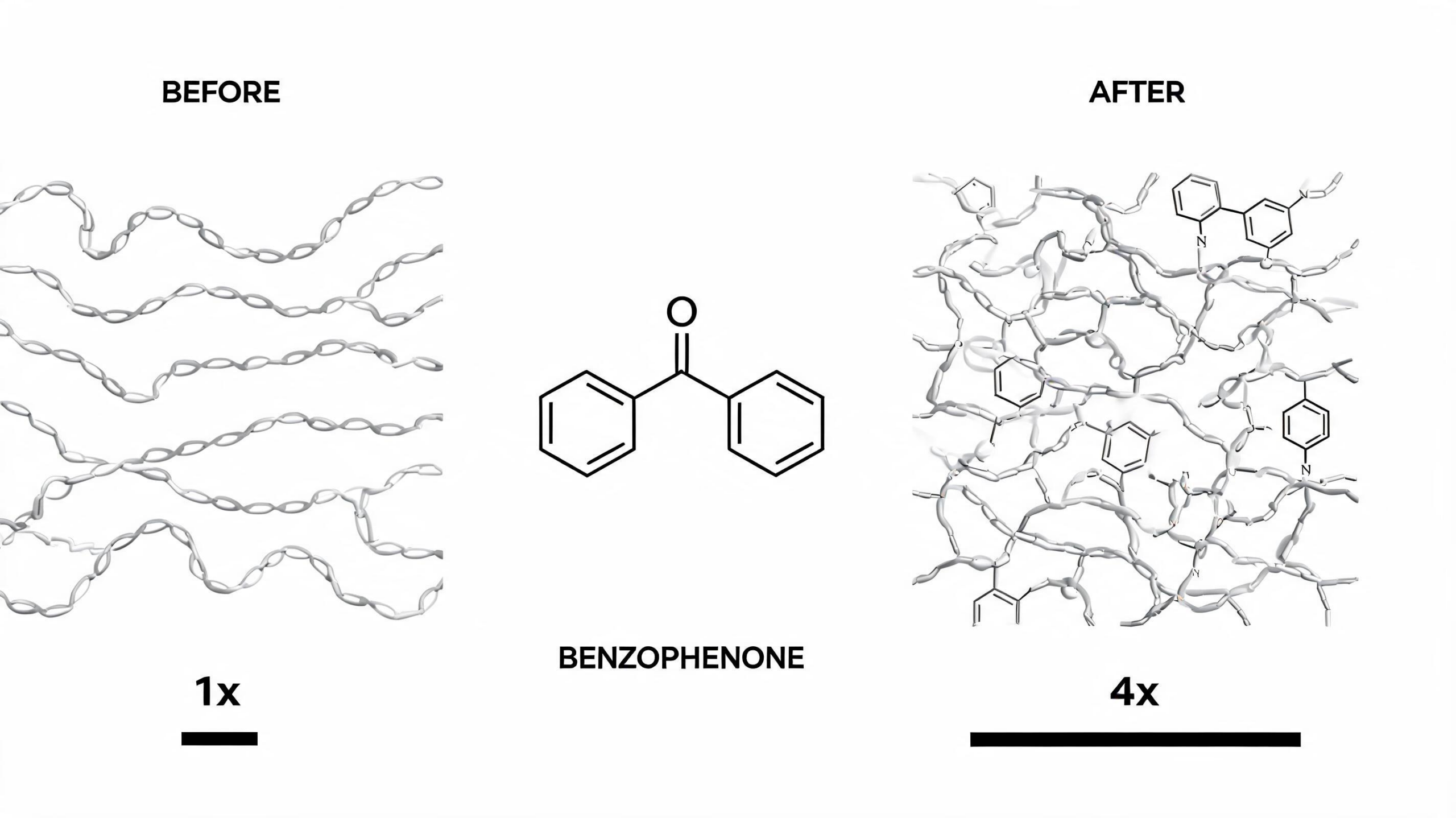
Pressure-sensitive adhesives are the quiet workhorses of modern technology. They bond flexible displays to their frames, hold automotive trim in place, and secure medical patches to skin, all while sticking instantly under nothing more than a light touch. Yet the acrylic polymers that dominate this market have long faced a stubborn trade-off: the same soft, flexible chains that make an adhesive tacky also make it weak when heated or sheared. A new study from researchers at Konkuk University in Seoul, published in Advances in Industrial and Engineering Chemistry, now reports a way to break that trade-off by chemically decorating finished polymer chains with a rigid aromatic group after they have already been made, rather than trying to build the functionality in from the start.
The team, led by Dal-ho Lee, Nam-gyu Yang, and corresponding author Doo-kyung Moon, focused on 4,4′-dihydroxybenzophenone, a molecule that combines a stiff, planar benzophenone core with two phenolic hydroxyl groups. When grafted onto an acrylic backbone, this bulky aromatic unit does two things at once. Its rigid structure restricts the wriggling motion of neighboring polymer segments, and its hydroxyl groups form hydrogen bonds with ester groups on adjacent chains, knitting the material together from the inside. The result, according to the study, is an adhesive that resists both heat and sustained mechanical stress far better than its unmodified counterpart.
What makes the work notable is not simply the chemistry of the additive but the route used to install it. The conventional approach would be to synthesize a methacrylate version of the benzophenone molecule and copolymerize it directly with the soft acrylic monomers. The researchers did exactly that, preparing 4,4′-bis(methacryloyloxy)benzophenone, abbreviated DBPA, by esterifying both hydroxyl groups of the parent diol with methacryloyl chloride. But copolymerization of structurally complex, high-molecular-weight functional monomers is notoriously inefficient in free-radical systems. Differences in monomer reactivity can skew composition, disrupt chain growth, and make molecular weight difficult to control, which in turn complicates any attempt to fine-tune the balance between adhesion and cohesion.
To sidestep those limitations, the group turned to a polymer analogous reaction, a strategy in which the polymer is synthesized first and the functional groups are attached afterward. They built a base copolymer of n-butyl acrylate and tert-butyl acrylate, the workhorse soft monomers of acrylic pressure-sensitive adhesives, and then added a small fraction of glycidyl methacrylate, whose pendant epoxy rings serve as reactive handles. After polymerization, the epoxy-bearing polymer was treated with 4,4′-dihydroxybenzophenone in the presence of the base catalyst DBU at 55 degrees Celsius for 30 hours. The phenolic hydroxyls opened the epoxy rings, covalently anchoring the benzophenone units along the backbone while leaving the chain architecture otherwise intact.
The comparison between the two routes proved revealing. Gel permeation chromatography showed that the copolymerized samples, with and without the benzophenone monomer, differed in number-average molecular weight by roughly 2,110 grams per mole, a sign that the functional monomer was perturbing the radical polymerization. The post-modified pair, by contrast, differed by only about 590 grams per mole, with nearly identical polydispersity indices of 1.86 and 1.87. Because molecular weight was held essentially constant, the researchers could attribute differences in performance directly to the presence and placement of the benzophenone groups rather than to chain-length effects, giving the study a unusually clean structure-property comparison.
Spectroscopy confirmed the chemistry at every step. Proton nuclear magnetic resonance spectra of the epoxy-bearing precursor showed the expected alkyl and ester signals of the acrylic backbone along with the broad resonances of glycidyl groups. After modification, new aromatic proton signals appeared between 7.0 and 8.2 parts per million, fingerprints of the benzophenone moiety, while changes in the 3.0 to 4.5 ppm region tracked the ring-opening of the epoxy groups. The spectra thus documented the conversion of a simple acrylic copolymer into a benzophenone-functionalized one without degrading the underlying chain.
Thermal measurements told a striking story. In thermogravimetric analysis under nitrogen, the temperature at which each polymer lost 10 percent of its mass rose from 267 degrees Celsius for the unmodified base polymer to 318 degrees Celsius for the copolymerized benzophenone version, and from 283 to 328 degrees Celsius for the post-modified pair. The rigid aromatic units raise the energy barrier for thermal decomposition and suppress chain mobility, while the phenolic hydroxyls promote intermolecular hydrogen bonding that further retards degradation. Differential scanning calorimetry added another dimension: glass transition temperatures climbed from around minus 44 to minus 47 degrees Celsius for the unmodified polymers to minus 40.3 and minus 26.3 degrees Celsius for the functionalized ones, with the post-modified material showing the largest shift, evidence of substantially restricted segmental motion.
The adhesive performance data were the most dramatic. In a standard shear test, films of the adhesives were laminated onto stainless steel with a 25 by 25 millimeter bonding area, pressed with a two-kilogram roller, and loaded with a 200-gram weight while researchers timed how long the joint survived. The unmodified polymers failed after 78 and 103 seconds. The benzophenone-functionalized versions held for 336 and 363 seconds, roughly three to four times longer, with the post-modified polymer again leading the field. The researchers attribute the gains to strengthened intermolecular interactions from the aromatic structures, including pi-pi stacking between benzophenone units, combined with the reduced chain mobility implied by the elevated glass transition temperatures.
The implications reach beyond one adhesive formulation. Because the polymer analogous approach decouples polymerization from functionalization, it relaxes the constraints that monomer reactivity places on composition design, allowing chemists to dial in functional group content independently of molecular weight. The authors argue that this provides a versatile platform not only for next-generation pressure-sensitive adhesives requiring high thermal stability and internal cohesion, but for functional polymer materials generally where precise structural control matters. For industries pushing flexible electronics, automotive assemblies, and medical devices to operate hotter, longer, and under greater mechanical stress, the message is that the fastest route to a tougher adhesive may not be rebuilding the polymer from scratch, but decorating the one you already have. The study was funded in part by grants from the Korea Institute of Energy Technology Evaluation and Planning and the Korea Planning and Evaluation Institute of Industrial Technology, and is published open access under a Creative Commons Attribution 4.0 license.
The distinction between tack, peel adhesion, and shear strength is central to understanding why this study matters. Tack describes the instantaneous grip an adhesive forms under light pressure, peel measures the force needed to remove a bonded layer, and shear reflects how long a joint resists a steady load pulling parallel to the bond line. In practice, these properties often pull against one another: formulations that grip quickly and release cleanly tend to flow under sustained stress, while highly crosslinked, cohesive networks resist flow but lose the softness needed for instant contact. The benzophenone strategy reported here is notable because it strengthens cohesion through intermolecular interactions rather than through permanent covalent crosslinks, preserving the linear chain architecture that gives acrylic adhesives their characteristic softness and conformability.
The choice of glycidyl methacrylate as a reactive handle reflects a broader trend in polymer chemistry toward epoxide chemistry for post-polymerization modification. Epoxy rings are strained three-membered structures that open readily when attacked by nucleophiles such as phenolic hydroxyls, particularly under basic catalysis, and the reaction proceeds cleanly at moderate temperatures without generating small-molecule byproducts. This makes epoxy-functional copolymers versatile intermediates: the same precursor could in principle be diversified with many different nucleophilic functional molecules, allowing a single base polymer to serve as a platform for screening a range of pendant groups. The study’s use of the strong amidine base DBU to accelerate the ring-opening at 55 degrees Celsius illustrates how catalyst selection can make such modifications practical on laboratory timescales.
The thermal analysis results also reward closer reading. In thermogravimetric analysis, a rising temperature of ten percent weight loss indicates that the earliest bond-breaking events in the polymer require more energy, which the authors link to the rigid aromatic content and the hydrogen-bonding network introduced by the benzophenone units. The fact that the post-modified materials achieved the highest degradation temperatures in the series suggests that the placement of the functional groups, not merely their presence, influences thermal behavior. Meanwhile, the elevated glass transition temperatures measured by differential scanning calorimetry provide an independent, physical confirmation of restricted segmental motion, since this transition marks the temperature range in which polymer chains gain enough thermal energy for large-scale cooperative movement.
Methodologically, the study demonstrates the value of holding molecular weight constant when comparing functionalized polymers. In free-radical copolymerization, incorporating a bulky functional monomer can alter chain transfer, propagation rates, and initiator efficiency, so any performance difference between a functionalized and unfunctionalized copolymer may confound composition effects with chain-length effects. By preparing the epoxy-bearing precursor first and modifying it afterward, the researchers ensured that both members of their comparison pair shared essentially the same backbone length and distribution, isolating the benzophenone contribution. This design principle, decoupling synthesis from functionalization, applies well beyond adhesives, offering a general route for introducing sensitive or sterically demanding groups into polymers whose direct copolymerization would be impractical, and it may inform future work on functional coatings, membranes, and biomedical polymer materials where precise structural control is equally critical.
Subject of Research: Post-polymerization grafting of dihydroxybenzophenone onto acrylic polymers to enhance the thermal stability and cohesion of pressure-sensitive adhesives
Article Title: Post-functionalization of acrylic polymers with dihydroxybenzophenone for enhanced adhesive properties
Article References: Lee, D.-H., Yang, N.-G., & Moon, D.-K. (2026). Post-functionalization of acrylic polymers with dihydroxybenzophenone for enhanced adhesive properties. Advances in Industrial and Engineering Chemistry, 2(1), Article 10. https://doi.org/10.1007/s44405-026-00047-y
Image Credits: AI Generated
DOI: 10.1007/s44405-026-00047-y
Keywords: pressure-sensitive adhesives, acrylic polymers, dihydroxybenzophenone, polymer analogous reaction, post-polymerization modification, glycidyl methacrylate, shear strength, thermal stability, glass transition temperature, hydrogen bonding, free-radical copolymerization, benzophenone functionalization
Cite Scienmag News
Hazel Monroe. (September 3, 2026). Benzophenone-Grafted Acrylic Adhesives Quadruple Shear Strength Through Post-Polymerization Modification. Scienmag. https://scienmag.com/benzophenone-grafted-acrylic-adhesives-quadruple-shear-strength-through-post-polymerization-modification/
Hazel Monroe. "Benzophenone-Grafted Acrylic Adhesives Quadruple Shear Strength Through Post-Polymerization Modification." Scienmag, 3 September 2026, https://scienmag.com/benzophenone-grafted-acrylic-adhesives-quadruple-shear-strength-through-post-polymerization-modification/. Accessed 4 October 2026.
Hazel Monroe. "Benzophenone-Grafted Acrylic Adhesives Quadruple Shear Strength Through Post-Polymerization Modification." Scienmag. September 3, 2026. https://scienmag.com/benzophenone-grafted-acrylic-adhesives-quadruple-shear-strength-through-post-polymerization-modification/


