


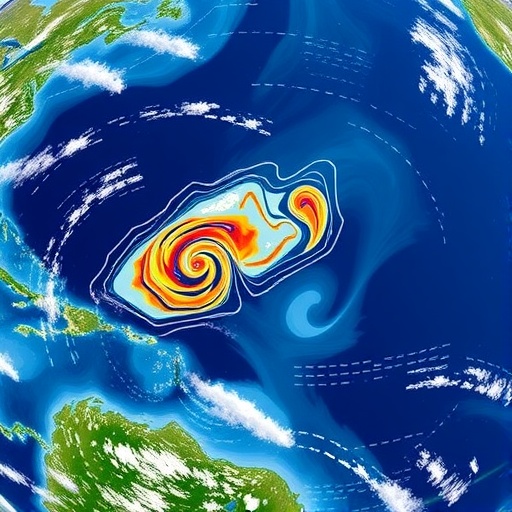
Emerging research from the University of Miami’s Rosenstiel School of Marine, Atmospheric, and Earth Science has unveiled a concerning and sustained deceleration in one of the Atlantic Ocean’s most crucial current systems. Spanning nearly twenty years, this slowdown affects an extensive latitudinal range along the North Atlantic’s western boundary, offering the clearest direct observational evidence to date that the Atlantic Meridional Overturning Circulation (AMOC) is weakening significantly. Such a shift has profound implications for regional and global climate, including unpredictable patterns in rainfall, intensification of storm activity, and altered temperature regimes.
The Atlantic Meridional Overturning Circulation is a fundamental component of Earth’s climate system. This vast conveyor belt transports warm, salty surface waters northward and returns cooler, denser deep waters south, thereby redistributing heat energy across the planet. This mechanism not only stabilizes temperature gradients but also influences atmospheric patterns, acting as an engine behind the climate dynamics bordering the North Atlantic. Alterations to this circulation could ripple through ecosystems, economies, and societies, especially those reliant on predictable weather patterns.
In their groundbreaking study, researchers deployed an innovative combination of seafloor-anchored instrumentation arrays at multiple key latitudes along the western edge of the North Atlantic, from subtropical zones around 16.5°N to the mid-latitudes near 42.5°N. These arrays continuously measure bottom pressures, accompanied by finely calibrated sensors recording temperature, density, and current velocities below depths of 1,000 meters. This approach enabled the team to infer changes in the deep ocean flow with unprecedented accuracy and consistency across the region.
The analysis delineated a clear, meridionally consistent trend: a marked and persistent decrease in the western boundary contributions to the AMOC. Notably, such large-scale declines transcend short-term variability and regional anomalies, pointing instead toward a fundamental basin-wide transformation. These results resonate with climate model projections that have long anticipated weakening in these ocean circulations owing to warming, freshwater input from ice melt, and changing salinity patterns.
A reduced AMOC exerts multifaceted impacts on weather systems. In Europe, for example, the current’s decline could translate into harsher, colder winters due to dampened northward heat transport. Meanwhile, the Caribbean and U.S. East Coast might experience shifts in hurricane intensity and frequency, exacerbated by altered sea surface temperatures. Furthermore, changes in rainfall distribution threaten to disrupt agricultural productivity and freshwater availability across large swaths of the North Atlantic’s bordering continents.
Moreover, a slowing AMOC contributes tangibly to regional sea-level rise, particularly along the U.S. eastern seaboard. This occurs because decreased southward movement of cold deep waters leads to thermal expansion and altered ocean dynamics, pressing additional stress on coastal infrastructure and communities already grappling with climate change. Understanding and forecasting these changes are critical for urban planning, disaster preparedness, and ecosystem conservation.
From a methodological perspective, focusing on long-term bottom pressure measurements offers a novel and efficient proxy to monitor these deep ocean currents. Unlike traditional surface observations or short-term studies, this technique harnesses stable, continuous data streams impervious to transient atmospheric noise, providing an early warning system akin to a “canary in the coal mine.” Such monitoring could prove indispensable for climate prediction frameworks worldwide.
The significance of these findings extends beyond oceanography into the broader climatological and environmental discourse. They underscore the interconnectedness of ocean circulation and atmospheric behavior, reinforcing the urgency with which we must approach climate mitigation and adaptation strategies. The capability to reliably detect and anticipate shifts in AMOC dynamics empowers policymakers, scientists, and communities alike with actionable intelligence to navigate an uncertain future.
This study, appearing in the April 8 issue of Science Advances, titled “Meridionally consistent decline in the observed western boundary contribution to the Atlantic Meridional Overturning Circulation,” garners support from the U.S. National Science Foundation and the U.K.’s Natural Environment Research Council. It exemplifies the collaborative, cross-disciplinary effort required to elucidate complex components of the Earth system.
As atmospheric greenhouse gas concentrations continue their upward trajectory, deciphering how ocean currents respond remains paramount. The documented decline in the AMOC’s western limb serves as a stark indicator, reflecting both natural variability and anthropogenic pressures reshaping planetary systems. Continuous, multifaceted observation networks are essential to validate models and guide responsive strategies aimed at mitigating the worst ramifications.
Ultimately, this research not only advances scientific understanding but also amplifies the call to action. The AMOC slowdown portends considerable shifts in climate patterns that govern everything from extreme weather phenomena to sea-level trends. Through heightened awareness and targeted research endeavors, humanity can better prepare for, and possibly alleviate, the impacts intrinsic to such vast environmental transformations.
News Publication Date: 8 April 2026.
Web References: https://www.science.org/doi/10.1126/sciadv.adz7738
References: See article DOI.
Cite Scienmag News
Violet Maxwell. (May 5, 2026). Study Reveals Two-Decade Slowdown in Key Atlantic Ocean Current. Scienmag. https://scienmag.com/study-reveals-two-decade-slowdown-in-key-atlantic-ocean-current/
Violet Maxwell. "Study Reveals Two-Decade Slowdown in Key Atlantic Ocean Current." Scienmag, 5 May 2026, https://scienmag.com/study-reveals-two-decade-slowdown-in-key-atlantic-ocean-current/. Accessed 5 September 2026.
Violet Maxwell. "Study Reveals Two-Decade Slowdown in Key Atlantic Ocean Current." Scienmag. May 5, 2026. https://scienmag.com/study-reveals-two-decade-slowdown-in-key-atlantic-ocean-current/


