


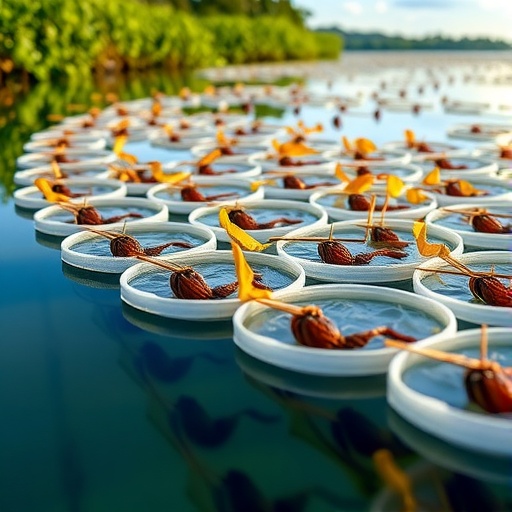
A groundbreaking study led by marine scientists at the University of Miami’s Rosenstiel School of Marine, Atmospheric, and Earth Science reveals the transformative potential of integrating seaweed into marine finfish aquaculture systems. The research highlights that cultivating macroalgae alongside fish in Integrated Multi-Trophic Aquaculture (IMTA) can significantly reduce key waste products, enhancing both environmental sustainability and economic viability in commercial aquaculture operations. This innovative approach capitalizes on the nutrient-rich effluent produced by fish farms, enabling seaweed species to absorb waste and mitigate environmental impacts.
The study’s significance emerges amid growing global interest in expanding marine aquaculture, especially in the Southeast U.S. and Caribbean regions, where the demand for sustainable seafood production intensifies. Principal investigator Dr. John D. Stieglitz and lead author Haley Lasco spearheaded experimental work, employing a pilot-scale IMTA system at the University of Miami’s experimental hatchery facility on Virginia Key, Florida. This controlled environment allowed precise monitoring of macroalgae species’ responses to wastewater streams generated by yellowtail snapper grow-out tanks, simulating real-world commercial aquaculture conditions.
Through rigorous two-week trials, four macroalgae species native to the region were cultivated in replicated tanks receiving consistent fish effluent. These trials assessed growth rates, nutrient uptake efficacy, and biochemical composition—encompassing proteins, lipids, fiber, ash, minerals, and elemental carbon and nitrogen ratios. The objective was to identify the optimal macroalgae candidates capable of nutrient extraction while producing high-quality biomass with commercial value. Of particular interest was the seaweeds’ ability to reduce total ammonia nitrogen (TAN), a toxic byproduct of fish metabolism, to below detectable levels.
IMTA leverages natural ecosystem relationships by co-culturing species across trophic levels—finfish, shellfish, and macroalgae—to recycle nutrients and minimize waste. Here, macroalgae acts as an effective biofilter, transforming nitrogenous wastes into valuable biomass. The University of Miami research indicates that selecting appropriate local seaweed species is pivotal for optimizing nutrient removal and diversifying aquaculture products. By integrating these extractive species, aquaculture farms gain a dual benefit: mitigating environmental pollution and generating a secondary revenue stream through harvested seaweed.
The experimental results demonstrated robust growth of specific native macroalgae in response to nutrient-rich effluent, accompanied by enhanced biochemical profiles suited for commercial applications. Stable isotope analyses further confirmed the assimilation of nutrients originating from fish farm discharge, validating the reciprocal ecological function within the IMTA system. This bioconversion process exemplifies how aquaculture can evolve from a mono-trophic, waste-producing operation to a sustainable integrated model where waste is transformed into resource.
Beyond nutrient recycling, the integration of macroalgae addresses critical environmental concerns. Excessive nitrogen and organic matter discharge from intensive finfish farming have long challenged coastal ecosystems, leading to eutrophication, hypoxia, and biodiversity decline. Implementing IMTA with well-chosen seaweed species offers a tangible strategy to circumvent these issues by closing nutrient loops. Additionally, cultivating seaweed locally enhances regional ecosystem resilience and supports circular economies within marine resource management.
The researchers provide practical guidance for aquaculture producers, emphasizing species selection based on site-specific environmental conditions, production goals, and market demands. This framework assists stakeholders in tailoring IMTA designs for maximum sustainability and profitability. Since each macroalga species exhibits unique physiological traits, such as nutrient uptake rates and growth dynamics, matching complementary species to the farm’s effluent profile is crucial for system success.
Key to the study’s impact is demonstrating the economic viability of IMTA through the co-production of seaweed alongside finfish. Harvested macroalgae, rich in protein and other bioactive compounds, holds promise for diverse markets including food, feed, pharmaceuticals, and biofuels. This diversification reduces reliance solely on fish yields and offers buffer against market volatility. Moreover, producing macroalgae locally can stimulate green job opportunities and invigorate rural coastal economies.
The team’s pioneering work also sets a precedent for sustainable aquaculture expansion in regions with abundant marine biodiversity yet limited existing multi-trophic aquaculture implementations. The Southeast U.S. and Caribbean represent prime candidates for scaling up IMTA, informed by the data-driven insights from this study. Such integration is aligned with global efforts to increase seafood production while mitigating ecological footprint, a cornerstone of the UN’s Sustainable Development Goals.
In conclusion, the University of Miami’s study redefines marine aquaculture paradigms by showcasing the symbiotic potential between finfish and native macroalgae within IMTA systems. By efficiently recycling nutrients and generating marketable products, these integrated operations promise enhanced environmental stewardship and business resilience. This research not only elucidates mechanistic processes underpinning effective nutrient capture but also offers actionable pathways for industry adoption, marking a critical advance in sustainable food production technologies.
Funded by the Gulf States Marine Fisheries Commission in partnership with NOAA Fisheries, the study was published in the journal Aquaculture International on February 10, 2026. Through its comprehensive experimental design and analyses, the work advocates for a future aquaculture industry that is both ecologically responsible and economically sound by leveraging nature’s essential ecological interdependencies.
News Publication Date: February 10, 2026
Web References: DOI link
Cite Scienmag News
Violet Maxwell. (May 5, 2026). Study Reveals Seaweed Integration Enhances Aquaculture Efficiency and Reduces Waste. Scienmag. https://scienmag.com/study-reveals-seaweed-integration-enhances-aquaculture-efficiency-and-reduces-waste/
Violet Maxwell. "Study Reveals Seaweed Integration Enhances Aquaculture Efficiency and Reduces Waste." Scienmag, 5 May 2026, https://scienmag.com/study-reveals-seaweed-integration-enhances-aquaculture-efficiency-and-reduces-waste/. Accessed 4 September 2026.
Violet Maxwell. "Study Reveals Seaweed Integration Enhances Aquaculture Efficiency and Reduces Waste." Scienmag. May 5, 2026. https://scienmag.com/study-reveals-seaweed-integration-enhances-aquaculture-efficiency-and-reduces-waste/


