


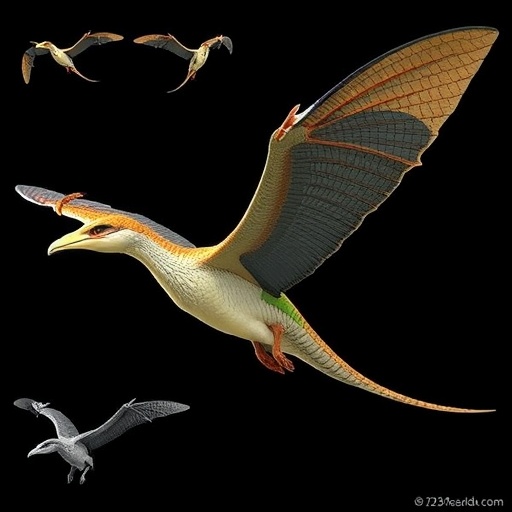
Pterosaurs, the pioneering vertebrates that first achieved powered flight, have long fascinated paleontologists, not only for their evolutionary significance but also for their astounding diversity and scale. These ancient reptiles, which soared the skies during the Mesozoic era, ranged from small, bat-like forms to giant creatures boasting wingspans surpassing ten meters—comparable in size to small contemporary aircraft. However, despite decades of study, the precise configurations and variations of their wing structures remain shrouded in uncertainty. New research led by the University of Bristol challenges existing scientific reconstructions, suggesting that the diversity in pterosaur wing morphologies has been significantly underestimated.
Unlike modern birds and bats, whose wing structures are generally well-preserved and understood, fossils of pterosaurs rarely capture the complete shape of their wings. The fragile membranes and soft tissues essential for flight rarely fossilize intact, leaving scholars to rely predominantly on the bony elements that supported the wings. This limitation has resulted in reconstructions that tend to represent a narrow spectrum of wing forms, potentially obscuring a much richer variety of flight adaptations in pterosaurs.
To address this gap, the research team employed a sophisticated approach known as theoretical morphospace analysis. This method involves constructing a multidimensional map that encompasses all plausible wing shapes based on biomechanical principles and comparative anatomy. By plotting experimentally studied pterosaurs—including iconic species such as Pteranodon, noted for its prolific presence in popular culture, and Quetzalcoatlus, the largest known flying animal—the researchers were able to assess how the reconstructed wing designs align with the range of mechanically feasible wing morphologies.
Through the lens of morphospace, it became apparent that the wings attributed to many pterosaur species cluster within a surprisingly constricted area, indicating a lack of variation previously assumed to exist. This clustering is particularly striking given the extensive evolutionary timeframe across which pterosaurs flourished—over 100 million years—and their vast range in body sizes from the minuscule to the colossal. The findings imply that current reconstructions tend to converge on similar wing architectures, which may not accurately reflect the genuine ecological and functional diversity within the group.
Benton Walters, lead author of the study and a researcher at Bristol’s School of Earth Sciences, explains that in extant flying animals, diverse ecological niches produce a broad array of wing geometries adapted to different flight behaviors. “Living flyers such as birds and bats exhibit distinct wing shapes that correlate tightly with their lifestyles and flight capabilities. The limited variation in pterosaur wing reconstructions suggests a systematic underestimation of their morphological diversity,” Walters remarks. This indicates that past efforts may have overlooked significant variations in wing membrane extent, curvature, and functional morphology.
The constraints in fossil preservation challenge the ability to definitively state wing shape parameters based solely on skeletal features. Exceptional fossils preserve enough detail to infer aspects of the soft wing tissues, but such discoveries are rare and offer only snapshots of an evolutionary continuum. Consequently, many reconstructions extrapolate wing forms based on a limited sample, which may skew interpretations toward more conservative or convenient morphologies.
This new perspective has vital implications not only for reconstructing the physical appearance of these prehistoric flyers but also for understanding their flight mechanics and ecological roles. By expanding the theoretical range of wing shapes, researchers can generate more nuanced hypotheses about pterosaur flight performance, maneuverability, and habitat use. For example, variations in wing loading, aspect ratio, and membrane flexibility would have influenced soaring efficiency, takeoff strategies, and predation tactics, painting a more complex picture of pterosaur ecology.
Moreover, the interdisciplinary integration of biomechanics, paleontology, and cutting-edge computational techniques promises to revolutionize how extinct flying animals are studied. Advances such as enhanced fossil imaging using multispectral or ultraviolet light have begun to uncover soft tissue details invisible to the naked eye, potentially allowing refined reconstructions grounded in new empirical data. Walters notes, “Emerging technologies that reveal hidden fossil structures will be critical in validating and expanding upon our morphological frameworks.”
Ultimately, the study serves as a pivotal benchmark, identifying crucial gaps in the current understanding of pterosaur wing design and guiding future research efforts. It underscores the inherent challenges in reconstructing extinct organisms, particularly those with delicate anatomical features unlikely to fossilize comprehensively. The work invites a reevaluation of established paradigms, advocating for openness to greater morphological diversity in the coming era of paleobiological inquiry.
As the field progresses, the integration of theoretical modeling with empirical fossil evidence holds promise for unlocking the secrets of these extraordinary animals that mastered the skies long before birds and bats. The evolving picture of pterosaur wing diversity not only enhances appreciation of their evolutionary innovation but also enriches broader discussions on the mechanics and evolution of vertebrate flight.
This investigation, detailed in the forthcoming issue of the journal Palaeobiology, represents a significant stride in paleontological science, shining new light on the limits and possibilities of flight adaptations in prehistoric times. It challenges conventional assumptions and heralds an exciting phase where modern analytical tools reshape our understanding of life’s ancient history.
Cite Scienmag News
Violet Maxwell. (June 24, 2026). Study Reveals Greater Diversity in Pterosaur Wing Shapes Than Previously Believed. Scienmag. https://scienmag.com/study-reveals-greater-diversity-in-pterosaur-wing-shapes-than-previously-believed/
Violet Maxwell. "Study Reveals Greater Diversity in Pterosaur Wing Shapes Than Previously Believed." Scienmag, 24 June 2026, https://scienmag.com/study-reveals-greater-diversity-in-pterosaur-wing-shapes-than-previously-believed/. Accessed 3 September 2026.
Violet Maxwell. "Study Reveals Greater Diversity in Pterosaur Wing Shapes Than Previously Believed." Scienmag. June 24, 2026. https://scienmag.com/study-reveals-greater-diversity-in-pterosaur-wing-shapes-than-previously-believed/


