


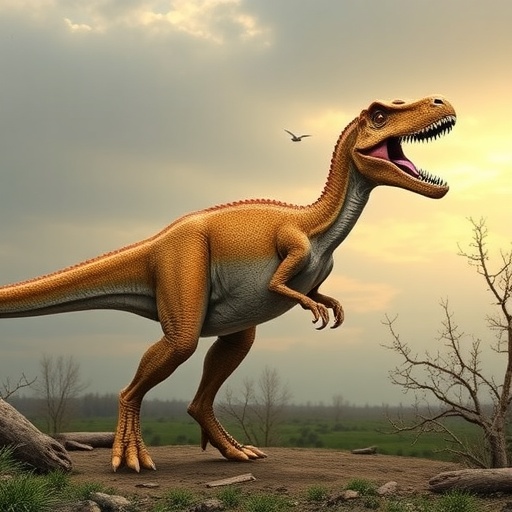
An international team of paleontologists has proposed a new way to reconstruct how dinosaurs processed food—by studying the stones they swallowed. These gastroliths, preserved in the abdominal cavities of some dinosaur fossils, may reveal whether an animal crushed plants in a muscular stomach, relied on its teeth and jaws, or allowed food to break down slowly through fermentation in an elongated intestine. The findings, led by Ryuji Takasaki of the Faculty of Biosphere-Geosphere Science at Okayama University of Science, suggest that dinosaur digestion was far more diverse than a single “reptilian” model implies.
The study focuses on the physical wear recorded on gastroliths. Stones carried in a digestive tract can be abraded as they move against one another and against the muscular walls of the stomach. Over time, sharp edges may become rounded and smooth. By comparing the shapes of stones recovered from living birds and crocodilians, the researchers developed a framework for interpreting similar remains in dinosaur fossils. Their results indicate that the degree of abrasion may provide a biological signal: heavily worn stones are more consistent with powerful stomach contractions, while angular stones may point to a less muscular digestive environment.
Living birds provide the clearest modern comparison. Many herbivorous birds swallow stones that accumulate in the gizzard, a specialized, muscular chamber positioned between the stomach and intestine. As the gizzard contracts, the stones help grind tough plant tissues into smaller particles, increasing the surface area available to digestive enzymes. This mechanical processing is especially important for birds, which lack teeth. The team’s analysis suggests that the gastroliths of herbivorous birds tend to become rounded through repeated abrasion, whereas carnivorous birds and crocodilians often retain sharper stones because their digestive systems place less grinding force on them.
The distinction also appears to reflect diet. In the living animals examined by the researchers, herbivorous species generally carried smoother, more severely abraded gastroliths. Carnivorous species, including animals that consume invertebrates, were more likely to retain stones with angular edges. This pattern offers a possible link between stone morphology and stomach function. It does not mean that every rounded stone proves the presence of a gizzard, or that every sharp stone rules one out, but the overall trend creates a testable method for interpreting fossils in which soft digestive organs have vanished.
Applying this approach to dinosaur fossils produced a striking result. Many toothless theropods—members of the evolutionary group that includes birds—possessed rounded gastroliths. The researchers argue that these dinosaurs may have used muscular stomachs to mechanically grind plant material, much as chickens do today. For toothless animals, such a system would have compensated for the absence of jaws capable of chewing. The stones would have acted as internal grinding tools, breaking down leaves, stems and other fibrous foods before chemical digestion and absorption took place.
The findings also challenge the idea that all herbivorous dinosaurs processed plants in the same way. Some dinosaurs appear to have depended mainly on their teeth and jaws to fragment food. Others may have used muscular stomachs and gastroliths for mechanical digestion. A third strategy may have involved prolonged fermentation in the intestinal tract, where microorganisms break down plant fiber that the animal’s own enzymes cannot digest efficiently. These alternatives would have placed different demands on the digestive anatomy and may help explain why herbivorous dinosaurs evolved such a wide range of body shapes, feeding structures and gut proportions.
Evidence from ornithischians and sauropods supports this broader picture. Numerous gastroliths have been found in Psittacosaurus, a distant relative of Triceratops, as well as in giant sauropods that reached lengths of more than 20 meters. Yet many of these stones remain relatively angular rather than highly rounded. According to the researchers, this pattern suggests that these dinosaurs may not have relied heavily on a powerful, gizzard-like stomach. Instead, their teeth and jaws may have performed more of the initial processing, while long digestive tracts allowed fermentation to continue over an extended period.
Sauropods may have been particularly dependent on this intestinal strategy. Their enormous bodies and long necks enabled them to harvest large quantities of vegetation, but their small heads and relatively limited chewing ability would have restricted the amount of mechanical processing performed before swallowing. A lengthy gut could have provided the time and space needed for microbial fermentation. In this model, the angular gastroliths found with some sauropod remains were swallowed stones, but not necessarily evidence of intense stomach grinding. Their role may have been limited, incidental or linked to other aspects of digestion.
The researchers emphasize that gastroliths should not be interpreted in isolation. Tooth shape, jaw mechanics, body size, feeding posture, gut proportions and the chemical composition of fossilized tissues can all provide independent clues about diet and digestion. Combining these lines of evidence could reveal how digestive systems evolved repeatedly across the dinosaur family tree. The study therefore turns seemingly ordinary stones into potential records of internal anatomy, offering a rare view of organs that almost never fossilize. By tracing the wear produced inside ancient stomachs, paleontologists may be able to reconstruct not only what dinosaurs ate, but also how evolution transformed food processing into one of their most successful survival strategies.
Web References: https://doi.org/10.1017/pab.2026.10112
References: Paleobiology; Ryuji Takasaki, Yoshitsugu Kobayashi, Anthony R. Fiorillo, Tsogtbaatar Chinzorig and Gregory M. Funston.
Cite Scienmag News
Violet Maxwell. (August 4, 2026). New hypothesis illuminates how dinosaur digestive systems evolved. Scienmag. https://scienmag.com/new-hypothesis-illuminates-how-dinosaur-digestive-systems-evolved/
Violet Maxwell. "New hypothesis illuminates how dinosaur digestive systems evolved." Scienmag, 4 August 2026, https://scienmag.com/new-hypothesis-illuminates-how-dinosaur-digestive-systems-evolved/. Accessed 3 September 2026.
Violet Maxwell. "New hypothesis illuminates how dinosaur digestive systems evolved." Scienmag. August 4, 2026. https://scienmag.com/new-hypothesis-illuminates-how-dinosaur-digestive-systems-evolved/


