


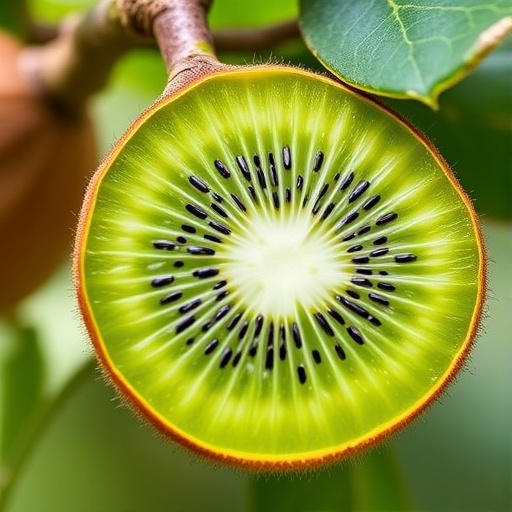
Kiwifruit is offering scientists a new view of how a plant’s genome works—not as a linear sequence of DNA, but as a three-dimensional structure that folds, loops, and organizes genes inside the nucleus. In a study published in Horticulture Research, researchers created a high-resolution 3D genome atlas for kiwifruit leaf and fruit tissues, revealing how genome architecture, epigenetic signals, and gene activity interact during fruit development.
The work addresses a major gap in plant biology. Although three-dimensional genome research has expanded rapidly in model species and annual crops, perennial fruit plants remain comparatively understudied. Their long life cycles, complex developmental programs, and tissue-specific traits make them difficult to analyze. Kiwifruit, however, provides an important system for examining how chromatin organization influences fruit formation, maturation, and other agriculturally valuable characteristics.
Inside the nucleus, DNA is packaged with proteins into chromatin. This material is not arranged randomly. Regions of the genome can be separated into active and inactive compartments, folded into domains, or connected by loops that bring distant regulatory elements close to genes. These physical arrangements can affect whether a gene is switched on, silenced, or maintained in a state ready for activation. The new kiwifruit atlas shows that these layers of organization operate across different scales, from entire chromosome compartments to local regulatory neighborhoods.
Researchers from the State Key Laboratory of Forest Food Resources Development and Utilization and the College of Horticulture Science at Zhejiang A&F University, together with collaborators at Zhejiang University, used in situ Hi-C to map contacts between DNA regions in leaf and fruit tissues. Hi-C captures the frequency with which segments of chromatin come into physical proximity, allowing scientists to reconstruct the genome’s three-dimensional folding pattern. The team generated approximately 6.51 billion paired-end sequencing reads, using three biological replicates for each tissue to improve the reliability of the results.
The Hi-C data were combined with several complementary molecular datasets. ATAC-seq was used to identify chromatin regions that are physically accessible to regulatory proteins, while whole-genome bisulfite sequencing measured DNA methylation, an epigenetic modification often associated with gene repression. The researchers also examined seven histone modifications—chemical marks on the proteins around which DNA is wrapped—and analyzed RNA-seq data from leaves and multiple fruit developmental stages. Together, these techniques connected genome structure with chromatin state and gene expression.
The resulting map identified A and B compartments, hierarchical subcompartments, TAD-like domains, and chromatin loops. A compartments generally correspond to genomic regions with greater activity, whereas B compartments are more closely associated with inactive or repressed chromatin. In kiwifruit, B-type subcompartments represented roughly 55 to 60 percent of the genome and were enriched in transposable elements, DNA methylation, and repressive histone marks. Transposable elements are mobile DNA sequences that can influence genome stability and gene regulation, but they are frequently kept silent through epigenetic mechanisms.
At the broadest level, leaves and fruits shared a similar overall genome architecture. The differences appeared at finer scales. Fruit tissues displayed more short-range chromatin contacts, suggesting stronger local interactions between nearby genomic regions, while leaves showed relatively more long-range contacts. Such differences may reflect the distinct regulatory demands of each tissue. A developing fruit must activate coordinated programs for cell expansion, metabolism, storage, pigmentation, and ripening, whereas leaves prioritize processes such as photosynthesis, gas exchange, and environmental response.
The researchers identified 68 genes that were specifically active in fruit tissue. Most of these genes were located within TAD-like domains, regions in which DNA interactions are more frequent internally than with surrounding areas. Although plant genomes do not always form TADs identical to those described in animals, similar domain-like structures can still help organize regulatory interactions. The findings suggest that fruit-associated genes may operate within specialized chromatin neighborhoods that concentrate relevant regulatory signals and help insulate them from neighboring genomic regions.
The study also highlights an important principle of modern genomics: gene activity cannot always be explained by DNA sequence alone. Two tissues may contain the same genetic information yet use it differently because their chromatin is folded in different ways, their DNA carries different epigenetic marks, and their regulatory regions vary in accessibility. In kiwifruit, the relatively stable large-scale genome structure appears to provide a framework, while local changes in chromatin contacts, domain organization, and epigenetic state may help determine which genes become active during fruit development.
For agriculture, this framework could eventually help researchers identify regulatory mechanisms behind fruit quality, maturation, stress tolerance, and other traits. The atlas does not by itself produce new varieties or prove that any single chromatin interaction controls a particular characteristic. However, it provides a detailed reference for testing those possibilities. By treating the genome as a dynamic three-dimensional system rather than a static string of DNA, scientists may gain new strategies for understanding—and ultimately improving—perennial fruit crops.
News Publication Date: 2 June 2026
Web References: https://academic.oup.com/hr/article/13/6/uhag076/8506998; https://academic.oup.com/hr
References: DOI: 10.1093/hr/uhag076
Keywords
Kiwifruit, Actinidia chinensis, 3D genome, chromatin architecture, Hi-C, epigenomics, gene expression, fruit development, DNA methylation, chromatin loops, plant genomics, horticulture
Cite Scienmag News
Juliet Wilcox. (August 4, 2026). 3D Genome Atlas Reveals How Kiwifruit Directs Growth and Fruit Identity. Scienmag. https://scienmag.com/3d-genome-atlas-reveals-how-kiwifruit-directs-growth-and-fruit-identity/
Juliet Wilcox. "3D Genome Atlas Reveals How Kiwifruit Directs Growth and Fruit Identity." Scienmag, 4 August 2026, https://scienmag.com/3d-genome-atlas-reveals-how-kiwifruit-directs-growth-and-fruit-identity/. Accessed 5 September 2026.
Juliet Wilcox. "3D Genome Atlas Reveals How Kiwifruit Directs Growth and Fruit Identity." Scienmag. August 4, 2026. https://scienmag.com/3d-genome-atlas-reveals-how-kiwifruit-directs-growth-and-fruit-identity/


