


For decades, humanity has gazed skyward, intrigued by the dynamic relationship between the Sun’s tempestuous activity and the weather we experience on Earth. The Sun’s powerful eruptions—solar flares and coronal mass ejections—hurl vast quantities of electromagnetic radiation and charged particles across space. Yet, despite this cosmic spectacle, direct and immediate effects upon Earth’s weather patterns have long evaded definitive detection. Now, a groundbreaking study from the University of New Hampshire is illuminating how the Sun’s violent outbursts can produce abrupt alterations in terrestrial weather, particularly precipitation, on timescales of hours to days following these solar storms.
Historically, scientists have acknowledged the Sun’s subtle modulation of Earth’s atmosphere over approximately 11-year solar cycles, manifesting in nuanced influences such as slight temperature variations and altered ozone concentrations. However, the recent findings led by physicist Joachim Raeder point to a much more intense and rapid atmospheric response linked to discrete solar storm events. Crucially, this response can appear within a solitary day after a solar flare, revealing a previously uncharted short-term solar-terrestrial connection that alters weather in an unmistakable manner.
The research, published in the esteemed journal Geophysical Research Letters, represents a significant leap forward in space-weather sciences. Raeder analyzed an unprecedented 67-year compilation of space weather data alongside high-resolution atmospheric records, employing state-of-the-art computer modeling and anomaly detection techniques. These methodologies enabled the isolation of subtle but consistent deviations in weather patterns tightly correlated with the occurrence and intensity of solar storms, exposures that had previously remained obscured amid the chaotic variability of Earth’s atmosphere.
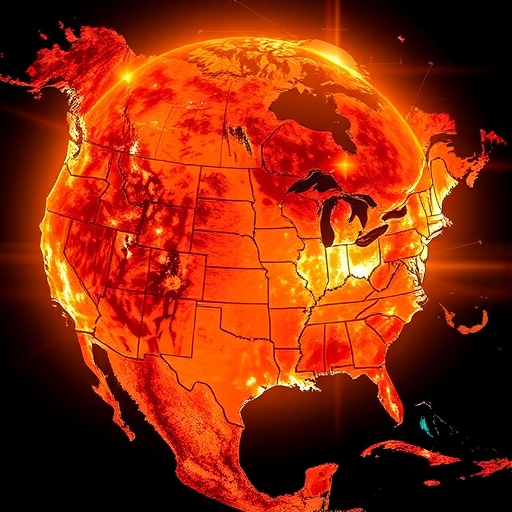
One of the most striking revelations from the study is the identification of specific geographies, such as the Rocky Mountains region in the western United States and Canada’s expansive Hudson Bay, where precipitation—both rainfall and snowfall—diminishes notably after significant solar storm impacts. This phenomenon exhibits seasonality as well, with major solar storms in the extremes of summer and winter catalyzing more pronounced precipitation suppression compared to those in spring or autumn, suggesting that atmospheric baseline conditions critically modulate the solar storm-weather coupling.
Beyond precipitation, the study also delved into other meteorological parameters. Variations in wind velocity, ambient temperature, surface radiation flux, and atmospheric pressure were observed, though these effects appeared more erratic and localized. Unlike the clear precipitation pattern, the fragmented data did not permit definitive inferences about how these other variables are influenced by solar storms on a broader scale. This underscores the intrinsic complexity and spatial heterogeneity of Earth’s atmospheric response mechanisms.
Unraveling the causal chain linking solar activity to weather alterations is a formidable scientific challenge due to the atmosphere’s turbulent and nonlinear nature. Yet, Raeder’s work offers compelling mechanistic hypotheses. Central to the discussion is the role of electromagnetic radiation emanating from solar flares penetrating Earth’s atmosphere, particularly via pathways connected to the Polar vortex—a vast, persistent cold low-pressure system encircling the polar regions. This vortex may act as a conduit enabling solar energetic photons and particles to influence lower-atmospheric dynamics, thereby facilitating rapid meteorological changes.
This emerging model contrasts with more conventional theories, such as the cosmic ray-cloud hypothesis, which posits that solar modulation of galactic cosmic rays affects cloud nucleation processes and thus indirectly impacts weather phenomena. Raeder’s findings suggest that direct electromagnetic forcing and interactions with the Polar vortex might constitute a more immediate and robust mechanism for the observed weather disruptions, opening new avenues for research into solar-terrestrial climate interactions.
The implications of this research extend far beyond academic interest. While daily weather forecasts will not yet incorporate solar storm data, understanding these solar-induced atmospheric perturbations promises to improve the fidelity of climate modeling and medium-term weather predictions once integrated into comprehensive simulation frameworks. Incorporating solar storm parameters into climate projections could unveil new dimensions of climate variability, especially in regions susceptible to these solar influences.
Moreover, this knowledge arrives at a critical geopolitical and technological juncture. Solar storms are known to disrupt satellite operations, power grids, and communication networks. Now, recognizing that they also have tangible effects on terrestrial weather conditions sharpens the urgency to develop integrated space-weather forecasting systems that not only safeguard infrastructure but also anticipate meteorological contingencies.
Future research inspired by this revelation will likely focus on refining the spatial and temporal mapping of solar storm impacts, discerning the exact physical pathways of solar influence, and evaluating the interaction between solar activity and atmospheric circulation patterns. Enhanced satellite missions and ground-based atmospheric monitoring, coupled with advanced computational models, will be instrumental in parsing out these complex interdependencies.
The University of New Hampshire’s study marks a seminal point in multidisciplinary climate and space weather science, bridging astrophysics, atmospheric sciences, and climatology. It invites the global scientific community to reassess the Sun’s role as a dynamic and influential actor in shaping Earth’s immediate weather, not just its long-term climate backdrop. The subtle dance of solar particles and photons with our planet’s atmospheric systems beckons a deeper exploration with profound scientific and societal dividends.
This research serves as a reminder that our star, the basis of all terrestrial life, is not merely a passive provider of energy but an active cosmic force continuously reshaping our environment. As humanity ventures further into the era of space exploration and technological dependence, grasping the nuanced impacts of solar activity on Earth will be essential for predicting and mitigating the complex challenges posed by our star’s volatility.
News Publication Date: June 23, 2026
Web References: https://agupubs.onlinelibrary.wiley.com/doi/10.1029/2025GL121097
References: University of New Hampshire press release, Geophysical Research Letters publication
Cite Scienmag News
Russell Cooper. (June 24, 2026). Solar Storms Could Disrupt Weather Patterns Across North America, Scientists Warn. Scienmag. https://scienmag.com/solar-storms-could-disrupt-weather-patterns-across-north-america-scientists-warn/
Russell Cooper. "Solar Storms Could Disrupt Weather Patterns Across North America, Scientists Warn." Scienmag, 24 June 2026, https://scienmag.com/solar-storms-could-disrupt-weather-patterns-across-north-america-scientists-warn/. Accessed 4 September 2026.
Russell Cooper. "Solar Storms Could Disrupt Weather Patterns Across North America, Scientists Warn." Scienmag. June 24, 2026. https://scienmag.com/solar-storms-could-disrupt-weather-patterns-across-north-america-scientists-warn/


