


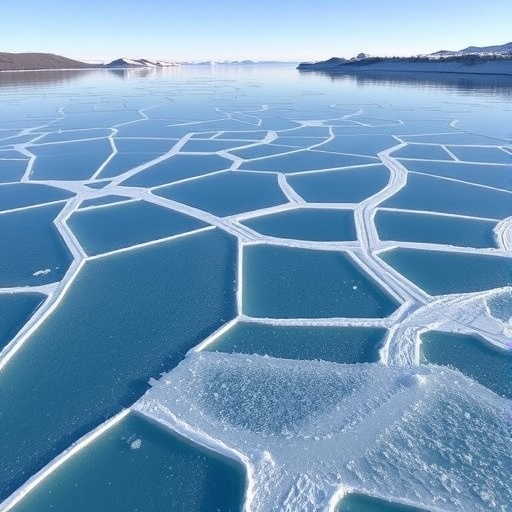
Qinghai Lake, China’s largest saline lake, continues to capture atmospheric carbon even when its surface is sealed beneath winter ice, according to a study published in Carbon Research. The research shows that microbial communities remain active during the frozen season and that dark-dependent carbon fixation—an array of biochemical processes that convert inorganic carbon into organic matter without relying directly on light—can account for most of the carbon assimilated beneath the ice. The findings challenge the assumption that winter largely suspends biological carbon processing in high-altitude saline lakes and suggest that frozen periods may play a more important role in annual carbon budgets than previously recognized.
The study, led by Xiaoyan Li of Beijing Normal University, examined microbial inorganic carbon fixation in Qinghai Lake on the Tibetan Plateau. The lake experiences prolonged ice cover, low temperatures, strong seasonal changes and high salinity, creating conditions that differ sharply from those in temperate freshwater systems. Although summer microbial productivity in open water has received considerable scientific attention, the under-ice environment remains comparatively poorly understood. During winter, snow and ice reduce the amount of sunlight reaching the water, while low temperatures alter nutrient availability, microbial metabolism and the composition of aquatic communities.
To measure carbon uptake, the researchers used a stable-isotope method based on ¹³C-bicarbonate. Bicarbonate is an inorganic form of carbon that microorganisms can incorporate into cellular material through carbon-fixation pathways. Water samples were collected on March 1, 2024, from three representative locations and several depths beneath the ice. The samples were incubated in situ for six hours in transparent and opaque bottles. Transparent bottles allowed researchers to estimate fixation occurring under available light, while opaque bottles provided an estimate of dark-dependent fixation. Geochemical measurements and microbial community analyses were conducted alongside the incubation experiments to connect carbon uptake with environmental conditions and the organisms present.
Across the sampled sites and depths, total microbial carbon fixation ranged from 4.92 to 13.09 micrograms of carbon per liter per hour. Dark-dependent fixation ranged from 2.82 to 9.21 micrograms of carbon per liter per hour, while light-dependent fixation ranged from 1.14 to 4.37 micrograms. On average, dark fixation contributed 61.06 ± 10.95 percent of total microbial carbon fixation. This result indicates that carbon assimilation beneath Qinghai Lake’s winter ice is not driven primarily by photosynthesis. Instead, microorganisms appear to rely substantially on chemical energy and other non-light-dependent metabolic routes to convert inorganic carbon into biomass.
Dark carbon fixation does not mean that microorganisms stop using energy; rather, it means that carbon incorporation is not directly powered by sunlight. Different groups of bacteria, archaea, algae and other microbes can use oxidation-reduction reactions involving compounds such as sulfur, nitrogen or hydrogen to generate the energy needed for carbon assimilation. In a saline lake, gradients in oxygen, nutrients, sulfate and nitrate can create multiple chemical niches. Even when light is weak or absent, these gradients may support microbial metabolism. The study’s measurements suggest that the under-ice water column provides enough chemical energy and biological activity to sustain a significant winter carbon-fixation signal.
The researchers also found contrasting depth patterns between the two pathways. Light-dependent carbon fixation increased with depth, whereas dark-dependent fixation declined. The pattern may appear counterintuitive because sunlight generally weakens as it travels through water. However, the authors interpret the result through an environment–microbe–function framework, in which depth-related changes in temperature, nutrients, suspended particles, water chemistry and microbial composition jointly influence activity. The measurements represent specific conditions beneath the ice rather than a universal rule for all seasons or lakes, but they reveal that carbon fixation is controlled by more than light availability alone.
Environmental correlations provided additional clues. Dark-dependent fixation was significantly associated with temperature and nitrate, while light-dependent fixation showed relationships with temperature, sulfate and chlorophyll a, a common indicator of photosynthetic biomass. The two pathways were also linked to different microbial genera. Dark fixation correlated with Nannochloropsis, Bacteroides, Pyramimonas, Tetracystis and Hemiselmis. Light fixation was associated with Leptolyngbya, Amphora, Navicula and Surirella. These associations do not by themselves prove that every listed genus directly carried out the measured fixation, but they point to possible ecological partitioning, with different microbial groups occupying distinct chemical and energetic niches under the ice.
The winter rates reported for Qinghai Lake were higher than those documented in many other ice-covered lakes, particularly several polar systems, although they were lower than the exceptionally high values observed in some alkaline saline lakes. The comparison places Qinghai Lake in an intermediate but environmentally significant position. Its winter microbial communities may therefore contribute meaningfully to the lake’s annual carbon balance, even though their activity is hidden beneath ice and is unlikely to be detected through conventional observations focused on open-water productivity. The findings also raise questions about whether carbon fixed in winter is retained as biomass, transferred through food webs, respired back to carbon dioxide or eventually buried in sediments.
The study has important limitations. Sampling was restricted to three sites and a single date, and dangerous ice conditions prevented access to deeper areas below approximately 15 meters. The sequencing analysis focused on cyanobacteria and phytoplankton rather than the full bacterioplankton community, leaving many potentially active microorganisms uncharacterized. Future studies will need repeated measurements throughout the entire ice season, broader spatial surveys, deeper sampling and experiments that identify the organisms directly responsible for dark and light carbon fixation. As climate change alters ice duration, snow cover, temperature and nutrient cycling on the Tibetan Plateau, understanding these hidden winter processes will become increasingly important for predicting whether saline lakes store more carbon, release more carbon dioxide or shift toward entirely different microbial regimes.
News Publication Date: 3-Aug-2026
Web References: https://doi.org/10.1007/s44246-026-00291-3
References: Han, Yixuan; Shi, Fangzhong; Liu, Xin; Wang, Zhigang; Wang, Rui; Li, Xiaoyan. “Microbial inorganic carbon fixation characteristics in the largest saline lake of China during the ice-covered period.” Carbon Research. DOI: 10.1007/s44246-026-00291-3.
Cite Scienmag News
Gavin Prescott. (August 4, 2026). Winter Ice at Qinghai Lake Captures Carbon, Scientists Find. Scienmag. https://scienmag.com/winter-ice-at-qinghai-lake-captures-carbon-scientists-find/
Gavin Prescott. "Winter Ice at Qinghai Lake Captures Carbon, Scientists Find." Scienmag, 4 August 2026, https://scienmag.com/winter-ice-at-qinghai-lake-captures-carbon-scientists-find/. Accessed 6 September 2026.
Gavin Prescott. "Winter Ice at Qinghai Lake Captures Carbon, Scientists Find." Scienmag. August 4, 2026. https://scienmag.com/winter-ice-at-qinghai-lake-captures-carbon-scientists-find/


