


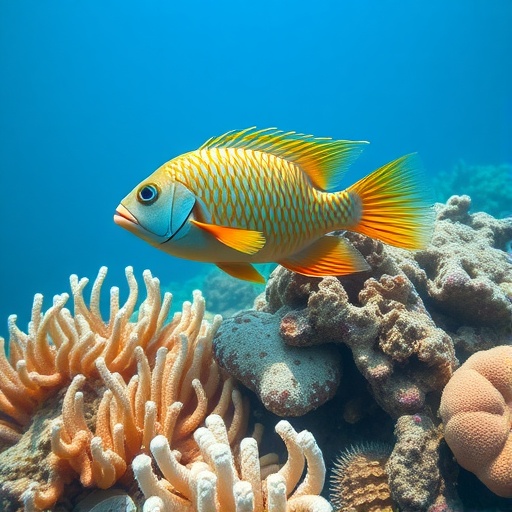
Juvenile parrotfish may be small, but the places they choose to feed could shape the future of Caribbean coral reefs. A new study conducted on patch reefs in the Florida Keys reveals that these young grazers concentrate their feeding activity on a remarkably small fraction of the reef, and that their decisions are governed by an intricate interplay between three-dimensional reef structure, visibility, and the ever-present threat of predators. The findings, published in the journal Coral Reefs, offer a finely detailed picture of how grazing—the ecological process that keeps reef-choking algae in check—actually unfolds on the seafloor, square meter by square meter.
Grazing by parrotfish has long been recognized as one of the most important drivers of coral reef resilience in the western Atlantic. By scraping and cropping macroalgae and algal turfs, these fish clear space for coral larvae to settle and grow, helping reefs recover after disturbances such as hurricanes, heat waves, and disease outbreaks. Yet most research on herbivory has been conducted at relatively coarse scales, comparing grazing between entire reefs or between broad habitat types. What happens within a single habitat patch—why a parrotfish bites in one spot and ignores another just a meter away—has remained largely mysterious. The new research, led by David P. Kochan of Florida International University and colleagues, set out to close that gap by tracking the movements and feeding of juvenile striped parrotfish, Scarus iseri, on six small patch reefs approximately eight kilometers southeast of Key Largo, Florida.
The methodological heart of the study is photogrammetry, a technique that converts thousands of overlapping underwater photographs into precise digital three-dimensional models. Divers swam over each patch reef in a systematic “lawnmower” pattern roughly 1.5 meters above the bottom, using paired GoPro Hero 4 cameras mounted 30 centimeters apart on a rigid frame. The cameras fired overlapping images every half second, capturing between 4,000 and 6,000 photographs per reef. Specialized software then stitched these images into digital elevation models and orthomosaics with a resolution of one millimeter. From these virtual reefs, the researchers extracted fine-scale habitat metrics at approximately one-square-meter resolution, including total surface area, three-dimensional grazeable surface area, maximum structural height, and a novel measure called viewshed—the proportion of the surrounding seafloor visible from a given point, given the obstructing structure around it.
Viewshed proved to be a conceptually powerful addition to the ecologist’s toolkit. Reef fish rely heavily on visual information to detect approaching predators, and a large field of view can be a lifesaver. But visibility cuts both ways: open areas with high viewsheds offer little in the way of shelter, and predators can spot prey from greater distances. Structural complexity, by contrast, provides crevices and refuges but blocks sightlines. By quantifying both dimensions simultaneously, the researchers could test how juvenile parrotfish navigate this trade-off in real time.
To observe the fish themselves, divers conducted roughly 80 five-minute follows of individual juvenile S. iseri per reef, recording every bite and mapping the fish’s location onto a grid of one-square-meter cells marked out with twine and sand pegs. Because a single five-minute follow touches only a tiny fraction of a reef’s cells, the data were overwhelmingly zero-inflated—most cells saw no fish at all. The team addressed this with hurdle models, a two-part statistical framework that first models whether a cell is used or grazed at all, using a binomial distribution with a complementary log–log link, and then models the intensity of use or grazing when it occurs, using a truncated negative binomial distribution. Spatial autocorrelation among neighboring cells was explicitly accounted for, and reef identity was treated as a random effect. The models also incorporated observations of predators, including the graysby Cephalopholis cruentata, which divers followed for repeated hour-long sessions, as well as camera-derived abundance estimates of transient predators such as barracuda and grouper.
The results were striking. Three-quarters of all observed space use occurred in just 24 percent of the reef cells, and three-quarters of all grazing was packed into just under 22 percent of cells. Far from being uniformly distributed, the ecological work of these small grazers was concentrated in scattered hotspots across the reef. Grazing rates averaged 24.5 bites per minute per individual, and with roughly 45 juvenile parrotfish resident on each reef, the cumulative effect on small algal turfs could be substantial—particularly relevant because these turfs are the precursors to long sediment-laden algal turfs, a troublesome substrate type that inhibits coral recruitment and has been expanding across Florida’s reefs.
Perhaps the most interesting pattern involved the interaction between viewshed and maximum structural height. Cells that combined both high visibility and tall structure were used and grazed far more than their individual features would predict, while cells with both low visibility and low height were avoided. Intriguingly, the most heavily used areas tended to lie along the edges of the patch reefs rather than in the most structurally complex centers. The explanation, the authors suggest, lies in the trade-off between refuge and information: complex central areas offer abundant shelter but severely restrict what a fish can see, whereas edge habitats balance both needs. Areas with expansive viewsheds but no nearby structure were among the least favored, presumably because a prey fish there can be seen just as easily as it can see.
Predation risk left its fingerprints throughout the data. Grazing intensity decreased in the presence of transient apex predators such as barracuda and large grouper, which threaten the smaller mesopredators that prey on juvenile parrotfish. Group size also mattered: fish swimming in groups spread their space use more thinly across the reef and grazed less intensely in any single cell, consistent with the theory that schooling dilutes individual predation risk and allows members to share the burden of vigilance. Field observations suggested that only a small portion of a group feeds at any moment while the rest watch for danger—an elegant division of labor made possible by collective behavior. Larger juveniles, meanwhile, bit more frequently than smaller ones, hinting that body size shapes foraging capacity even within this narrow life stage.
The study carries sobering implications for reefs that are losing their structure. Caribbean reefs have undergone widespread flattening over recent decades as coral cover has declined, and the new findings suggest that such structural loss will not simply reduce the number of grazing fish; it will redistribute where grazing happens. If the fine-scale mosaics of refuge and visibility that currently concentrate grazing are erased, algae may escape cropping in places where corals most need relief. At the same time, the results offer practical guidance for restoration. Managers who outplant corals or deploy artificial structures could, in principle, design habitat that preserves sightlines while providing shelter—for example, adding structure that does not block viewsheds in areas of heavy algal growth—thereby encouraging grazers to work exactly where their services are most needed.
The research also underscores how much ecological function hides below the resolution of traditional surveys. Chain-and-tape measures of rugosity, the standard for decades, collapse a reef’s three-dimensional heterogeneity into a single number and miss features such as crevices, overhangs, and flexible gorgonians that divers had to count separately. As photogrammetry becomes faster and cheaper, and as emerging AI-powered video tracking promises even finer maps of fish behavior, the fine-scale geography of ecosystem functions like grazing is becoming visible for the first time. What this study reveals is that a reef is not a uniform lawn tended evenly by its grazers, but a shifting landscape of risky and safe, productive and barren patches—a “reefscape of fear” within which even a ten-centimeter fish makes consequential decisions, bite by bite.
Cite Scienmag News
Violet Maxwell. (September 5, 2026). What shapes where juvenile parrotfish graze on Atlantic reefs. Scienmag. https://scienmag.com/what-shapes-where-juvenile-parrotfish-graze-on-atlantic-reefs/
Violet Maxwell. "What shapes where juvenile parrotfish graze on Atlantic reefs." Scienmag, 5 September 2026, https://scienmag.com/what-shapes-where-juvenile-parrotfish-graze-on-atlantic-reefs/. Accessed 5 September 2026.
Violet Maxwell. "What shapes where juvenile parrotfish graze on Atlantic reefs." Scienmag. September 5, 2026. https://scienmag.com/what-shapes-where-juvenile-parrotfish-graze-on-atlantic-reefs/


