


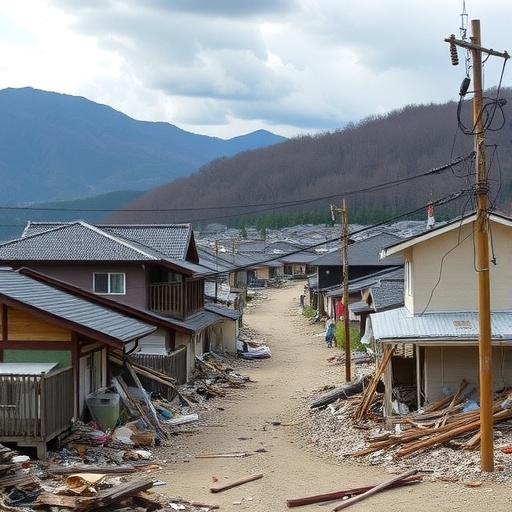
Japan’s 2011 triple disaster—earthquake, tsunami, and the ensuing nuclear crisis—triggered a wave of population displacement that planners and policymakers continue to analyze for lessons on recovery. A new study in Communications Earth & Environment argues that how people left and whether they returned was shaped less by the scale of reconstruction spending than by deeper, structural conditions in the affected communities. The work reframes the usual narrative: investment matters, but it cannot substitute for the underlying systems that determine long-term liveability and safety perceptions.
Researchers led by T. Yoshida and D. P. Aldrich examine post-disaster depopulation in Japan by linking demographic trends to the built and institutional environment after 2011. Rather than treating reconstruction as a single lever, the study evaluates how spatial organization, housing availability, employment pathways, and governance capacity interact to influence residents’ decisions over time. In other words, the “choice to come back” is modeled as an outcome of constraints, not only incentives.
A key finding is that structural factors—such as the arrangement of housing and infrastructure, local economic opportunities, and the credibility and continuity of administrative arrangements—correlate more strongly with long-term population decline than measures of reconstruction investment alone. Large projects may rebuild physical assets, but if community networks and daily routines do not stabilize, return migration remains limited. The paper emphasizes that depopulation can accelerate when reconstruction does not restore the social and economic functions that make places sustainable.
The study also highlights the role of risk communication and perceived safety. Even when physical rebuilding progresses, uncertainty about environmental conditions and future hazards can suppress household formation and discourage relocation back into the area. This effect can become self-reinforcing: fewer residents reduce local services, which further worsens conditions for those considering return.
Methodologically, the authors use comparative analysis across affected regions and focus on the interplay between demographic outcomes and post-disaster rebuilding dynamics. The analysis distinguishes short-term displacement from longer-term depopulation, a distinction that policymakers often compress, potentially obscuring which interventions actually change trajectories.
For governments planning future recovery, the message is cautionary and practical. Reconstruction budgets should be paired with interventions that directly target structural livability: employment creation, accessible and stable housing arrangements, resilient local services, and transparent administrative pathways. The study suggests that communities recover best when people can see continuity—both economically and institutionally—rather than temporary construction milestones.
In a viral-science-news takeaway, the findings make a clear claim with policy implications: depopulation after disasters is not simply an accounting problem solved by spending. It is a systems problem, where rebuilding must reconnect infrastructure, institutions, and livelihoods to restore the everyday conditions that make people stay.
Cite Scienmag News
Violet Maxwell. (July 27, 2026). Structural Factors, Not Reconstruction Spending, Drove Depopulation After Japan’s 2011 Disasters. Scienmag. https://scienmag.com/structural-factors-not-reconstruction-spending-drove-depopulation-after-japans-2011-disasters/
Violet Maxwell. "Structural Factors, Not Reconstruction Spending, Drove Depopulation After Japan’s 2011 Disasters." Scienmag, 27 July 2026, https://scienmag.com/structural-factors-not-reconstruction-spending-drove-depopulation-after-japans-2011-disasters/. Accessed 4 September 2026.
Violet Maxwell. "Structural Factors, Not Reconstruction Spending, Drove Depopulation After Japan’s 2011 Disasters." Scienmag. July 27, 2026. https://scienmag.com/structural-factors-not-reconstruction-spending-drove-depopulation-after-japans-2011-disasters/


