

Monday, July 27, 2026
Science
No Result
View All Result
  • Login
  • HOME
  • SCIENCE NEWS
  • CONTACT US
  • HOME
  • SCIENCE NEWS
  • CONTACT US
No Result
View All Result
Scienmag
No Result
View All Result
Home Science News Medicine

Study Finds Falls Risk Perception Influenced by Multiple Factors in Elderly Hip Fracture Patients

July 27, 2026
in Medicine
Reading Time: 2 mins read
0
Study Finds Falls Risk Perception Influenced by Multiple Factors in Elderly Hip Fracture Patients

Study Finds Falls Risk Perception Influenced by Multiple Factors in Elderly Hip Fracture Patients

65
SHARES
587
VIEWS
Share on FacebookShare on Twitter
ADVERTISEMENT

A new cross-sectional study published in BMC Geriatrics sheds light on how older adults with hip fractures perceive their risk of falling—and which factors shape those perceptions. The research, led by Du, Wang, Song, and colleagues, focuses on a population that is already medically vulnerable after hip injury, where falls can rapidly worsen outcomes and threaten independence.

Using a study design that captures data at a single point in time, the authors examined falls risk perception alongside potential influencing variables. This approach helps clarify patterns in how perception aligns with clinical realities, even though it cannot establish causality.

Participants were elderly patients recovering from hip fracture, a group known for elevated fall incidence due to impaired mobility, pain, muscle weakness, and changes in balance. The researchers highlight that “risk perception” is not merely a subjective viewpoint; it can influence adherence to protective behaviors such as using assistive devices, participating in physiotherapy, and following safety recommendations at home.

The analysis emphasizes that falls risk perception may be shaped by multiple domains. These include personal and demographic characteristics, health status, and the extent of functional limitation after the fracture. In clinical terms, the study suggests that risk understanding is likely intertwined with physical capability and perceived ability to navigate daily activities safely.

Importantly, the team notes that inaccurate or underinformed perception could reduce engagement with fall-prevention strategies. Conversely, heightened awareness without practical guidance may create anxiety or maladaptive behavior, underscoring the need for balanced communication.

From a technical perspective, the study’s cross-sectional framework supports identifying associations between variables and perceived risk. The findings can inform targeted risk-communication interventions, especially when clinicians discuss recovery progress and safety planning.

With the DOI-linked publication appearing in 2026, the work adds to a growing evidence base on fall-prevention psychology in geriatric care. It also raises an actionable question for healthcare teams: Are patients’ fall-risk beliefs being assessed and aligned with individualized rehabilitation plans?

Ultimately, by mapping the factors that influence perceived fall risk in hip fracture patients, the study offers a pathway toward more responsive interventions—potentially improving adherence to preventive behaviors during a critical recovery window.

Subject of Research: Falls risk perception and its influencing factors in elderly hip fracture patients.

Article Title: Falls risk perception and its influencing factors in elderly patients with hip fracture: a cross-sectional study.

Article References: Du, Y., Wang, C., Song, R. et al. Falls risk perception and its influencing factors in elderly patients with hip fracture: a cross-sectional study. BMC Geriatr (2026). https://doi.org/10.1186/s12877-026-08030-4

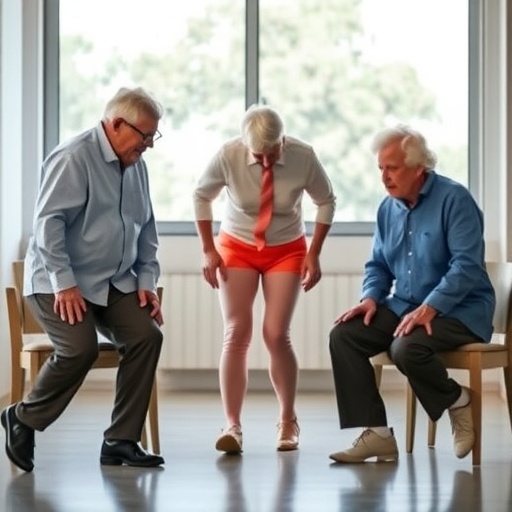
Image Credits: AI Generated

DOI: https://doi.org/10.1186/s12877-026-08030-4

Tags: assessing fall risk perception in geriatric rehabilitationclinical implications for fall prevention in elderlycross-sectional study on fall risk perceptioneffects of mobility impairment after hip fractureelderly hip fracture patientsfactors affecting safety behavior adherence in older adultsfactors influencing fall risk perceptionFalls risk perceptionimpact of demographic and health variables on fall perceptionimportance of patient education on fall risksinfluence on adherence to fall prevention strategiesrole of functional limitations in falls risksubjective versus objective fall risk assessment
Share26Tweet16
Previous Post

GC-MS Method Developed and Validated to Measure Ethylene and Diethylene Glycols

Next Post

Structural Factors, Not Reconstruction Spending, Drove Depopulation After Japan’s 2011 Disasters

Related Posts

Taiwan Develops High-Resolution PM2.5 Model Using Low-Cost Sensors and Satellites
Medicine

Taiwan Develops High-Resolution PM2.5 Model Using Low-Cost Sensors and Satellites

July 27, 2026
Blood metabolomics reveals responses to deep brain stimulation in Parkinson’s disease
Medicine

Blood metabolomics reveals responses to deep brain stimulation in Parkinson’s disease

July 27, 2026
GC-MS Method Developed and Validated to Measure Ethylene and Diethylene Glycols
Medicine

GC-MS Method Developed and Validated to Measure Ethylene and Diethylene Glycols

July 27, 2026
Lipid-Shelled Nanobubble Ultrasound Agents: Formulation and Activation Study
Medicine

Lipid-Shelled Nanobubble Ultrasound Agents: Formulation and Activation Study

July 27, 2026
Land Degradation Linked to Wider Crop Yield Gaps Across Global Croplands
Medicine

Land Degradation Linked to Wider Crop Yield Gaps Across Global Croplands

July 27, 2026
CLEAR Builds Auditable Radiology Foundation Model Based on Clinical Concepts
Medicine

CLEAR Builds Auditable Radiology Foundation Model Based on Clinical Concepts

July 27, 2026
Next Post
Structural Factors, Not Reconstruction Spending, Drove Depopulation After Japan’s 2011 Disasters

Structural Factors, Not Reconstruction Spending, Drove Depopulation After Japan’s 2011 Disasters

  • Mothers who receive childcare support from maternal grandparents show more

    Mothers who receive childcare support from maternal grandparents show more parental warmth, finds NTU Singapore study

    27656 shares
    Share 11059 Tweet 6912
  • University of Seville Breaks 120-Year-Old Mystery, Revises a Key Einstein Concept

    1061 shares
    Share 424 Tweet 265
  • Bee body mass, pathogens and local climate influence heat tolerance

    682 shares
    Share 273 Tweet 171
  • Researchers record first-ever images and data of a shark experiencing a boat strike

    546 shares
    Share 218 Tweet 137
  • Groundbreaking Clinical Trial Reveals Lubiprostone Enhances Kidney Function

    531 shares
    Share 212 Tweet 133
Science

Embark on a thrilling journey of discovery with Scienmag.com—your ultimate source for cutting-edge breakthroughs. Immerse yourself in a world where curiosity knows no limits and tomorrow’s possibilities become today’s reality!

RECENT NEWS

  • Taiwan Develops High-Resolution PM2.5 Model Using Low-Cost Sensors and Satellites
  • Uber and Lyft’s Impact on Jobs, Wages, and Economic Growth
  • Urban Mobile Green Perception Varies With Visibility and Surrounding Green Context
  • Blood metabolomics reveals responses to deep brain stimulation in Parkinson’s disease

Categories

  • Agriculture
  • Anthropology
  • Archaeology
  • Athmospheric
  • Biology
  • Biotechnology
  • Blog
  • Bussines
  • Cancer
  • Chemistry
  • Climate
  • Earth Science
  • Editorial Policy
  • Marine
  • Mathematics
  • Medicine
  • Pediatry
  • Policy
  • Psychology & Psychiatry
  • Science Education
  • Social Science
  • Space
  • Technology and Engineering

Subscribe to Blog via Email

Enter your email address to subscribe to this blog and receive notifications of new posts by email.

Join 5,146 other subscribers

© 2025 Scienmag - Science Magazine

Welcome Back!

Login to your account below

Forgotten Password?

Retrieve your password

Please enter your username or email address to reset your password.

Log In
No Result
View All Result
  • HOME
  • SCIENCE NEWS
  • CONTACT US

© 2025 Scienmag - Science Magazine

Discover more from Science

Subscribe now to keep reading and get access to the full archive.

Continue reading
