


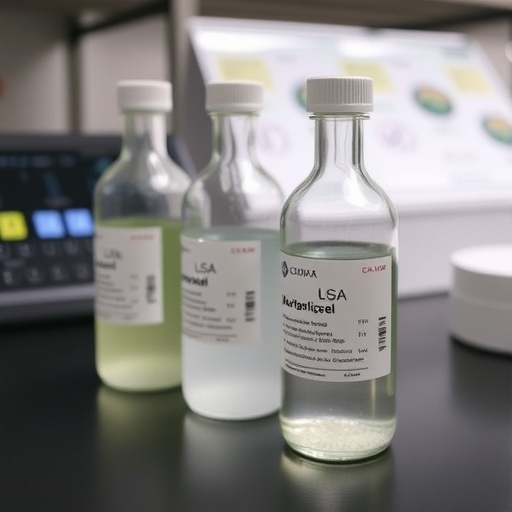
A new analytical chemistry study is bringing sharper tools to a problem that can be medically serious: trace contamination by ethylene glycol and diethylene glycol in pharmaceutical syrups. In a paper published in BMC Pharmacology and Toxicology, researchers report the development and validation of a gas chromatography–mass spectrometry (GC–MS) method designed specifically to detect these two related compounds in complex, over-the-counter and prescription liquid formulations.
The work focuses on building a workflow that can separate glycol contaminants from the many non-volatile ingredients found in syrups. By coupling chromatographic separation with mass spectral identification, the method aims to distinguish target analytes even when the sample matrix is chemically crowded. Such selectivity is crucial for reliable decisions in quality control and safety assessments.
Validation is the centerpiece of the research. The team evaluated performance characteristics that regulators and laboratories rely on, including accuracy (how close measured values are to true concentrations), precision (repeatability across runs), and linearity (whether instrument response scales predictably with analyte concentration). These metrics help determine whether the method is trustworthy across the range relevant to screening and compliance testing.
Sensitivity also matters because glycol contaminants may appear at low levels. The authors describe how the GC–MS setup supports detection at concentrations appropriate for safety-oriented monitoring, while maintaining a balance between signal strength and background suppression from syrup components. In practical terms, the method is tuned to avoid false positives caused by matrix-derived peaks.
A further consideration is robustness—the ability to tolerate normal variations during routine testing. Validated chromatographic methods typically include checks that retention times remain stable and that identification criteria hold under day-to-day conditions. This reduces uncertainty when large numbers of samples are processed.
Importantly, the study targets two glycols with similar chemical features, a scenario that can challenge both separation and spectral interpretation. The reported approach demonstrates that GC–MS can resolve these analytes and confirm their identities using mass fragmentation patterns rather than relying on chromatography alone.
For pharmaceutical manufacturers, the implications are clear: faster, more defensible screening of potential contaminants in syrups could strengthen routine quality assurance. For analytical labs, the method offers a documented route to reproducible results that can support regulatory-facing documentation.
Overall, the research represents a targeted advancement in method development, aligning advanced instrumentation with validation practices that make analytical findings actionable in real-world quality control.
Cite Scienmag News
Ophelia Keating. (July 27, 2026). GC-MS Method Developed and Validated to Measure Ethylene and Diethylene Glycols. Scienmag. https://scienmag.com/gc-ms-method-developed-and-validated-to-measure-ethylene-and-diethylene-glycols/
Ophelia Keating. "GC-MS Method Developed and Validated to Measure Ethylene and Diethylene Glycols." Scienmag, 27 July 2026, https://scienmag.com/gc-ms-method-developed-and-validated-to-measure-ethylene-and-diethylene-glycols/. Accessed 3 September 2026.
Ophelia Keating. "GC-MS Method Developed and Validated to Measure Ethylene and Diethylene Glycols." Scienmag. July 27, 2026. https://scienmag.com/gc-ms-method-developed-and-validated-to-measure-ethylene-and-diethylene-glycols/


