


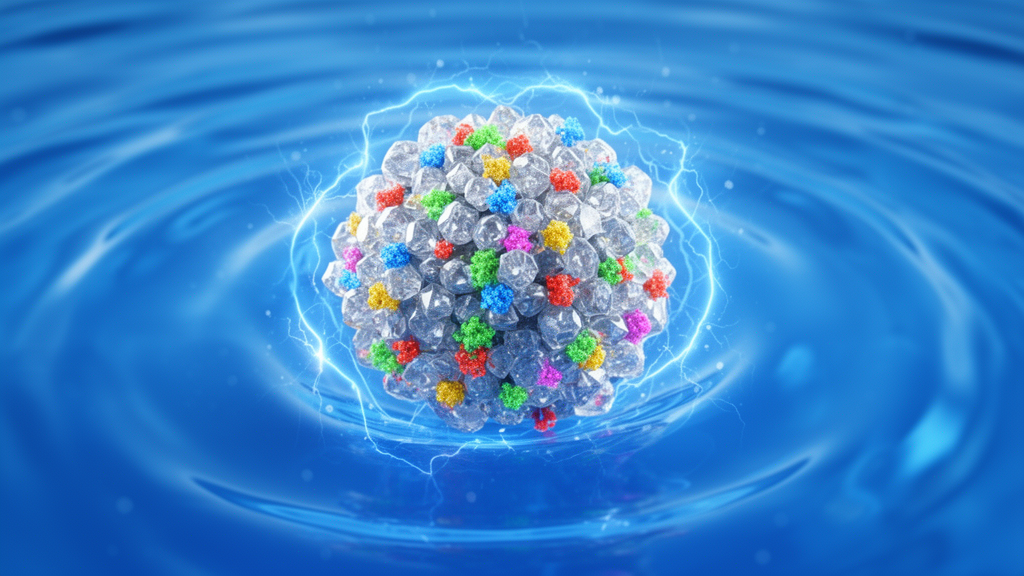
Researchers have synthesized strontium divanadate (SrV2O6) nanoparticles through a sol–gel method and reported that the material performs well in two demanding roles at once: storing electrical charge in supercapacitors and breaking down organic dye pollutants under light irradiation. The study, published in the journal Ionics, describes a pure crystalline structure with a uniform elemental distribution across the nanoparticles, a combination the authors identify as the foundation for the material's dual functionality. According to the study, the sol–gel preparation yielded nanoparticles with this uniform elemental distribution, giving the team a well-defined material to test in both electrochemical and photocatalytic measurements.
On the energy storage side, the nanoparticles delivered high specific capacitance together with good rate capability, meaning the material retained its charge-storage performance as the operating conditions became more demanding. The authors characterize the overall energy and power densities as moderate, positioning the compound as a candidate rather than a finished electrode material. Two headline figures stand out from the electrochemical testing.
The measured energy density reached a maximum of 3.14 Wh/kg, while the power density reached 1046 W/kg. The authors highlight the power figure in particular as evidence of the material's potential for high-power energy storage devices. The optical and electronic properties underpin the second application.
SrV2O6 exhibited a band gap of 2.16 eV, which the study links to good light absorption and semiconducting behaviour. When illuminated, the material generated reactive oxygen species efficiently, and these reactive species, combined with favourable surface interactions, drove the photocatalytic degradation of two common organic dyes. Efficient charge separation within the semiconductor is cited as the mechanism that keeps the reactive species production going.
The degradation results were substantial in the laboratory tests. The nanoparticles degraded 90 percent of methylene blue and 94 percent of brilliant green under light irradiation, performance the authors attribute to the reactive oxygen species generation and the favourable surface interactions between the dye molecules and the nanoparticle surfaces. The findings are measured observations from a laboratory study of the synthesized nanoparticles, not demonstrations in operating devices or field-scale water treatment.
The abstract itself flags two practical limitations: relatively poor electrical conductivity and particle agglomeration. To push the electrochemical performance further, the authors point to controlling the particle morphology and minimizing agglomeration as promising strategies. Within the scope of the reported results, SrV2O6 emerges as a promising multifunctional material for both energy storage and environmental remediation applications, with the caveat that overcoming its conductivity and aggregation limits will determine whether that promise survives outside the synthesis laboratory.
Subject of Research: Sol–gel synthesized SrV2O6 nanoparticles for supercapacitor energy storage and photocatalytic dye degradation
Article Title: SrV2O6 nanoparticles for supercapacitor and photocatalytic applications toward sustainable energy and environmental remediation
Article References: Srinivasan, N. K., Anbuselvan, S., Selvakumar, P., & Ganesan, S. (2026). SrV2O6 nanoparticles for supercapacitor and photocatalytic applications toward sustainable energy and environmental remediation. Ionics. https://doi.org/10.1007/s11581-026-07583-z
Image Credits: AI Generated
DOI: 10.1007/s11581-026-07583-z
Keywords: SrV2O6, nanoparticles, supercapacitor, photocatalysis, sol-gel method, methylene blue, brilliant green, energy density, band gap, environmental remediation, photocatalytic, applications
Cite Scienmag News
Faith Mcneil. (October 24, 2026). Strontium Vanadate Nanoparticles Show Dual Promise for Energy Storage and Dye Cleanup. Scienmag. https://scienmag.com/strontium-vanadate-nanoparticles-show-dual-promise-for-energy-storage-and-dye-cleanup/
Faith Mcneil. "Strontium Vanadate Nanoparticles Show Dual Promise for Energy Storage and Dye Cleanup." Scienmag, 24 October 2026, https://scienmag.com/strontium-vanadate-nanoparticles-show-dual-promise-for-energy-storage-and-dye-cleanup/. Accessed 24 October 2026.
Faith Mcneil. "Strontium Vanadate Nanoparticles Show Dual Promise for Energy Storage and Dye Cleanup." Scienmag. October 24, 2026. https://scienmag.com/strontium-vanadate-nanoparticles-show-dual-promise-for-energy-storage-and-dye-cleanup/


