

Monday, November 16, 2026
Science
No Result
View All Result
  • Login
  • HOME
  • SCIENCE NEWS
  • CONTACT US
  • HOME
  • SCIENCE NEWS
  • CONTACT US
No Result
View All Result
Scienmag
No Result
View All Result
Home Science News Technology and Engineering

Flicker Light Test and Machine Learning Estimate Age from Retinal Vessels

October 24, 2026
in Technology and Engineering
Blake Davidson
By Blake Davidson Scienmag Editorial Profile - Data Science
Reading Time: 3 mins read
0
Flicker Light Test and Machine Learning Estimate Age from Retinal Vessels

Flicker Light Test and Machine Learning Estimate Age from Retinal Vessels

65
SHARES
587
VIEWS
Share on FacebookShare on Twitter
ADVERTISEMENT

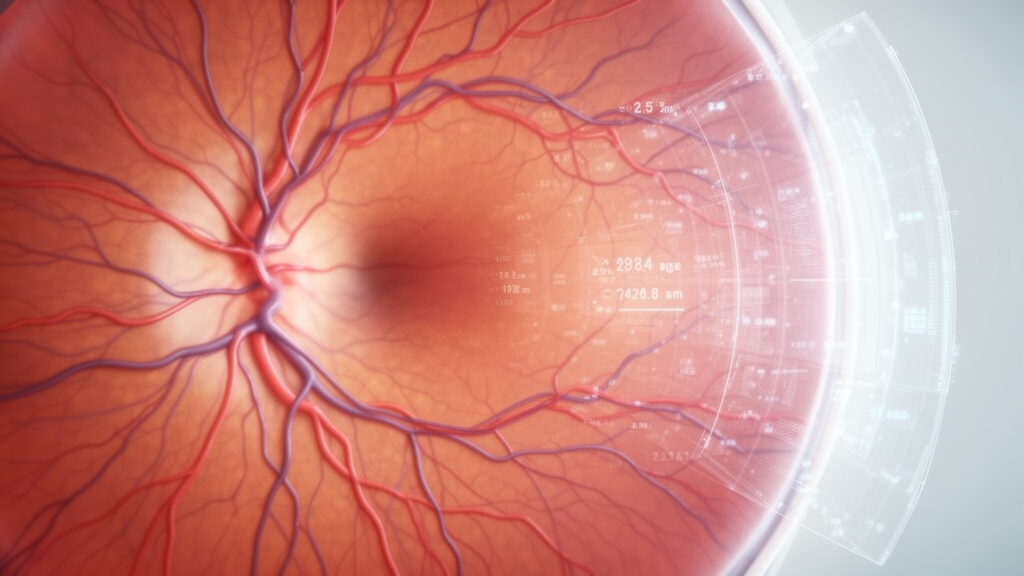
Researchers have reported a new, non-invasive way to estimate a person’s chronological age: measuring how the blood vessels at the back of the eye respond to flickering light, then feeding those dynamic responses into a machine learning model. The study, published as an open-access article in Scientific Reports, is presented by its authors as the first demonstration that retinal vascular reactivity can serve as a functional biomarker for estimating chronological age.

The approach centers on the retinal arteries and veins, whose diameters change when the retina is stimulated with flicker light. Rather than relying on a single static measurement, the team captured vessel diameter changes across three flicker cycles, building a time series that describes how each vessel reacts, recovers, and reacts again. These dynamic patterns of vascular function formed the raw material for age prediction.

Several machine learning and deep learning models were trained and compared on this task. The best-performing model was the Extra Trees Regressor, an ensemble method that builds many decision trees on randomized splits of the data and averages their outputs. When applied to the flicker-induced vessel reactivity signals, it achieved a mean absolute error of 9.3 years, a root mean squared error of 12.4, and a mean absolute percentage error of 17.7 percent.

The authors describe this level of performance as demonstrating acceptable reliability and accuracy for a first demonstration of the concept. A mean absolute error of 9.3 years means that, on average, the model’s age estimate deviated from a person’s true chronological age by that margin.

Beyond raw prediction accuracy, the study addressed the question of interpretability. The researchers applied Local Interpretable Model-agnostic Explanations, known as LIME, to their time series age estimation model. According to the authors, this provided valuable insights into the key features influencing the predictions, revealing which aspects of the vessel response patterns carried the most weight in the model’s age estimates.

The team frames the work as a contribution to personalized anti-aging medicine, arguing that individualized insights into aging could come from accessible and reliable tools for assessing chronological age. Because the measurement relies on non-invasive dynamic vessel response recordings, the authors position the method as offering a unique contribution compared to existing techniques.

The article was published on 22 October 2026 and is being shared early to provide faster access to peer-reviewed, accepted research. The publisher notes that this version is citable and carries a permanent DOI, but remains subject to further edits and will be replaced automatically by the final Version of Record.

By establishing that flicker-induced retinal vascular reactivity can be translated into an age estimate by machine learning, the authors say the study provides a foundation for future research on non-invasive markers of aging.

Subject of Research: Estimating chronological age from flicker-induced retinal vascular reactivity using machine learning

Article Title: Estimating chronological age from flicker-induced retinal vascular reactivity: a machine learning approach

Article References: Assaf, A., Alsaify, B. A., AlJarrah, O. Y., Li, S., Schmidt-Trucksaess, A., Kilani, A., Kotliar, K., & Lanzl, I. (2026). Estimating chronological age from flicker-induced retinal vascular reactivity: a machine learning approach. Scientific Reports, 16(1), Article 33453. https://doi.org/10.1038/s41598-026-75953-8

Image Credits: AI Generated

DOI: 10.1038/s41598-026-75953-8

Keywords: retinal vessels, chronological age, machine learning, Extra Trees Regressor, flicker stimulation, vascular reactivity, biomarker of aging, LIME interpretability, Scientific Reports, non-invasive measurement, Estimating, chronological

Cite Scienmag News

Blake Davidson. (October 24, 2026). Flicker Light Test and Machine Learning Estimate Age from Retinal Vessels. Scienmag. https://scienmag.com/flicker-light-test-and-machine-learning-estimate-age-from-retinal-vessels/

Blake Davidson. "Flicker Light Test and Machine Learning Estimate Age from Retinal Vessels." Scienmag, 24 October 2026, https://scienmag.com/flicker-light-test-and-machine-learning-estimate-age-from-retinal-vessels/. Accessed 16 November 2026.

Blake Davidson. "Flicker Light Test and Machine Learning Estimate Age from Retinal Vessels." Scienmag. October 24, 2026. https://scienmag.com/flicker-light-test-and-machine-learning-estimate-age-from-retinal-vessels/

Tags: age estimation using retinal imagingbiomarker of agingblood vessel response to flicker lightChronologicalchronological agedeep learning for retinal analysisdynamic vessel diameter measurementensemble machine learning modelsestimatingExtra Trees Regressorflicker light responseflicker stimulationLIME interpretabilityMachine learningmachine learning age predictionnon-invasive age estimationnon-invasive measurementopen-access scientific researchretinal artery and vein analysisretinal vascular biomarkerretinal vessel reactivityretinal vesselsScientific Reportsvascular reactivity
Share26Tweet16
Previous Post

Study finds no link between physical activity and quality of life in Riyadh university

Next Post

Neural network predicts three-year local recurrence after lung SBRT with higher accuracy than standard models

Related Posts

Review Assesses Three-Dimensional Printed Lattice Structures for Advanced Functional Wearables
Technology and Engineering

Review Assesses Three-Dimensional Printed Lattice Structures for Advanced Functional Wearables

November 16, 2026
Machine Learning Enhances Genomic Association Studies but Faces Key Interpretability Hurdles
Biotechnology

Machine Learning Enhances Genomic Association Studies but Faces Key Interpretability Hurdles

November 16, 2026
Machine Learning Drones Advance Predictive Surface Quality Management in Industry
Chemistry

Machine Learning Drones Advance Predictive Surface Quality Management in Industry

November 16, 2026
New Selection Framework Standardizes Sensor Deployment for Structural Health Monitoring
Technology and Engineering

New Selection Framework Standardizes Sensor Deployment for Structural Health Monitoring

November 16, 2026
Tetra-Hybrid Nanofluid Flow Over Vertical Cylinder Enhances Heat Transfer Performance
Technology and Engineering

Tetra-Hybrid Nanofluid Flow Over Vertical Cylinder Enhances Heat Transfer Performance

November 16, 2026
Harmony Search Tuning Boosts Convolutional Network Intrusion Detection Accuracy to 97.5 Percent
Technology and Engineering

Harmony Search Tuning Boosts Convolutional Network Intrusion Detection Accuracy to 97.5 Percent

November 16, 2026
Next Post
Neural network predicts three-year local recurrence after lung SBRT with higher accuracy than standard models

Neural network predicts three-year local recurrence after lung SBRT with higher accuracy than standard models

  • Mothers who receive childcare support from maternal grandparents show more optimized

    Mothers who receive childcare support from maternal grandparents show more parental warmth, finds NTU Singapore study

    27656 shares
    Share 11059 Tweet 6912
  • University of Seville Breaks 120-Year-Old Mystery, Revises a Key Einstein Concept

    1061 shares
    Share 424 Tweet 265
  • Bee body mass, pathogens and local climate influence heat tolerance

    682 shares
    Share 273 Tweet 171
  • Researchers record first-ever images and data of a shark experiencing a boat strike

    546 shares
    Share 218 Tweet 137
  • Groundbreaking Clinical Trial Reveals Lubiprostone Enhances Kidney Function

    531 shares
    Share 212 Tweet 133
Science

Embark on a thrilling journey of discovery with Scienmag.com—your ultimate source for cutting-edge breakthroughs. Immerse yourself in a world where curiosity knows no limits and tomorrow’s possibilities become today’s reality!

RECENT NEWS

  • Mycoplasma Antibodies Persist for Months, Varying by Age
  • Review Assesses Three-Dimensional Printed Lattice Structures for Advanced Functional Wearables
  • Machine Learning Enhances Genomic Association Studies but Faces Key Interpretability Hurdles
  • Ecological Information Increases Swedish Support for Selective Post-Fire Logging

Categories

  • Agriculture
  • Anthropology
  • Archaeology
  • Athmospheric
  • Biology
  • Biotechnology
  • Blog
  • Bussines
  • Cancer
  • Chemistry
  • Climate
  • Earth Science
  • Editorial Policy
  • Marine
  • Mathematics
  • Medicine
  • Pediatry
  • Policy
  • Psychology & Psychiatry
  • Science Education
  • Science News
  • Social Science
  • Space
  • Technology and Engineering

Subscribe to Blog via Email

Enter your email address to subscribe to this blog and receive notifications of new posts by email.

Join 5,150 other subscribers

© 2026 Scienmag - Science Magazine

Welcome Back!

Login to your account below

Forgotten Password?

Retrieve your password

Please enter your username or email address to reset your password.

Log In
No Result
View All Result
  • HOME
  • SCIENCE NEWS
  • CONTACT US

© 2026 Scienmag - Science Magazine

Discover more from Science

Subscribe now to keep reading and get access to the full archive.

Continue reading

