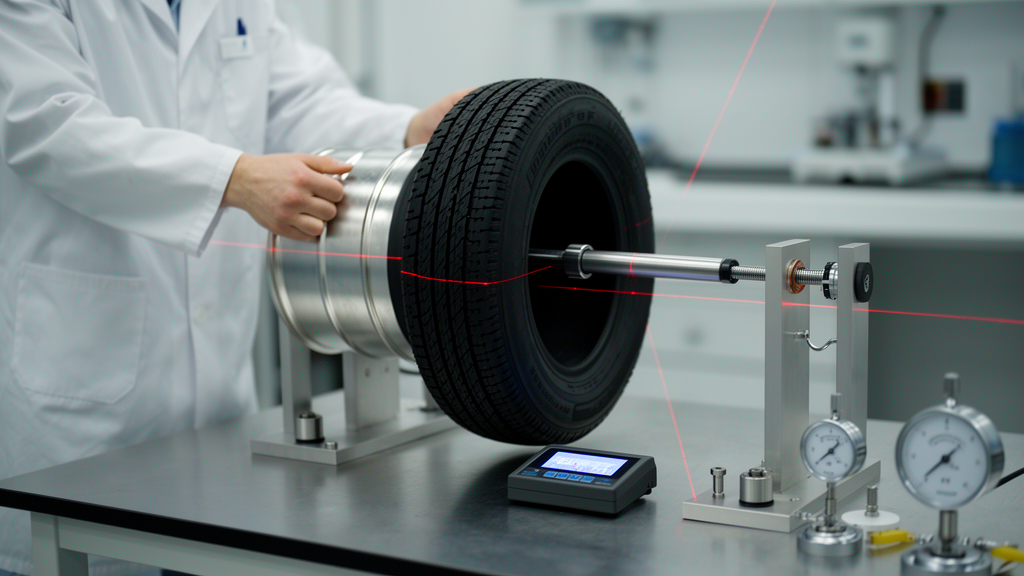
That is the central finding of a new open-access study published in Sports Engineering, in which a research team developed and experimentally verified a theoretical model that predicts exactly how applied-force misalignments corrupt laboratory measurements of rolling resistance in roller-ski wheels. Because rolling resistance is one of the most difficult wheeled performance parameters to quantify, the findings carry weight far beyond Nordic skiing, touching any laboratory that measures rolling resistance directly with force transducers, from bicycle tires to wheelchair wheels. The research team, consisting of Anna-Mia Brulin, Mats Ainegren and David Sundström, focused on the force method, a direct measurement approach in which the reaction force at the wheel axle is resolved into components by a load cell.
In sports applications, the stakes are unusually high. Roller skiing is the standard snow-free training and competition surrogate for cross-country skiing, and it is also a workhorse of experimental research on large indoor treadmills. Ensuring that rolling resistance coefficients are comparable to the friction coefficients of skis on snow, that competition conditions are equal among athletes, and that experimental studies remain valid and reproducible all depend on knowing this coefficient accurately.
Rolling resistance must also be separated from gravity and aerodynamic drag when interpreting the external forces acting on a skier. In simplified terms, the rolling resistance coefficient is defined as the ratio between the rolling resistance force and the normal force pressing the wheel against the surface. The resistance arises primarily from viscoelastic hysteresis in the wheel material: cyclic deformation during rolling dissipates energy as heat, displacing the center of pressure of the normal force ahead of the wheel axis in the rolling direction.
Bearing friction adds parasitic losses on top. Consequently, even a small fraction of the normal force leaking into the rolling direction through geometric misalignment can be comparable in magnitude to the rolling resistance force itself. Existing approaches for roller-ski wheels include field coast-down measurements, in which a freely rolling skier decelerates, and towing methods, in which a skier or weighted sled is pulled by a string attached to a load cell, either on roads or on a treadmill belt.
These methods capture realistic thermal conditions but are sensitive to aerodynamic drag, weather and road-surface roughness. Laboratory alternatives include flywheel devices and small treadmills mounting a single ski in a fixture, which improve control but depend on the validity of indirect models. The automotive industry, by contrast, has long relied on drum testing on a rotating cylindrical surface, codified in standards such as ISO 28580:2018 and SAE J1269, which specify strict alignment tolerances precisely because the force method is known to be alignment-sensitive.
No equivalent standardized procedure exists for roller-ski wheels, and the influence of force misalignment had not been systematically quantified until now. The new study addressed that gap in two stages. First, the researchers developed a theoretical model incorporating two misalignment angles.
The angular deviation is the clockwise angle between the load cell's z-axis and the direction normal to the rolling surface. The inclination angle arises only on a cylindrical rolling surface, where a horizontal axle offset between the wheel and the cylinder tilts the effective load axis, compounded by the hysteresis-driven displacement of the contact pressure center between a loaded stationary wheel and a rolling wheel. On a flat treadmill surface, only the angular deviation contributes to measurement error; on a cylindrical surface, both angles combine to tilt the applied force relative to the true contact-force axes.
The mathematics of the error is elegantly simple. When the equipment is perfectly aligned, the ratio of the load cell force components equals the true rolling resistance coefficient. With misalignment, the measured coefficient instead approximates the true coefficient plus the tangent of the total misalignment angle.
In other words, the error grows with the misalignment angle, independent of the wheel's own rolling resistance. The model also provides the inverse solution: if the misalignments are known, the true coefficient can be recovered by subtracting the tangent of the total angle from the measured value. Forces perpendicular to the measurement plane, which arise from slip or toe angles known to substantially increase rolling resistance, were excluded because the experimental equipment can be adjusted to drive them toward zero.
To verify the model, the team built two experimental setups: a motor-driven aluminum cylinder with a 300 millimeter radius and a smooth cylindrical rolling surface, and a small treadmill with a flat rubber mat. In both setups, forces were measured with a six-axis load cell with full-scale capacities of 700 newtons for the horizontal components and 1700 newtons for the vertical component, mounted on a screw jack that applied the normal load. Ball bearings mechanically constrained the load-application axis in the rolling direction, minimizing unintended misalignments, while precision steel shims introduced controlled horizontal axle offsets and angular deviations.
Four roller-ski wheels were tested: two classic wheels and two skate wheels, comprising the manufacturer's standard medium-resistance wheel and a polyurethane racing wheel with a Shore A hardness of 78. The experimental protocol was meticulous. Wheels were preheated to 40 degrees Celsius in a temperature-controlled insulated box to shorten the warm-up period, then rolled until steady-state conditions were reached, since operating temperature differs between wheel types.
All warm-up and measurements were performed at a rolling speed of 20 kilometers per hour with an applied normal load of 300 newtons, at an ambient temperature of 23 degrees Celsius. Correct alignment was established separately for each wheel under each condition by driving the rolling surface in both forward and reverse directions; alignment was confirmed when load-cell readings were identical in both directions. Misalignments were then introduced in controlled increments, from minus 2 to plus 2 millimeters of axle offset on the cylinder and from minus 10 to plus 10 milliradians of angular deviation on the treadmill, with ten consecutive measurements at each of five positions per wheel.
The results confirmed the model's predictions with striking precision. The theoretical model predicted that the measured rolling resistance coefficient increases by approximately 0.001 per milliradian of angular deviation on the flat treadmill surface. For horizontal axle offset on the 300 millimeter radius cylinder, the predicted increase was approximately 0.0030 per millimeter for classic wheels and 0.0029 per millimeter for skate wheels.
Both misalignment types significantly affected the measured coefficient for all four wheels, with p-values below 0.001 and effect sizes near 1.0, and pairwise comparisons revealed significant differences between all five misalignment positions for each wheel and setup. Although one-sample t-tests showed statistically significant differences between measured and predicted values under most conditions, the residuals and standard deviations were generally small, and the close agreement between measured and predicted slopes supported the model's validity. The researchers attribute the small systematic differences to instrument alignment, operator handling and inherent measurement accuracy limits.
The practical implications are considerable. ISO 28580:2018 requires that the applied load in the force method act perpendicular to the test surface and pass through the wheel center within 1 milliradian. Based on the new model, a 1 milliradian deviation shifts the measured coefficient by roughly 0.001, which corresponds to a relative error of 20 percent for a roller-ski wheel with a coefficient of 0.005, compared with only 5 percent for a wheel with a coefficient of 0.020.
The same absolute alignment error therefore has a far greater relative effect when measuring lower rolling resistance coefficients, and stricter tolerances on the order of 0.3 milliradians have been suggested for tire testing. The study also acknowledges what the model does not capture: it does not fully account for systematic differences between cylindrical and flat treadmill measurements, indicating that geometric force misalignment alone is insufficient to explain all discrepancies. Because an elastic wheel deforming against a rigid cylindrical surface attains higher strain than on a flat surface, the hysteresis losses should be stronger on the drum.
Following the framework of Clark and Dodge, which distinguishes a measurement effect from a stress effect, incorporating the stress-effect formulation would require reducing the rolling resistance measured for a typical roller-ski wheel on a 300 millimeter radius cylinder by approximately 5.6 to 8 percent to determine its coefficient on a flat surface. Surface material differences, thermal conditions, airflow and the dynamic loading that varies continuously throughout the skiing cycle may all further influence results, and the influence of dynamic loading on roller-ski rolling resistance warrants further investigation. For now, the message to laboratories is clear: accurate force-transducer alignment and wheel positioning are not optional refinements but prerequisites for valid, comparable rolling resistance measurements.
Subject of Research: Effect of applied-force misalignments on rolling resistance measurements of roller-ski wheels using the force method
Article Title: Effect of applied-force misalignments on rolling resistance measurements using the force method
Article References: Brulin, A.-M., Ainegren, M., & Sundström, D. (2026). Effect of applied-force misalignments on rolling resistance measurements using the force method. Sports Engineering, 29(2), Article 38. https://doi.org/10.1007/s12283-026-00570-7
Image Credits: AI Generated
DOI: 10.1007/s12283-026-00570-7
Keywords: rolling resistance, roller skiing, force method, measurement error, load cell alignment, sports engineering, drum testing, ISO 28580, cross-country skiing, theoretical model, Effect, applied-force
Cite Scienmag News
Denise Maddox. (October 24, 2026). Tiny Alignment Errors Skew Rolling Resistance Measurements, Study Warns. Scienmag. https://scienmag.com/tiny-alignment-errors-skew-rolling-resistance-measurements-study-warns/
Denise Maddox. "Tiny Alignment Errors Skew Rolling Resistance Measurements, Study Warns." Scienmag, 24 October 2026, https://scienmag.com/tiny-alignment-errors-skew-rolling-resistance-measurements-study-warns/. Accessed 24 October 2026.
Denise Maddox. "Tiny Alignment Errors Skew Rolling Resistance Measurements, Study Warns." Scienmag. October 24, 2026. https://scienmag.com/tiny-alignment-errors-skew-rolling-resistance-measurements-study-warns/