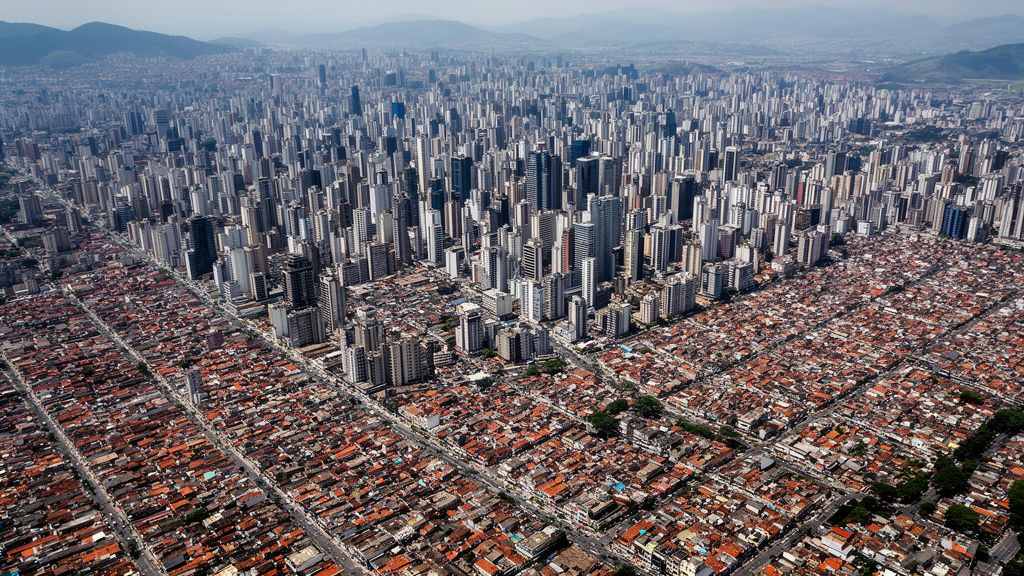
Residential segregation may leave measurable fingerprints in the physical structure of cities. A study of São Paulo, Latin America’s largest metropolis, suggests that the entropy of the built fabric—how varied and disordered the arrangement of buildings is—is linked in non-linear ways to income levels and the spatial clustering of income groups.
The research, by Vinicius M. Netto, Caio Cacholas, Camila Carvalho and Edgardo Brigatti, quantified built-form entropy using a Shannon-based measure computed from building footprints. Income distributions were characterised with the Gini index, a measure of inequality, and Moran’s I, which captures spatial autocorrelation or clustering. To compare these indicators directly, the team placed them on a common spatial footing using a regular tessellation of the city.
The analysis revealed a non-linear relationship between entropy, income and segregation. Income levels and residential clustering rose toward both extremes of the entropy spectrum, but the increase was stronger at the high-entropy end. In other words, both highly disordered and highly ordered urban fabrics were associated with distinctive socio-spatial patterns, with the disordered end showing the sharpest effects.
According to the authors, this asymmetry points to different segregation processes at different ends of the entropy scale. High-entropy urban forms appear associated with distinct spatial dynamics, including the enclaving of elite groups and the incremental, unplanned growth of lower-income settlements. Low-entropy forms, by contrast, seem to reflect more selective occupation of land, shaped by formal planning and by market filtering that restricts who can live where.
The findings suggest that urban form is not a neutral backdrop against which social patterns unfold. Instead, the configuration of buildings may function both as an affordance that enables segregation processes and as a signal that records them, offering researchers a spatial lens for reading social divisions directly from the built fabric of cities.
Subject of Research: The relationship between built-form entropy and income-based residential segregation in São Paulo
Article Title: Is segregation encoded in urban form? An entropy-based analysis
Article References: Netto, V. M., Cacholas, C., Carvalho, C., & Brigatti, E. (2026). Is segregation encoded in urban form? An entropy-based analysis. PLOS One, 21(10), e0360856. https://doi.org/10.1371/journal.pone.0360856
Image Credits: AI Generated
DOI: 10.1371/journal.pone.0360856
Keywords: urban form, segregation, entropy, São Paulo, income inequality, spatial analysis, Shannon entropy, Gini index, Moran's I, building footprints, urban morphology, encoded
Cite Scienmag News
Scienmag. (October 24, 2026). Urban form may encode segregation, entropy study of São Paulo suggests. https://scienmag.com/urban-form-may-encode-segregation-entropy-study-of-sao-paulo-suggests/
Scienmag. "Urban form may encode segregation, entropy study of São Paulo suggests." Scienmag, 24 October 2026, https://scienmag.com/urban-form-may-encode-segregation-entropy-study-of-sao-paulo-suggests/. Accessed 24 October 2026.
Scienmag. "Urban form may encode segregation, entropy study of São Paulo suggests." Scienmag. October 24, 2026. https://scienmag.com/urban-form-may-encode-segregation-entropy-study-of-sao-paulo-suggests/