


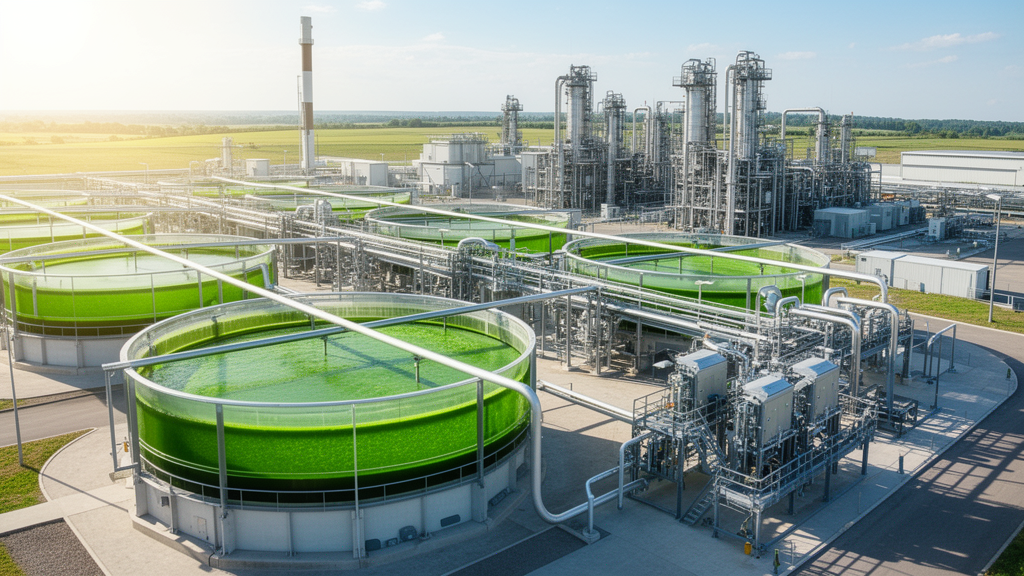
Algae are emerging as one of the most versatile feedstocks for third-generation biofuel production, and a comprehensive review published in Frontiers in Environmental Chemistry maps how far chemical, thermochemical, and biochemical conversion technologies have advanced in recent years. The review, led by Muhammad Waseem of Auburn University and Muhammad Usman Khan of Washington State University Tri-Cities, synthesizes research from 2020 through 2025 and argues that the future of algal bioenergy lies not in any single conversion route, but in integrated biorefinery systems that co-produce fuels, chemicals, and high-value coproducts while recycling nutrients and carbon.
The case for algae rests on striking biological advantages. Algal cultures can sequester roughly 210 tons of carbon dioxide per hectare per year, a rate the review places at 10 to 50 times higher than terrestrial forests. Nutrient demands are similarly modest: producing a kilogram of biomass requires about 0.003 milligrams of nitrogen for algae, compared with roughly 40 milligrams for rapeseed and 45 for sunflower, and phosphorus needs are similarly low. Algae grow 20 to 30 times faster than conventional food crops and contain nearly 30 times more oil than first- and second-generation biomass feedstocks. They tolerate seawater, freshwater, and even industrial wastewater, and open-pond field trials have reported productivities of approximately 18 to 20 grams per square meter per day, with near-term targets around 25 grams per square meter per day.
On the chemical side, transesterification remains the dominant route from algal lipids to biodiesel, converting triglycerides with an alcohol in the presence of alkaline, acidic, or enzymatic catalysts to yield fatty acid methyl esters and glycerol. Alkaline catalysts can achieve conversion above 90 percent at moderate temperatures of 50 to 70 degrees Celsius in short reaction intervals of around four hours, but they suffer from soap formation when free fatty acids and water are present. Acid catalysts tolerate these impurities but demand higher temperatures and longer reaction times, while enzyme-catalyzed routes run at mild temperatures of 30 to 60 degrees Celsius without washing steps, albeit at higher catalyst cost and slower kinetics. The review highlights a shift toward fatty acid ethyl esters produced via ethanolysis, which offer a fully renewable carbon cycle, a higher cetane number, better cold flow, and superior performance in wet in-situ processing because ethanol has greater solvent power for lipids in the presence of cellular water.
Direct, or in-situ, transesterification of wet algal biomass eliminates the drying step, which can account for up to 80 percent of material preparation expenses, yet comparisons show a trade-off: direct processing of wet biomass produced significantly lower biodiesel yields than conventional methods, whereas solvent extraction before conversion pushed yields as high as 98 percent, with complete conversion possible after hexane or chloroform pretreatment. Ultrasound and microwave assistance have produced roughly 90 percent fatty acid methyl ester yields with favorable energy ratios. Non-catalytic supercritical transesterification of Chlorella protothecoides achieved optimum yields of 87.8 percent with ethanol and 90.8 percent with methanol, but the extreme temperatures and pressures involved make catalytic routes more practical at scale. Emerging catalyst architectures, including metal-organic frameworks and nanostructured metal oxides, are being engineered for water and free-fatty-acid tolerance, recyclability, and reduced washing burdens, while immobilized and nano-immobilized lipases aim to make enzymatic routes economically competitive.
Thermochemical conversion faces a different bottleneck: algal biomass typically contains only 10 to 30 percent dry solids, making drying energy-intensive, and its nitrogen and sulfur content raises the risk of nitrogen oxide and sulfur oxide emissions. Gasification partially oxidizes dried biomass into syngas, primarily hydrogen and carbon monoxide, with a calorific value of 4.5 to 6 megajoules per cubic meter, roughly 10 to 15 percent that of natural gas. Tar formation fouls turbines, pipes, and filters and reduces overall efficiency, and while cyclones, ceramic filters, and wet scrubbers can remove tar, they do not convert it into useful gas. Reactor choice matters considerably: fixed-bed gasifiers suit small decentralized systems but tolerate ash and salts poorly, fluidized-bed designs offer the best mixing and flexibility for algae but need secondary tar cracking, and entrained-flow gasifiers minimize tar at high temperature but demand finely ground, low-moisture feed. Chemical looping gasification, in which an oxygen carrier transfers lattice oxygen to the fuel in a separate reactor, promises nitrogen-free syngas and in-situ tar conversion, making it attractive for downstream synthesis of methanol or Fischer-Tropsch diesel.
Pyrolysis converts biomass at around 500 degrees Celsius in the absence of air into char, bio-oil, and combustible gases, and it handles the high ash content of algae better than most alternatives. Conventional slow pyrolysis yields biochar over 10 to 30 seconds of residence time at low heating rates, fast pyrolysis produces bio-crude oil at 400 to 500 degrees Celsius within 2 to 3 seconds, and flash pyrolysis generates gas in 1 to 2 seconds at heating rates up to 600 degrees Celsius per second. The central problem is compositional: protein-rich algae produce bio-oils laden with nitrogen-containing compounds such as nitriles, amides, and pyridines, alongside oxygenates, which reduce stability and heating value and create nitrogen oxide precursors and catalyst poisoning during upgrading. Metal-modified zeolites such as iron- or nickel-doped HZSM-5 can simultaneously promote aromatization and suppress oxygenated and nitrogenated fractions, and two-stage pyrolysis-upgrading configurations decouple volatilization from product quality control. Algal biochar, with its high mineral content and surface functionality, is increasingly valued for soil amendment, nutrient recycling, carbon sequestration, and pollutant adsorption, improving the techno-economic case for the whole process.
Hydrothermal processing sidesteps drying altogether by using hot compressed water as solvent, reactant, and catalyst. Hydrothermal carbonization operates at mild conditions of 180 to 250 degrees Celsius and 10 to 40 bar to yield carbon-rich hydrochar, with reported yields ranging from 15 percent for Chlamydomonas reinhardtii to 60.5 percent for Chlorella vulgaris. Hydrothermal liquefaction runs at 250 to 450 degrees Celsius and 40 to 165 bar, processing the entire wet biomass to produce bio-crude amounting to 30 to 60 percent of dry feedstock with a heating value of 25 to 35 megajoules per kilogram; Chlorella sp. has yielded up to 72 percent under optimized conditions. Hydrothermal gasification above water’s critical point of 374 degrees Celsius and 221 bar produces biosyngas, with Chlorella vulgaris achieving 67 percent hydrogen yield at 500 degrees Celsius. Heat integration, using hot reactor effluent to preheat the inlet stream, can push energy efficiency to 85 percent, and coupling liquefaction with dark fermentation of the aqueous byproduct stream, rich in short-chain organic acids, offers a route to biohydrogen while easing wastewater treatment burdens.
Biochemical routes exploit microbes and enzymes directly. Fermentation converts hexose and pentose sugars into ethanol and carbon dioxide under anaerobic conditions, with a theoretical yield of 51.14 grams of ethanol from 100 grams of sugar, and algal carbohydrates give ethanol productivity roughly twice that of sugarcane and five times that of corn; Chlorella vulgaris starch conversion efficiencies of up to 65 percent have been reported. Brown algae, lacking lignin and rich in mannitol, laminarin, and alginate, are considered especially feasible ethanol feedstocks when specialized microorganisms ferment these diverse carbon sources. Anaerobic digestion proceeds through hydrolysis, acidogenesis, acetogenesis, and methanogenesis to yield biogas and a nutrient-rich digestate, with an electrical conversion efficiency of about 21 percent and recoverable heat. But algae resist: rigid cell walls make hydrolysis rate-limiting, high salinity suppresses methanogens in strains such as Chlorella vulgaris and Dunaliella tertiolecta, and long-chain fatty acids from lipid-rich biomass accumulate volatile fatty acids that inhibit both bacteria and archaea. Mitigation strategies include thermal or enzymatic pretreatment, two-stage digestion that decouples acidogenesis from methanogenesis, and carbonaceous additives such as biochar that adsorb inhibitors and promote direct interspecies electron transfer.
Photobiological hydrogen production confronts what researchers call the oxygen paradox, since photosynthetic oxygen inactivates the hydrogenase enzymes that release hydrogen gas. Indirect biophotolysis decouples the steps by storing solar energy as starch during aerobic phases and degrading it anaerobically afterward, and two-stage photosynthesis in green algae has yielded up to 200 kilograms of hydrogen per hectare per day. Newer strategies include truncated light-harvesting antenna strains that let sunlight penetrate deeper into bioreactors, synthetic microalgal-bacterial consortia in which heterotrophic bacteria scavenge dissolved oxygen, nanoparticle additives that act as artificial redox mediators, and the discovery of oxygen-tolerant iron-iron hydrogenases from Thermosediminibacter oceani that retain activity even in the presence of oxygen.
The review’s overarching conclusion is that sustainability is system-dependent rather than technology-dependent. Life cycle assessments show that algal biofuels achieve substantial greenhouse gas reductions only when integrated with wastewater-derived nutrients, recycled process water, and waste carbon dioxide streams; standalone cultivation relying on synthetic fertilizers and fossil electricity often shows unfavorable energy return on investment. Techno-economic analyses indicate that high production costs can only be offset by cascading valorization into polyunsaturated fatty acids, pigments such as astaxanthin and phycocyanin, and recombinant proteins before energy conversion. Downstream innovations, including bio-flocculation, magnetic nanoparticle-assisted separation, pulsed electric field permeabilization, three-phase partitioning, aqueous two-phase systems, and switchable hydrophilicity solvents that extract lipids from wet biomass, all aim to bypass the energy penalty of drying. The authors frame the path forward as cultivation-conversion co-design: circular operating windows in which wastewater nutrients and captured carbon dioxide feed algal growth, and conversion residues such as digestate and hydrochar are recycled back into the system, aligning algal bioenergy with measurable goals in energy return, carbon intensity, and operating cost.
Subject of Research: Chemical, thermochemical, and biochemical conversion of algal biomass into biofuels and bioproducts
Article Title: Recent advances in chemical, thermochemical, and biochemical processing of algae
Article References: Waseem, M., Mahmood, F., Cai, Y., Ma, S., Muzamil, M., & Khan, M. U. (2026). Recent advances in chemical, thermochemical, and biochemical processing of algae. Frontiers in Environmental Chemistry, 7, Article 1703150. https://doi.org/10.3389/fenvc.2026.1703150
Image Credits: AI Generated
DOI: 10.3389/fenvc.2026.1703150
Keywords: algae, biofuels, transesterification, pyrolysis, hydrothermal liquefaction, gasification, anaerobic digestion, fermentation, biohydrogen, biorefinery, life cycle assessment, microalgae
Cite Scienmag News
Violet Maxwell. (October 24, 2026). Algae Conversion Advances Point Toward Integrated Biorefineries for Biofuels. Scienmag. https://scienmag.com/algae-conversion-advances-point-toward-integrated-biorefineries-for-biofuels/
Violet Maxwell. "Algae Conversion Advances Point Toward Integrated Biorefineries for Biofuels." Scienmag, 24 October 2026, https://scienmag.com/algae-conversion-advances-point-toward-integrated-biorefineries-for-biofuels/. Accessed 24 October 2026.
Violet Maxwell. "Algae Conversion Advances Point Toward Integrated Biorefineries for Biofuels." Scienmag. October 24, 2026. https://scienmag.com/algae-conversion-advances-point-toward-integrated-biorefineries-for-biofuels/


