


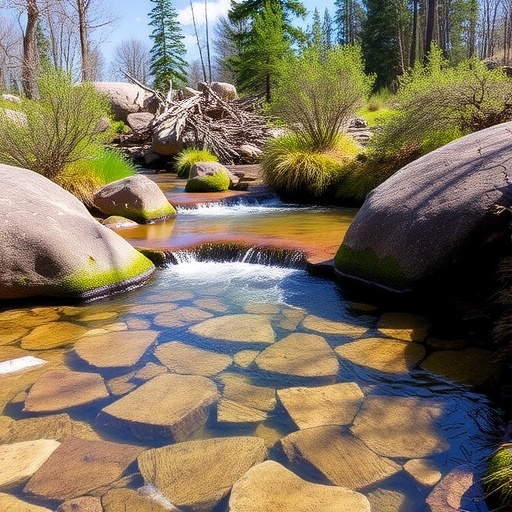
In the vast and interconnected web of the Earth’s hydrologic continuum, springs emerge as extraordinary ecological niches, serving as vibrant hotspots for microbial diversity. Recent groundbreaking research, published in Communications Earth & Environment, unveils the critical role these natural freshwater sources play in fostering microbial communities that not only display remarkable complexity but also influence broader environmental processes. By delving deep into the microbial assemblages inhabiting springs, scientists are beginning to unravel the intricate patterns and functions that underscore their ecological significance in freshwater systems and beyond.
Springs constitute the juncture where groundwater naturally emerges at the Earth’s surface, creating unique environments that bridge subterranean and surface ecosystems. Unlike rivers or lakes, springs provide stable physicochemical conditions influenced by the geology of aquifers and surrounding landscapes. This stability fosters distinct microbial consortia, often containing rare or specialized taxa adapted to these environments. The study spearheaded by Esmond, de Bruyn, DiBattista, and collaborators harnesses advanced molecular techniques and extensive sampling to characterize these microbial hotspots, illuminating their unparalleled diversity relative to other freshwater habitats.
Microbial life in springs has long been recognized for its ecological importance, yet quantifying and understanding its diversity remained elusive due to technical and logistical challenges. With the advent of high-throughput sequencing technologies and metagenomics, researchers can now capture a comprehensive snapshot of microbial communities at unprecedented resolution. The researchers employed these methodologies to analyze spring microbiomes across a range of geographical locations, revealing that these environments harbor an exceptionally rich tapestry of bacteria, archaea, and microbial eukaryotes. Such findings redefine our understanding of freshwater microbial ecology, positioning springs as critical nodes within aquatic microbial networks.
The environmental parameters governing spring ecosystems contribute significantly to shaping microbial assemblages. Factors such as temperature stability, nutrient influx from groundwater sources, mineral composition, and oxygen availability create conditions conducive to niche differentiation. The study highlights the influence of hydrogeological and geochemical gradients, determining microbial community structures that are not only diverse but often highly endemic. This endemicity indicates isolated evolutionary trajectories shaped by the unique physicochemical matrices springs offer, fostering microbial lineages distinct from adjoining water bodies.
From a biogeochemical perspective, spring microbes play instrumental roles in elemental cycling, including carbon, nitrogen, sulfur, and phosphorus transformations. These microbial processes impact water chemistry and nutrient fluxes downstream, linking the microscopic universe of springs to broader ecosystem functions. The research underscores that microbial metabolic pathways in spring environments involve diverse mechanisms such as chemoautotrophy, denitrification, and methanogenesis, each contributing to maintaining ecological balance within these freshwater reservoirs and influencing connected aquatic systems.
One of the most compelling aspects of this research is the implication springs have for understanding microbial biogeography. Traditionally, microbial dispersal was thought to be nearly unrestricted across water bodies due to their small size and vast abundance. However, the documented diversity and uniqueness of spring microbiomes challenge this assumption, suggesting localized evolutionary hotspots where microbial populations establish long-term, stable communities. These insights reshape the paradigm of microbial distribution and suggest that springs function as evolutionary crucibles, fostering speciation and endemism in freshwater microorganisms.
The findings also shed light on the resilience and stability of spring microbial ecosystems amid environmental change. Springs often exhibit buffered conditions compared to other water bodies, which may provide refugia for sensitive microbial taxa under fluctuating climate regimes or anthropogenic disturbances. This pulsates with relevance given the growing impacts of climate change on freshwater habitats globally. Understanding how microbial diversity in springs responds to environmental stressors offers predictive power for ecosystem management and conservation strategies aimed at preserving freshwater biodiversity in a rapidly changing world.
Moreover, these microbial communities hold immense potential for biotechnological applications. Springs are natural reservoirs of novel microorganisms producing unique bioactive compounds and enzymes adapted to specific environmental niches. The paper hints at unexplored microbial metabolisms that may translate into breakthroughs in bioremediation, pharmaceuticals, and industrial catalysts. Unlocking the genetic and functional diversity harbored within springs opens avenues for bioprospecting and advancing biotechnology informed by nature’s ingenuity through evolutionary adaptation.
Integrating hydrology, geochemistry, and microbiology, this research exemplifies the multidisciplinary approach needed to decode the complexity of Earth’s hydrologic continuum. It serves as a clarion call for more sustained and targeted investigations into freshwater microbial diversity, especially within understudied spring ecosystems. The synergy of novel analytical tools combined with ecological theory propels our capacity to map microbial life’s distribution, function, and evolutionary patterns within dynamic planet-wide water networks.
This work also invites a reassessment of current hydroecological models, advocating for the inclusion of microbial parameters as vital components influencing water quality and ecosystem health. Springs, often overlooked in water resource management, emerge as vital conduits of biodiversity and biogeochemical transformation that merit dedicated protection. By illuminating these connections, the research builds a compelling narrative that highlights the intertwined fate of microbial life and freshwater systems that humanity depends upon for sustenance.
Furthermore, the presence of microbial taxa in springs that are rare or absent in surrounding waters challenges conservationists to prioritize these sites when designing freshwater biodiversity reserves. The study’s geographic scope, spanning diverse climatic and geological settings, demonstrates that microbial richness in springs is a universal phenomenon rather than an isolated peculiarity. This global perspective underscores the ecological value springs provide worldwide, prompting a redefinition of freshwater conservation priorities to include microbial dimensions.
In exploring these microbial hotspots, the researchers also touch upon the evolutionary history inscribed within spring habitats. Geological timescales have allowed certain springs to persist through climatic epochs, acting as refugia that preserve ancient microbial lineages. The continuity and isolation characteristic of many spring ecosystems render them living archives of microbial evolution. Their study contributes to the broader understanding of how microorganisms adapt and diversify in relatively stable microhabitats over millions of years, offering glimpses into the deep-time dynamics of Earth’s biosphere.
The societal implications of recognizing springs as epicenters of microbial diversity extend to public health, water security, and environmental education. Springs frequently serve as drinking water sources, and their microbiological quality directly impacts human well-being. Gaining comprehensive insights into the microbial communities inhabiting springs enables better management of waterborne pathogens and beneficial microbes alike, ensuring safe and sustainable water supplies. Additionally, elevating the profile of microbial diversity within these freshwater gems enhances public appreciation of the unseen biological wealth embedded in natural water systems.
This seminal body of work by Esmond and colleagues marks a transformative step in freshwater ecology and microbial biogeography. By spotlighting springs as epicenters of biodiversity, it challenges the scientific community to move beyond traditional macrobenthic or chemical assessments in freshwater research and embrace microbial dimensions as integral components of aquatic ecosystem science. As researchers continue to delve into this hidden microbial world, the discoveries unfolding within springs promise to reshape environmental sciences and inform stewardship of the planet’s precious freshwater resources.
The study ultimately reiterates the intricate interdependencies sustaining the hydrologic continuum and reminds us that the smallest life forms often wield the greatest influence over ecological processes. It invites a paradigm shift where conservation, research, and policy collectively recognize the foundational role of microbial diversity in freshwater springs. Harnessing this understanding is key to safeguarding water ecosystems and the multifaceted services they provide in an era marked by escalating human and climatic pressures on natural environments.
In conclusion, springs are far more than mere points of groundwater discharge; they are vibrant crucibles of microbial life, serving as reservoirs of biodiversity, evolution, and ecosystem functionality. This newfound perspective elevates their status within ecological research and environmental conservation, underscoring the imperative to protect these irreplaceable natural wonders. As we peer into the microbial cosmos flourishing within springs, we uncover profound insights into life’s persistence and adaptability at the heart of Earth’s water cycle.
Cite Scienmag News
Morgan Morrow. (June 13, 2026). Springs: Microbial Diversity Hotspots in Water Cycle. Scienmag. https://scienmag.com/springs-microbial-diversity-hotspots-in-water-cycle/
Morgan Morrow. "Springs: Microbial Diversity Hotspots in Water Cycle." Scienmag, 13 June 2026, https://scienmag.com/springs-microbial-diversity-hotspots-in-water-cycle/. Accessed 4 September 2026.
Morgan Morrow. "Springs: Microbial Diversity Hotspots in Water Cycle." Scienmag. June 13, 2026. https://scienmag.com/springs-microbial-diversity-hotspots-in-water-cycle/


