


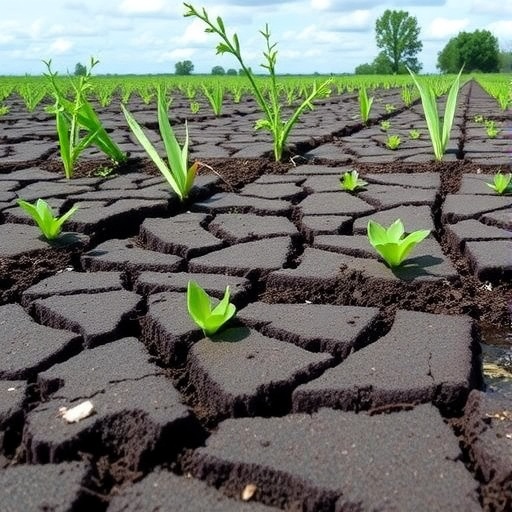
In the dynamic interface between terrestrial ecosystems and the atmosphere, peatlands stand as critical reservoirs of carbon, underpinning the global carbon cycle and influencing climate regulation on a planetary scale. Recent groundbreaking research led by Ge, Li, Peng, and colleagues unveils a nuanced mechanism by which organic phosphorus plays a pivotal role in preserving the carbon sequestered within peat soils, particularly under conditions of declining water tables. This discovery, published in Communications Earth and Environment, sheds new light on how woody plants mediate peat carbon stability amid hydrological stress, challenging pre-existing paradigms about peatland carbon vulnerability.
Peatlands, often regarded as waterlogged ecosystems rich in organic matter, have historically been viewed through the lens of their hydrologic stability. The gradual lowering of the water table—a phenomenon increasingly driven by climate change, land-use alteration, and drainage—has long been associated with accelerated peat decomposition, releasing vast stores of carbon dioxide and methane into the atmosphere. However, this study delves deeper into the biogeochemical intricacies that govern carbon preservation under such environmental perturbations, focusing on the often-overlooked role of organic phosphorus compounds.
At the heart of their investigation lies the interplay between organic phosphorus and woody vegetation dynamics. Woody plants, through their root systems and associated microbial communities, influence nutrient cycling in peat ecosystems. The researchers demonstrated that organic phosphorus compounds act as a molecular shield, facilitating the stabilization of peat carbon by binding with cellulose and lignin-derived compounds prevalent in decaying woody litter. This binding process impedes microbial breakdown, effectively slowing peat degradation even when aerobic conditions prevail due to water-table decline.
Utilizing state-of-the-art spectroscopic analyses and soil chemistry assays, the team characterized the chemical composition of organic phosphorus in peat profiles subjected to experimental water-table manipulations. They observed elevated concentrations of organophosphorus compounds in the rhizosphere of woody plants compared to areas dominated by herbaceous vegetation. This spatial variation suggests a biological mediation where woody plant roots exude or transform phosphorus species, enhancing their capacity to stabilize carbon-rich organic matter chemically.
Moreover, isotopic tracing techniques revealed that the pathways for phosphorus cycling in these peatlands are more complex than previously understood. Organic phosphorus, traditionally overshadowed by its inorganic counterpart in biogeochemical discussions, appears to be recycled efficiently within the peat matrix, supporting sustained microbial and plant productivity despite hydrological changes. This recycling underpins a feedback loop where phosphorus availability indirectly promotes carbon retention through its effects on plant growth and litter quality.
The spatial and temporal dynamics of peat carbon preservation elucidated by this work have significant implications for global carbon budget models. Current models often simplify peat decomposition by emphasizing hydrologic parameters and temperature sensitivity, neglecting nutrient-driven biochemical controls such as those involving organic phosphorus. By integrating this mechanism, predictive frameworks can better account for the resilience of peat carbon stocks under climate-induced water-table oscillations.
Intriguingly, the research highlights the differential roles that vegetation types play in peat ecosystems. The presence of woody plants, ranging from shrubs to small trees, enhances organic phosphorus-mediated carbon preservation, contrasting with herbaceous-dominated peatlands, which tend to be more vulnerable to carbon loss under drying scenarios. This vegetation-mediated effect introduces a biotic dimension to peatland carbon dynamics, suggesting that shifts in plant community composition could modulate ecosystem responses to environmental stress.
From the perspective of ecosystem management and restoration, these findings underscore the potential for promoting woody plant establishment as a strategy to mitigate peatland carbon emissions. Encouraging the growth of specific woody species that efficiently mediate organic phosphorus cycling could help maintain peatland carbon stocks amidst climate-driven hydrological perturbations. However, the ecological trade-offs, including impacts on biodiversity and methane emissions, require careful consideration.
The molecular mechanisms by which organic phosphorus stabilizes carbon compounds involve complex chemical interactions, including the formation of stable organo-phosphorus complexes that resist enzymatic hydrolysis. This chemical recalcitrance provides a protective matrix around peat organic matter, shielding it from microbial attack. As microbial communities shift with water-table changes, their capability to degrade these complexes diminishes, further reinforcing carbon preservation.
Technological advancements such as high-resolution phosphorus nuclear magnetic resonance (31P NMR) spectroscopy enabled the team to resolve the fine-scale speciation of phosphorus compounds within peat samples. The identification of specific phosphodiesters and phosphonates enriched in woody plant zones suggests targeted pathways through which phosphorus chemistry interfaces with carbon biogeochemistry. These insights contribute to a more mechanistic understanding of nutrient-organic matter interactions in peatland soils.
The broader implications of this study extend to global climate policy and carbon accounting. Peatlands contain approximately one-third of the world’s soil carbon despite covering only 3% of the land surface. Their role as carbon sinks depends on preserving peat integrity, which this study reveals is intricately linked to nutrient dynamics beyond water availability. Incorporating organic phosphorus-related processes in climate models will enhance the accuracy of carbon flux predictions under future climate scenarios.
Furthermore, this research highlights an often-neglected aspect of nutrient-poor ecosystems: the critical function of organic forms of nutrients. While inorganic phosphorus has dominated paradigms in ecosystem nutrient cycling, organic phosphorus forms represent a substantial and bioavailable pool, especially in peatlands. Understanding the ecological roles of organic phosphorus transforms our conception of nutrient limitation and carbon sequestration potential.
In conclusion, the innovative work by Ge, Li, Peng, and collaborators uncovers an essential biochemical facilitator—organic phosphorus—that underpins the resilience of peat carbon stocks amid hydrological stress driven by climate change. Their findings call for a paradigm shift in peatland ecology and carbon cycling research, emphasizing nutrient-organic matter interactions mediated by vegetation as key determinants of ecosystem function. As the global community grapples with the urgency of climate mitigation, such nuanced scientific insights offer pathways to safeguard some of Earth’s most critical carbon reservoirs.
Cite Scienmag News
Violet Maxwell. (June 13, 2026). Organic Phosphorus Protects Peat Carbon Amid Drought. Scienmag. https://scienmag.com/organic-phosphorus-protects-peat-carbon-amid-drought/
Violet Maxwell. "Organic Phosphorus Protects Peat Carbon Amid Drought." Scienmag, 13 June 2026, https://scienmag.com/organic-phosphorus-protects-peat-carbon-amid-drought/. Accessed 3 September 2026.
Violet Maxwell. "Organic Phosphorus Protects Peat Carbon Amid Drought." Scienmag. June 13, 2026. https://scienmag.com/organic-phosphorus-protects-peat-carbon-amid-drought/


