

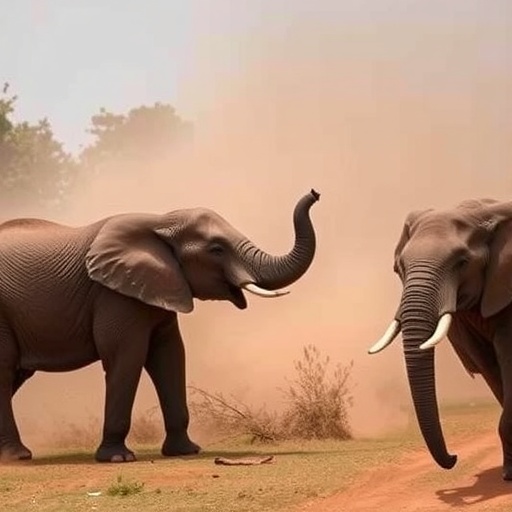
Southern Africa’s iconic savanna elephants are on a collision course with expanding human populations, and new research warns that the resulting crop-raiding conflicts are set to escalate dramatically over the coming decades. A study published in PNAS Nexus reveals that under all plausible climate change scenarios, the area at risk of elephant crop raids could double by 2085, driven by a volatile mix of human encroachment and climate-driven aridity.
An estimated 290,000 African savanna elephants (Loxodonta africana) currently roam across Southern Africa, often sharing landscapes with small-scale farmers whose livelihoods can be wiped out by a single night of crop destruction. Despite decades of coexistence efforts, the economic toll of these raids remains severe, and the new analysis is the first to combine causal inference statistical techniques with machine learning to disentangle the precise drivers of such incidents at a transboundary scale.
Evan Patrick of the University of California Santa Barbara and an international team examined nearly two decades of crop-raiding records from Namibia’s communal conservancies, spanning 2004 to 2020. They then expanded their lens to encompass a vast region that includes northern Botswana and swaths of Angola and Zambia. The researchers employed causal inference methods to move beyond simple correlation, isolating the specific contribution of factors like human population density, cropland extent, and climate variability. This rigorous approach allowed them to confirm that human population growth, the physical expansion of cropland, and intensifying aridity linked to climate change are the principal engines of conflict escalation.
Machine learning models then ingested an array of environmental and anthropogenic variables to create fine-resolution probability maps of future crop raiding. The key predictors turned out to be tree cover, distance to roads, distance to protective fences, proximity to rivers, human population density, and satellite-derived vegetation productivity—a proxy for the wild food resources available to elephants. These variables collectively shape the interface where elephant needs and human assets collide.
The models paint a sobering picture for the end of the century. Even under optimistic climate pathways, the probability of crop raiding is predicted to increase in both wet and dry seasons. Critically, the total geographic area facing significant raiding risk is projected to roughly double, pushing conflict into regions that today experience little to no elephant incursion. That expansion is not merely a consequence of elephants wandering farther; it directly reflects cropland spreading into buffer zones and wildlife corridors, compounded by reduced natural forage as rainfall patterns shift and temperatures rise.
The mechanism is a double squeeze. As climate change depresses the productivity of wild vegetation, elephants are forced to seek alternative food sources, making the nutritional jackpot of a mature maize field ever more tempting. At the same time, farmers, responding to their own demographic and economic pressures, clear new fields closer to protected areas and movement routes. The study’s causal framework clearly attributes rising raid frequency to both sides of this equation, with climate-driven aridity amplifying the effect of cropland proximity.
Ezequiel Fabiano of the University of Namibia, a co-author, noted that the transboundary nature of the data set is crucial, because elephants and the pressures they face do not respect political borders. The mapped risk projections are intended as practical tools, not academic abstractions. By identifying the spatial fingerprints of future conflict, the models can guide land use planners and conservation managers toward proactive interventions—such as strategically placed fencing, early-warning systems, or designated buffer zones—before new flashpoints emerge.
The study’s reliance on both causal inference and machine learning represents a methodological advance in conservation science. Traditional correlational studies often conflate several interacting factors, but by leveraging treatment-effect style statistical designs, the team could isolate, for example, how much a given increase in aridity alone boosts raid probability, holding other variables constant. The machine learning layers then mapped those statistical relationships onto the real-world landscape with high spatial granularity.
One potentially controversial finding is the role of roads and fences. The models show that distance to roads and fences strongly modulates conflict risk, but in nuanced ways: while well-maintained fences can reduce incursions, roads often facilitate human access and can fragment habitat, inadvertently increasing the edge zones where elephants and crops meet. The researchers argue that understanding such fine-scale dynamics is essential for mitigation measures that do not simply displace the problem to neighboring communities.
The authors stress that the forecasted doubling of conflict-prone area is not an inevitability, but a warning. Proactive land use planning, integrated with climate adaptation strategies for both people and wildlife, could still alter the trajectory. The findings arrive at a moment when many Southern African nations are revising conservation and agricultural policies, and the study’s high-resolution risk maps are being offered as a decision-support tool for governments, non-governmental organizations, and local conservancies. The hope is that with the right mix of technology, planning, and community engagement, the looming crisis can be defused before elephants and farmers are forced into ever more destructive stand-offs.
Subject of Research: Drivers and future probability of human-elephant conflict (crop raiding) in a transboundary Southern African landscape
Article Title: An expanding human footprint drives escalating human–elephant conflict across a transboundary African landscape through 2085
News Publication Date: 7-Jul-2026
Web References: [PNAS Nexus]
References: Evan Patrick et al., PNAS Nexus, 7 July 2026
Image Credits: Not available
Keywords
Human-elephant conflict, crop raiding, African savanna elephants, climate change, land use change, machine learning, causal inference, conservation planning, Namibia, Botswana, Angola, Zambia, transboundary wildlife management


