

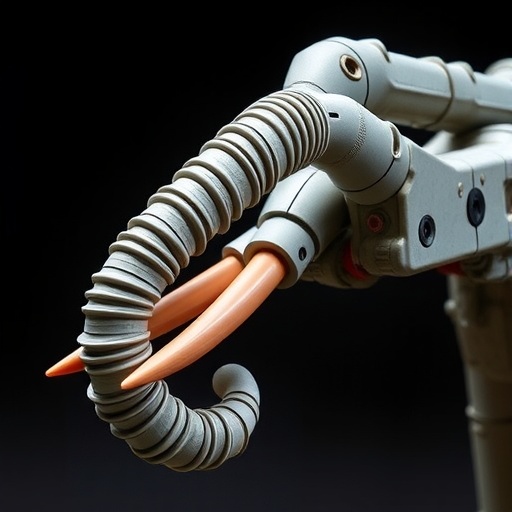
From the tip of an elephant’s trunk, nature has long offered a masterclass in gentle, adaptable grasping. Now a team of roboticists has distilled that biological genius into a soft gripper that can not only cradle a piece of tofu without crushing it, but also feel every contour of the object, its own finger positions, and the exact pressure it applies—all through a single internal camera. Dubbed EleTac, the system redefines what soft robots can perceive while keeping the hardware remarkably simple and lightweight.
Soft robotic grippers have promised a revolution in handling delicate, irregularly shaped items, from fruit on an assembly line to surgical tools. Yet the very flexibility that makes them appealing has made it fiendishly difficult to equip them with high-resolution tactile sensors. Rigid sensor arrays limit bending, while stretchable electronics still struggle to cover large, continuously deforming surfaces without blind spots or wiring nightmares. EleTac sidesteps the problem entirely by placing a miniature fisheye camera inside the gripper’s hollow pneumatic fingers, letting it watch the soft silicone skin deform from within.
As the two fingers inflate and close around an object, the inner camera streams video of shadows, wrinkles, and distortions that paint a detailed portrait of what is happening at the surface. A set of deep neural networks, trained on thousands of images, learns to decode these visual patterns into rich tactile parameters: where contact occurs, how much force is being exerted, the local shape of the object, and even the curvature and joint angles of the fingers themselves. This last capability—proprioception—means the gripper knows the exact configuration of its own body without any external joint encoders, a feat that mimics how animals sense limb position through internal muscle and skin stretch.
The vision-based approach yields a tactile resolution that rivals specialized sensor skins, yet the entire sensing hardware weighs just a few grams and costs a fraction of equivalent distributed sensor arrays. Because the camera is the only electronic component, the fingers remain fully soft, sealed, and safe for direct contact with food or sensitive materials. The team, led by Professor Van Anh Ho from the Japan Advanced Institute of Science and Technology, designed the gripper as a plug-and-play end-effector that can be mounted on existing robot arms or humanoid platforms with minimal integration effort.
During exhaustive bench tests, EleTac handled an eclectic assortment of objects—ripe strawberries, silken tofu, fabric swatches, metal bolts, playing cards, and screwdrivers—with a single simple control strategy. More impressively, in a trial where a pen was buried in a box of sand, the gripper probed the granular medium using touch alone, located the pen, and pulled it out, all without any visual input from outside the fingers. Another demonstration asked the robot to wipe marker ink from curved ceramic tableware with a sponge; the system constantly monitored the contact pressure and adjusted its wiping motion so that the sponge maintained just enough force to clean without losing contact, dynamically adapting to the varying curvature of a bowl or plate.
The secret lies in a training process that pairs real-world physical interactions with supervised learning. The researchers collected images under precisely known conditions of contact position, force vectors, and indentation depths, then trained convolutional neural networks to regress those quantities from new images. For proprioception, the network learned to estimate the two bending angles of each finger by observing the internal deformation patterns. Remarkably, the same camera feed provides all tactile and proprioceptive information simultaneously, an elegant economy of hardware that turns a simple pneumatic actuator into a multi-modal sensing organ.
Professor Ho envisions EleTac as a stepping stone toward safer, more capable service robots that can assist with everyday household tasks or support elderly populations. “With the ability to detect contact and apply gentle forces, soft robots may be able to assist with everyday tasks, support elderly or vulnerable individuals, and perform operations that are difficult for today’s rigid robotic systems,” he notes. The low material cost and easy fabrication also make the technology attractive for industrial deployment in food handling, laboratory automation, and sustainable packaging lines.
What makes EleTac particularly compelling is that it unites the two missing senses—touch and self-awareness—into a single compact module. Traditional industrial grippers are either blind or depend on carefully calibrated force sensors that only offer a scalar reading at a few points. Here, the entire inner surface becomes a continuous tactile retina, resolving contact locations down to a millimeter scale while simultaneously knowing the finger’s posture. This holistic perception enables feedback loops that simply cannot exist with conventional hardware, pushing soft robotics closer to the fluid, responsive manipulation seen in nature.
The development also underscores a broader trend in robotics: vision-based tactile sensing. By leveraging the rapid progress in camera miniaturization and deep learning, researchers are transforming dead materials into perceptive skins. With EleTac, they borrowed from an elephant’s trunk not just the shape and motion but the profound integration of sensing and acting that evolution has perfected. The trunk tip, which can uproot a tree or pick up a single blade of grass, now has a robotic counterpart that sees and feels its world from the inside out.
Subject of Research: Soft robotic gripper with integrated vision-based tactile sensing and proprioception
Article Title: EleTac: Elephant Trunk Tip-Inspired Soft Gripper with Vision-Based Tactile Sensing and Proprioception
News Publication Date: June 26, 2026
Web References: 10.1109/TRO.2026.3706568
References: IEEE Transactions on Robotics
Image Credits: Professor Van Anh Ho, Japan Advanced Institute of Science and Technology, Japan
Keywords
Soft robotics, tactile sensing, proprioception, elephant trunk inspiration, vision-based sensing, pneumatic gripper, deep learning, robotic grasping, bio-inspired design, human-robot interaction


