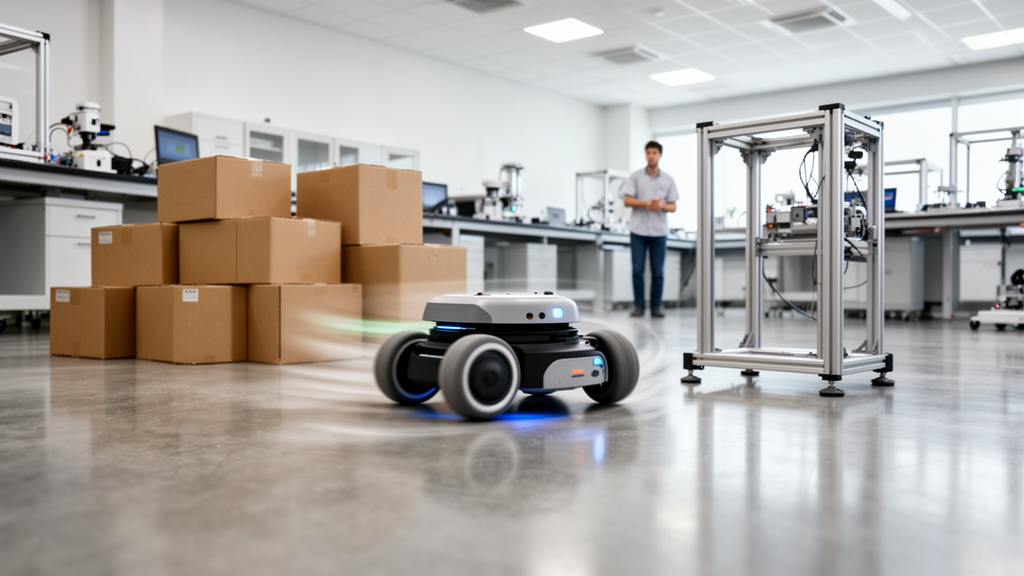
Autonomous mobile robots are quietly transforming factories, warehouses, and service industries, replacing humans in repetitive transportation tasks and stepping in for hazardous jobs where human presence would be dangerous. Among these machines, the Mecanum-wheeled omnidirectional mobile robot (MWOMR) stands out as a classical yet remarkable design. Unlike conventional wheeled robots that must swerve to change direction, an MWOMR can move instantaneously in any direction without turning its body, thanks to a clever wheel architecture. A typical Mecanum wheel carries a series of rotary rollers evenly distributed along the edge of its hub, and these rollers’ axles are set at a 45-degree angle relative to the wheel’s own axle. When the wheel rotates, the ground-touching roller generates friction along the roller’s axle, and by combining the rotational movements of all four Mecanum wheels installed on the robot, a resultant force can be produced in an arbitrarily predetermined direction. This is what gives the robot its signature omnidirectional mobility and superior maneuverability, characteristics that have attracted extensive attention from both academia and industry.
Now, a research team led by Zhe Sun, Shujie Hu, Xinan Miao, and Bo Chen of Zhejiang University of Technology in Hangzhou, China, together with Jinchuan Zheng and Zhihong Man of Swinburne University of Technology in Melbourne, Australia, and Tian Wang of Hangzhou RoboCT Technology Development Co. Ltd., has unveiled an integrated control framework that promises to make these agile robots far more capable of navigating cluttered environments on their own. Published in Frontiers in Control Engineering, their study tackles two of the most vital technologies for autonomous movement: trajectory planning and trajectory-tracking control. The work arrives at a moment when mobile robots are being deployed ever more widely, and when the ability to plan a path around obstacles in real time, and then follow that path with precision, separates a genuinely autonomous machine from a remote-controlled toy.
Trajectory planning, in essence, means generating a series of reference position-and-posture signals for a mobile robot based on environmental information perceived by its sensors, while respecting the robot’s kinematic constraints and accounting for surrounding obstacles. Planning strategies fall into two broad categories. Global planning algorithms require all environmental information in advance and take considerable time to execute, which makes them difficult to implement in real settings. Local planning, by contrast, possesses a stronger real-time property because it uses sensor-collected information to iteratively update the reference trajectory as the robot moves. Typical local planning approaches include fuzzy logic methods, neural network methods, and artificial potential field (APF) methods. The APF scheme is particularly elegant: it treats the target and obstacles as objects exerting virtual forces on the robot, with the target generating an attractive force and obstacles generating repulsive forces. The resultant of these virtual forces indicates the robot’s moving direction, guiding it smoothly around hazards and toward its destination. Because APF-based strategies offer smooth trajectory generation and real-time obstacle avoidance, they play a key role in mobile robot navigation.
The Zhejiang-led team harnessed this potential field concept with a thoughtful piecewise design. Their attractive-field function depends on the distance between the robot and the target at each sampling moment, modulated by an attractive-field parameter and a switching distance threshold. The purpose of the piecewise structure is to prevent an overlarge attractive force when the robot is far from its goal. If the attractive force were always proportional to distance, the robot would be forced to rush at high velocity from the starting point. Instead, a constant attractive force is exerted on the robot until it enters an area of predetermined radius around the destination, at which point the force becomes proportional to the remaining distance, allowing a gentle arrival. On the repulsive side, the field function depends on the distance between each obstacle and the robot, scaled by a repulsive-field coefficient and limited to a maximum acting range. Beyond that range, an obstacle exerts no influence at all, keeping the virtual force landscape clean and computationally efficient. The resultant force, decomposed along the X and Y axes, generates reference velocities that serve as the reference signal for the tracking control system.
Planning a trajectory is only half the battle; the robot must then follow it accurately despite disturbances, friction variations, and model uncertainties. For this task, the researchers turned to sliding mode control, a strategy widely utilized in mechatronic engineering practice owing to its superior performance and firm robustness in handling external disturbances and model uncertainties. Conventional sliding mode control, however, can only realize asymptotic convergence, meaning errors decay gradually rather than vanishing in finite time. To overcome this shortage, terminal sliding mode control was developed to enhance convergence speed and suppress the chattering phenomenon, and a subsequent non-singular terminal sliding mode method addressed the singularity problem inherent in the classical formulation, finding applications in systems ranging from vehicle steer-by-wire to servomotor-driven rigid robots.
The team’s contribution goes a step further by embracing the discrete nature of modern computer control. As embedded controllers grow more powerful, more control algorithms are implemented by computer systems that operate with sampling periods, during which the control input signal remains constant. This discrete reality creates a fundamental problem for sliding mode control: while discrete control inputs can bring system states close to the sliding surface, they usually cannot make the states stay on it. Directly applying a continuous sliding mode algorithm to a sampled-data system may harm stability and even result in loss of control. The researchers therefore designed a discrete integral terminal sliding mode (DITSM) control algorithm specifically suited to computer implementation, building on established concepts of quasi-sliding mode and quasi-sliding mode bands from the discrete-time variable structure control literature.
The DITSM controller operates on a velocity error defined as the difference between the reference velocity signal and the robot’s actual velocity. A sliding surface is constructed that combines the current error with an integral term of a fractional power, with parameters chosen as odd integers whose ratio approaches one. The closer this ratio is to one, the closer the surface is to a proportional one, yielding smoother control input but slower convergence. The researchers selected a ratio of three-fifths as a considered tradeoff. The total control input is composed of two parts: an equivalent control input, derived by temporarily neglecting the lumped parametric uncertainties, and a reaching control input that handles those uncertainties through a switching gain. A key practical merit of the design is that the switching gain is defined in terms of a single tunable parameter, which reduces the difficulty of tuning and simplifies the stability analysis considerably.
Stability was not left to intuition. The team constructed a discrete-time Lyapunov function and carried out a classified discussion covering all sign combinations of the sliding variables, proving that each component converges into a bounded region in finite steps and, once inside, cannot escape. Building on a lemma concerning discrete-time terminal sliding surfaces, they further showed that the tracking error itself converges into a bounded region after finitely many steps. The researchers also elaborated a detailed tuning guideline: increasing the integral coefficient accelerates convergence and keeps small steady-state errors, though an overlarge value may cause instability, while a larger boundary parameter accelerates error convergence at the cost of intensifying chattering. Benchmark controllers, a discrete conventional sliding mode controller and a discrete terminal sliding mode controller, were designed for comparison.
Simulations in MATLAB verified the framework in two scenarios. In the static-obstacle case, the robot started at the origin with a target fifteen meters away, and five static obstacles were scattered along the corridor. The attractive-field coefficient was set to 0.5, the repulsive-field coefficient to 8, the switching distance to 5 meters, and the maximum repulsive range to 3 meters, with motor output torque limited to 0 to 15 newton-meters to mimic motor protection and a sampling period of 0.01 seconds. The trajectory-planning algorithm updated every 20 sampling periods, balancing computation load and operational efficiency, while the robot’s heading angle remained fixed at zero to showcase its omnidirectional movement. Results showed the DITSM controller achieved the fastest convergence rate in X-axis velocity error, with the DTSM and DCSM controllers ranking second and slowest. Y-axis velocity errors exhibited oscillations because the planning algorithm updates every 20 sampling periods, but the oscillation amplitude under DITSM was the smallest, peaking at only 0.05 meters per second. The initial control action of the DITSM system was the strongest, explaining its fast convergence.
In the dynamic-obstacle case, the third and fourth obstacles were set in motion along the Y-axis at velocities of 1 meter per second and 0.5 meters per second respectively, within defined ranges. Screenshots of the robot’s trajectory at half-second intervals showed the APF-based planning scheme updating the reference trajectory according to the moving obstacles’ positions and guiding the robot around them. Under the DITSM control law, the robot realized satisfactory dynamic obstacle avoidance, with the fastest velocity-error convergence rate, the fastest transient response, and the smallest error oscillations compared with the benchmarks. The findings indicate that the proposed planning-and-control method achieves effective obstacle avoidance in both static and dynamic scenarios, with higher tracking accuracy and firmer robustness than the benchmark controllers. For a robot class already prized for moving in any direction without a swerve, this work adds the intelligence to do so safely among moving hazards, a combination that could accelerate deployment of MWOMRs in warehouses, factories, and beyond.
Subject of Research: Artificial potential field trajectory planning and discrete integral terminal sliding mode tracking control of a Mecanum-wheeled omnidirectional mobile robot
Article Title: Obstacle-avoidance trajectory planning and sliding mode-based tracking control of an omnidirectional mobile robot
Article References: Sun, Z., Hu, S., Miao, X., Chen, B., Zheng, J., Man, Z., & Wang, T. (2023). Obstacle-avoidance trajectory planning and sliding mode-based tracking control of an omnidirectional mobile robot. Frontiers in Control Engineering, 4, Article 1135258. https://doi.org/10.3389/fcteg.2023.1135258
Image Credits: AI Generated
DOI: 10.3389/fcteg.2023.1135258
Keywords: omnidirectional mobile robot, Mecanum wheels, obstacle avoidance, trajectory planning, trajectory tracking, sliding mode control, artificial potential field, discrete control, Lyapunov stability, autonomous robots, robotics, control engineering
Cite Scienmag News
Denise Maddox. (October 17, 2026). Sliding Mode Control Teaches Omnidirectional Robots to Dodge Obstacles. Scienmag. https://scienmag.com/sliding-mode-control-teaches-omnidirectional-robots-to-dodge-obstacles/
Denise Maddox. "Sliding Mode Control Teaches Omnidirectional Robots to Dodge Obstacles." Scienmag, 17 October 2026, https://scienmag.com/sliding-mode-control-teaches-omnidirectional-robots-to-dodge-obstacles/. Accessed 17 October 2026.
Denise Maddox. "Sliding Mode Control Teaches Omnidirectional Robots to Dodge Obstacles." Scienmag. October 17, 2026. https://scienmag.com/sliding-mode-control-teaches-omnidirectional-robots-to-dodge-obstacles/