


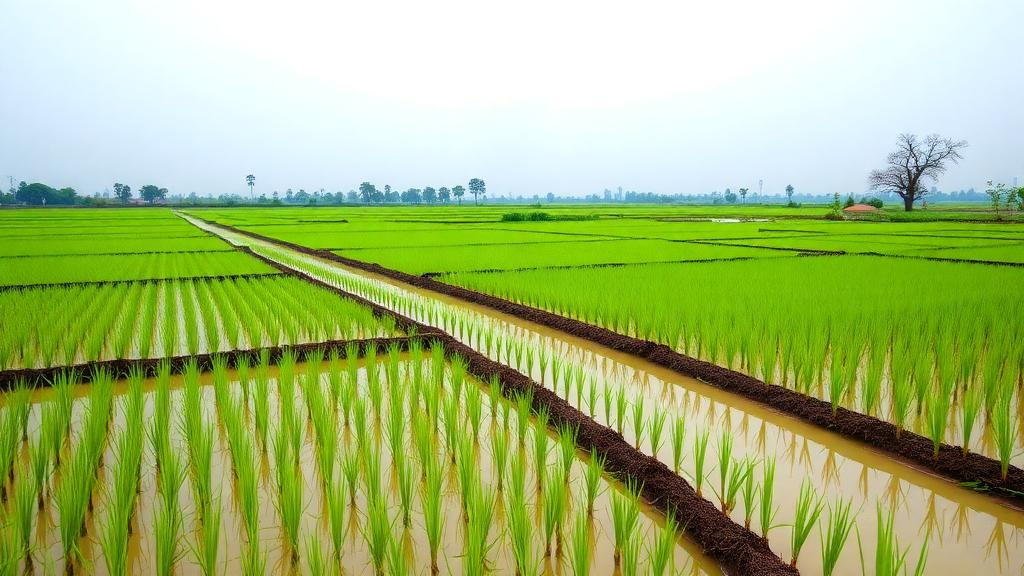
Rice feeds more than half of humanity, yet the flooded fields it depends on are among agriculture’s most stubborn sources of methane, a greenhouse gas roughly eighty times more potent than carbon dioxide over a twenty-year horizon. A new opinion paper published in the journal Plant and Soil argues that a largely overlooked element sitting in plain sight—silicon—could help break this deadlock. The authors, led by Suvendu Das of Gyeongsang National University in South Korea, together with Jagadeesh Yeluripati of the James Hutton Institute in Scotland and colleagues, propose a conceptual framework they call Silicon-Mediated Microbial Climate Regulation, or SiMCR. Their central claim is provocative: silicon fertilization does not merely strengthen rice plants against pests and lodging, as agronomists have long assumed, but actively reshapes the soil microbial communities that decide how much methane escapes from paddy water into the atmosphere.
The mechanistic story begins with the peculiar chemistry of flooded rice soils. When a paddy is submerged, oxygen diffusion into the soil is sharply restricted, creating anoxic zones where archaea known as methanogens thrive. These microorganisms decompose organic matter—residues from previous crops, straw incorporated into the soil, root exudates—and release methane as a metabolic byproduct. The gas then diffuses upward, mostly through the aerenchyma, the air-conducting tissue that rice roots use to survive waterlogging, and escapes into the air. Counteracting this process are methanotrophs, bacteria that consume methane in the oxygenated zones surrounding rice roots. The net emission from any given field is therefore a balance between methane production and methane oxidation, and that balance is governed by the composition and activity of the rhizosphere microbiome.
This is where silicon enters the picture. Rice is a pronounced silicon accumulator; the element is transported from the soil through dedicated transporters, first identified in rice in 2006, and deposited as amorphous silica in leaves, stems, and husks. Decades of research, particularly in Japan and more recently across tropical Asia, have documented silicon’s agronomic benefits: thicker cuticles, improved resistance to fungal pathogens such as brown spot, reduced lodging, and higher grain yields. But the authors argue that this plant-centric view has blinded the research community to a parallel, subterranean effect. When silicate fertilizers—often derived from recycled industrial slags—are applied to paddies, they dissolve into bioavailable silicate that alters soil pH, competes with phosphate for adsorption sites, and changes the redox dynamics of the rhizosphere. Each of these shifts ripples through the microbial food web.
The evidence for a climate effect comes from a series of field and laboratory studies conducted by the same research group and collaborators. Work published in Environment International in 2019 showed that slag-based silicate fertilizer amendments produced measurable taxonomic and functional shifts in paddy soil microbial communities. A 2022 study in the Journal of Cleaner Production dissected the mechanism by which slag-based silicate fertilizer suppresses methane emissions from paddies, and subsequent papers have reported reduced methane fluxes alongside maintained or increased rice productivity in Korean paddies. Related work suggests additional climate co-benefits: silicate amendments appear to suppress nitrous oxide emissions under certain moisture regimes, and long-term application has been linked to increases in soil organic carbon stocks, meaning the fertilizer may simultaneously cut emissions and lock carbon into the soil.
The proposed SiMCR framework ties these observations into a single mechanistic chain. Applied silicon, the authors contend, modulates the rhizosphere in ways that favor methane-oxidizing bacteria relative to methane-producing archaea, while also influencing the availability of electron acceptors such as iron that determine which metabolic pathways dominate in anoxic soil. Silicon deposited in plant tissue may further alter the quantity and composition of root exudates—the carbon compounds that feed methanogens—thereby starving methane production at its source. The framework is deliberately presented as a hypothesis-generating structure rather than a settled conclusion; the authors acknowledge that the precise microbial taxa and functional genes involved, and the conditions under which suppression is strongest, remain active questions for the research community.
What makes the paper unusual is its pivot from soil science to policy. The authors argue that disciplinary silos and entrenched soil fertility paradigms have kept silicon–microbe interactions out of mainstream climate-smart agriculture, while a policy preference for high-tech solutions—precision sensors, engineered microbes, novel chemistry—has diverted attention from a cheap, scalable, nature-based intervention. They call for quality-screened silicon fertilizers to be formally recognized as climate-smart soil amendments and for their inclusion in national climate action plans, specifically the Nationally Determined Contributions that countries submit under the Paris Agreement. The Food and Agriculture Organization’s 2025 global analysis of agrifood systems in these pledges provides the backdrop: agriculture remains underrepresented in methane mitigation commitments relative to its emissions footprint, and rice cultivation is one of the largest agricultural methane sources after livestock.
The recycling angle adds a circular-economy dimension that may strengthen the policy case. Many effective silicate fertilizers are manufactured from steelmaking slags, industrial byproducts that would otherwise accumulate as waste. Converting slag into a soil amendment that boosts yields, suppresses methane, and potentially immobilizes heavy metals in contaminated paddies addresses three problems at once, though the authors and prior reviews caution that slag quality must be screened to avoid introducing contaminants. The European Input List criteria for fertilizers and soil conditioners, updated in 2024, illustrate the kind of regulatory scaffolding the authors say is needed to distinguish quality-assured products from uncharacterized industrial waste.
Independent experts in silicon biology will likely note that the field has seen genuine controversies. Whether silicon is a truly essential plant nutrient or, as some researchers describe it, a beneficial quasi-essential element has been debated for years, and the magnitude of methane suppression varies with soil type, water management, straw management, and fertilizer composition. Recent work on straw return combined with silicon fertilization suggests practical synergies—silicon application can allow reduced nitrogen inputs while maintaining yield and lodging resistance—but generalizing results from Korean and Vietnamese paddies to the diverse rice systems of South and Southeast Asia will require broader field trials. The authors themselves frame SiMCR as a call for multidisciplinary research agendas spanning rhizosphere microbiology, soil biogeochemistry, and agronomy, rather than as a finished prescription.
The stakes are considerable. Rice paddies account for a substantial share of anthropogenic methane emissions, and demand for rice is projected to rise with population growth across Asia and Africa. Conventional mitigation options each carry trade-offs: mid-season drainage saves water and cuts methane but can increase nitrous oxide and complicate water management; cultivar selection is slow; straw removal or burning creates air pollution problems of its own. A soil amendment that integrates into existing fertilization practice, recycles industrial waste, and acts through natural microbial processes would be an unusually low-friction addition to the mitigation toolkit. The paper’s authors put it bluntly in their conclusion: without deliberately incorporating silicon–microbe interactions into both research and policy frameworks, the goal of genuinely climate-smart rice systems will remain out of reach, and urgent action is needed to unlock this neglected nexus for global food and climate security.
Whether SiMCR matures into a policy instrument or remains a compelling hypothesis will depend on the next phase of evidence: replicated field trials across rice-growing regions, identification of the microbial indicators that reliably predict methane suppression, and cost-benefit analyses that account for slag supply chains and regulatory screening. But the paper has already succeeded in reframing the question. Silicon, long treated as a plant-strengthening afterthought, is now on the table as a lever for microbial climate regulation—one of the few proposed interventions that could, in principle, help rice farmers grow more food while emitting less methane from the same flooded fields their ancestors have cultivated for millennia.
Subject of Research: Silicon-mediated microbial regulation of methane emissions in rice paddy soils
Article Title: Silicon-mediated microbial climate regulation: a new conceptual framework for climate policy and sustainable rice intensification
Article References: Das, S., Yeluripati, J., Seo, Y. H., & Kim, P. J. (2026). Silicon-mediated microbial climate regulation: a new conceptual framework for climate policy and sustainable rice intensification. Plant and Soil. https://doi.org/10.1007/s11104-026-09055-9
Image Credits: AI Generated
DOI: 10.1007/s11104-026-09055-9
Keywords: silicon fertilization, rice paddies, methane emissions, soil microbiome, methanogens, methanotrophs, climate-smart agriculture, greenhouse gas mitigation, slag recycling, Nationally Determined Contributions, soil biogeochemistry, sustainable intensification
Cite Scienmag News
Alan Morgan. (October 13, 2026). Silicon fertilizer could turn rice paddies into methane-fighting climate allies. Scienmag. https://scienmag.com/silicon-fertilizer-could-turn-rice-paddies-into-methane-fighting-climate-allies/
Alan Morgan. "Silicon fertilizer could turn rice paddies into methane-fighting climate allies." Scienmag, 13 October 2026, https://scienmag.com/silicon-fertilizer-could-turn-rice-paddies-into-methane-fighting-climate-allies/. Accessed 13 October 2026.
Alan Morgan. "Silicon fertilizer could turn rice paddies into methane-fighting climate allies." Scienmag. October 13, 2026. https://scienmag.com/silicon-fertilizer-could-turn-rice-paddies-into-methane-fighting-climate-allies/


