


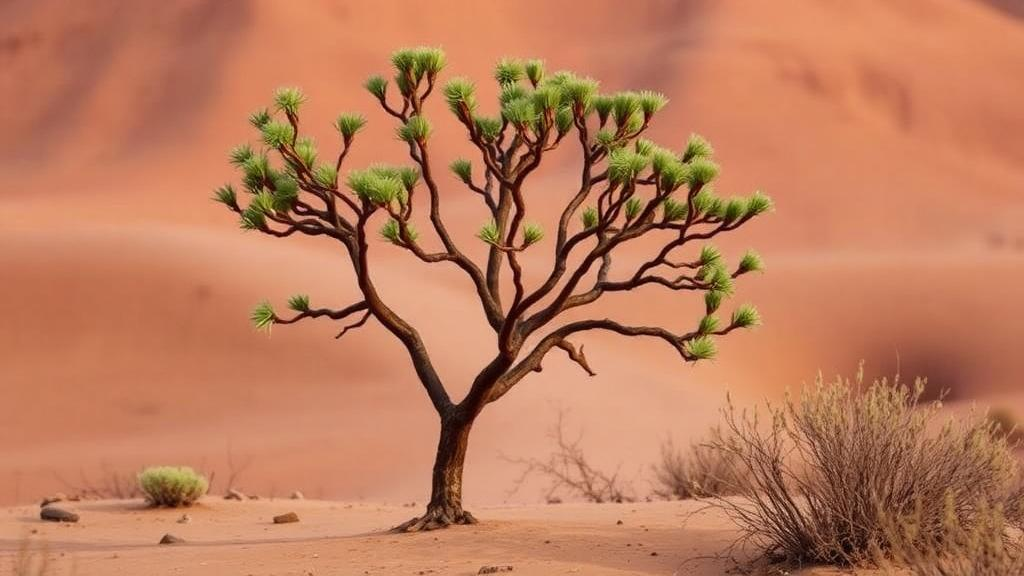
In the parched expanses of Rajasthan and Gujarat, one tree stands as a lifeline for both people and wildlife. Prosopis cineraria, known locally as Khejri and in the Gulf region as Ghaf, is a keystone leguminous tree that anchors entire ecosystems across the arid and semi-arid zones of South Asia and Western Asia. It enriches soil fertility, provides fodder and food, and moderates the harsh microclimate of the desert margins. Yet despite its outsized ecological and socio-economic importance, scientists have long lacked a detailed picture of how genetic variation is distributed across its natural range. A new study published in Plant Biosystems now offers the most comprehensive genetic survey of the species in western India to date, and its findings carry an urgent message for conservation.
Researchers from the Genetics and Tree Improvement Division of the ICFRE-Arid Forest Research Institute in Jodhpur, together with a collaborator from Rungta International Skills University in Bhilai, set out to map the population structure and genetic diversity of P. cineraria using microsatellite markers, commonly called SSR markers. These markers are short, repeating sequences of DNA scattered throughout the genome, and because they mutate rapidly and are inherited in a codominant fashion, they are among the most informative tools available for distinguishing closely related populations. The team sampled an impressive 621 individual trees across 25 populations spanning the states of Rajasthan and Gujarat, capturing the environmental gradient from hyper-arid desert to semi-arid scrubland.
The results, published on 13 October 2026, reveal a species with moderate but meaningful genetic variability. The SSR markers employed showed a polymorphism information content, or PIC, of 0.3526, a value that indicates the markers were moderately informative for detecting genetic differences among individuals. Observed heterozygosity, which measures the proportion of individuals carrying two different versions of a gene at a given locus, ranged from 0.438 to 0.564 across the sampled populations. Expected heterozygosity, a theoretical measure based on allele frequencies, ranged from 0.462 to 0.497. Together, these figures suggest that while the species retains a reservoir of genetic variation, that variation is not evenly or abundantly distributed across its range.
What makes the study striking is not the overall level of diversity but its architecture. Three independent analytical approaches converged on the same conclusion. Bayesian clustering, a statistical method that assigns individuals to genetic groups based on multilocus genotype data, identified three distinct genetic clusters across the sampled range. Principal coordinate analysis, which visualizes genetic distances in a reduced dimensional space, and UPGMA, a hierarchical clustering technique that builds a tree of population relationships, both corroborated this three-cluster structure. The consistency of these methods strengthens confidence that the pattern is real rather than an artifact of any single analytical technique. Notably, the clusters showed evidence of partial admixture, meaning some individuals carry genetic contributions from more than one cluster, hinting at historical gene flow that has since become restricted.
The most dramatic finding came from an analysis of molecular variance, or AMOVA, which partitions genetic variation into components within and among populations. The results showed that 65 percent of the total genetic variation was distributed among populations, while only 35 percent resided within populations. This is an unusual and consequential pattern for a widespread tree species. Many long-lived, outcrossing trees show the opposite tendency, with most variation held within populations because pollen and seed dispersal homogenize gene pools across large areas. The reversal observed here points to a species whose populations have become substantially isolated from one another.
Quantifying that isolation, the researchers calculated a fixation index, FST, of 0.646, a remarkably high value that was statistically significant at P equals 0.001. FST ranges from zero, indicating free interbreeding among populations, to one, indicating complete isolation. A value approaching 0.65 signals severe genetic differentiation, meaning that populations separated by even modest geographic distances have diverged genetically to a striking degree. Restricted gene flow, combined with ecological heterogeneity across the arid to semi-arid gradient and historical dispersal events, appears to have collectively shaped this fragmented genetic landscape, according to the study’s authors.
The implications for a keystone desert tree are profound. Genetic differentiation of this magnitude means that each population represents a distinct evolutionary unit, carrying unique combinations of alleles that may encode adaptations to local conditions such as soil salinity, temperature extremes, and rainfall variability. If a population is lost, its genetic contribution cannot simply be replaced by translocating trees from elsewhere, because no other population carries the same genetic makeup. This is particularly concerning in the context of climate change, where arid zones are expected to experience intensifying heat and increasingly erratic precipitation. The species’ renowned thermotolerance, highlighted by recent transcriptomic work showing multiple gene families involved in heat stress response, may depend on genetic variants that are unevenly distributed among the fragmented populations.
The study also fills an important gap in the scientific literature. Previous genetic investigations of P. cineraria in India relied on different marker systems, including single primer amplification reactions, gene-targeted markers such as CAAT box-derived polymorphism and start codon targeted polymorphism, and intersimple sequence repeats. A parallel 2025 population genomic study in the United Arab Emirates examined the species in the eastern part of its range. The new SSR-based survey of Rajasthan and Gujarat, funded through the Compensatory Afforestation Fund Management and Planning Authority of India’s Ministry of Environment, Forest and Climate Change under the National Program for Conservation and Development of Forest Genetic Resources, provides the densest population-level sampling yet conducted in the species’ Indian stronghold.
From a practical standpoint, the findings offer a roadmap for conservation planners. Because most variation lies among populations rather than within them, conservation strategies should prioritize protecting as many distinct populations as possible, particularly those representing each of the three genetic clusters identified by the Bayesian analysis. Seed collection for afforestation and restoration programs should be drawn from multiple populations and matched to local genetic clusters to avoid outbreeding problems and to preserve the adaptive potential embedded in each lineage. The study’s authors emphasize that the species’ ecological heterogeneity, historical dispersal patterns, and restricted gene flow collectively demand a conservation approach tailored to its fragmented genetic architecture rather than a one-size-fits-all strategy.
Beyond its immediate conservation value, the research contributes to a growing appreciation of desert trees as genetic resources for the future. P. cineraria is increasingly studied as a model for developing stress-tolerant crops, and its genome, published in 2022, has opened doors to understanding how legumes thrive under extreme aridity. The tree’s pods, leaves, and bark hold nutritional and pharmacological promise, and its role in traditional agroforestry systems across the Thar Desert has sustained agricultural communities for centuries. The iconic Khejri tree is so culturally embedded in Rajasthan that it is protected by community conservation traditions dating back centuries. Safeguarding its genetic diversity, the new study makes clear, is not merely an act of ecological stewardship but an investment in the resilience of dryland agriculture and the millions of people who depend on it. As arid ecosystems face mounting pressure from climate change and land use intensification, detailed genetic maps like this one will become indispensable tools for ensuring that keystone species such as the Khejri tree continue to anchor the deserts they have shaped for millennia.
Subject of Research: Genetic diversity and population structure of the keystone desert tree Prosopis cineraria in arid and semi-arid India
Article Title: Population structure and genetic diversity of Prosopis cineraria (Fabaceae) in arid and semi-arid regions of Rajasthan and Gujarat revealed by SSR markers
Article References: Population structure and genetic diversity of Prosopis cineraria (Fabaceae) in arid and semi-arid regions of Rajasthan and Gujarat revealed by SSR markers. (n.d.). https://doi.org/10.1007/s44473-026-00280-9
Image Credits: AI Generated
DOI: 10.1007/s44473-026-00280-9
Keywords: Prosopis cineraria, SSR markers, genetic diversity, population structure, Khejri, arid ecosystems, conservation genetics, AMOVA, FST, Rajasthan, Gujarat, Fabaceae
Cite Scienmag News
Juliet Wilcox. (October 13, 2026). Desert Tree’s Hidden Genetic Map Reveals Isolated Populations Across India’s Arid Lands. Scienmag. https://scienmag.com/desert-trees-hidden-genetic-map-reveals-isolated-populations-across-indias-arid-lands/
Juliet Wilcox. "Desert Tree’s Hidden Genetic Map Reveals Isolated Populations Across India’s Arid Lands." Scienmag, 13 October 2026, https://scienmag.com/desert-trees-hidden-genetic-map-reveals-isolated-populations-across-indias-arid-lands/. Accessed 13 October 2026.
Juliet Wilcox. "Desert Tree’s Hidden Genetic Map Reveals Isolated Populations Across India’s Arid Lands." Scienmag. October 13, 2026. https://scienmag.com/desert-trees-hidden-genetic-map-reveals-isolated-populations-across-indias-arid-lands/


