


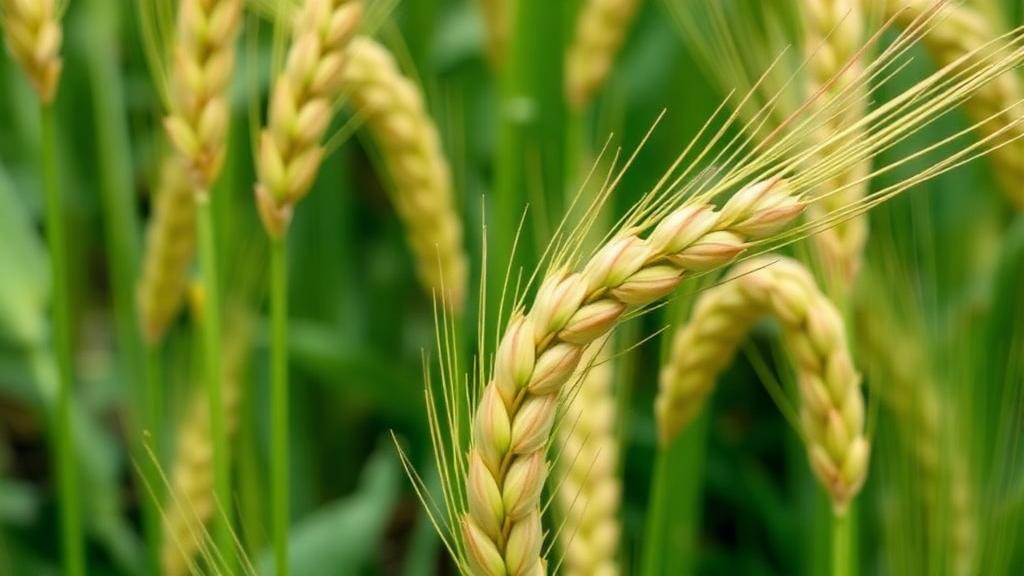
Powdery mildew is one of the most persistent and economically damaging diseases of wheat worldwide. The fungal pathogen Blumeria graminis f. sp. tritici coats leaves and spikes with white, powdery pustules, siphoning nutrients from the plant and reducing both grain yield and quality. In a study published in Theoretical and Applied Genetics, a team of Chinese researchers has now narrowed down the location of a gene that gives wheat plants lasting, age-dependent protection against this disease, and converted that discovery into a practical breeding tool. The work centers on a quantitative trait locus named QPm.caas-4BL.2, which was previously detected in the Chinese wheat line Zhou8425B, a well-known founder parent in Chinese wheat breeding programs.
The research, led by Yan Dong of the Ningxia Academy of Agriculture and Forestry Sciences and the Institute of Crop Sciences at the Chinese Academy of Agricultural Sciences, together with colleagues including Xianchun Xia and Dongsheng Chen, focused on what geneticists call fine mapping. Rather than simply knowing that a resistance gene sits somewhere on chromosome 4B, the team set out to pin it down to a segment of DNA small enough to identify the actual causal gene. This is a technically demanding process in wheat, because bread wheat carries three related copies of many genes across its subgenomes, and its genome is enormous, roughly five times the size of the human genome.
To achieve the resolution needed, the researchers exploited a clever feature of their mapping population. They had previously developed a recombinant inbred line population derived from a cross between Zhou8425B, which carries adult-plant resistance, and Chinese Spring, a susceptible reference variety whose genome has been fully sequenced and annotated. Adult-plant resistance, unlike seedling resistance, becomes effective as the plant matures and is often considered more durable because it typically involves multiple genes and exerts broader pressure on the pathogen. Within the recombinant inbred population, the team identified 63 individuals that were heterozygous in the target region of chromosome 4B, meaning they carried one chromosome segment from each parent at that locus.
These heterozygous individuals became the raw material for a technique known as residual heterozygous line-derived progeny testing. Each heterozygous plant was self-pollinated to generate families of offspring, and because the parent was heterozygous only in the region of interest, the offspring segregated precisely for the chromosome segment surrounding the resistance gene. By genotyping these progeny with molecular markers and scoring their disease symptoms in the field, the researchers could detect recombination events, the crossover points where DNA from the two parents had been shuffled, at extremely fine scale. Each recombination event acts as a natural experiment, splitting the chromosome into smaller and smaller pieces and allowing the gene to be bracketed ever more tightly.
Through this approach, QPm.caas-4BL.2 was confined to an 880-kilobase physical interval on the long arm of chromosome 4B, spanning positions 611.71 to 612.59 megabases in the Chinese Spring reference genome sequence, version 2.1, produced by the International Wheat Genome Sequencing Consortium. Within this interval, the reference annotation lists twelve high-confidence genes. The task then became to determine which of these twelve was responsible for the resistance phenotype, a process that combined several independent lines of evidence rather than relying on mapping data alone.
The strongest candidate emerged as TraesCS4B03G0836900, a gene annotated as encoding an MLO protein. MLO genes hold a special place in plant pathology. In barley, loss-of-function mutations in the Mlo gene were discovered decades ago to confer broad-spectrum, race-nonspecific resistance to powdery mildew, and this natural mutation has been deployed in European barley breeding since the late 1970s. MLO proteins are thought to act as negative regulators of defense, so when the protein is absent or altered, the plant’s own immune machinery becomes more effective at halting fungal penetration. In wheat, genome editing of the three MLO homoeologs has recently been shown to confer heritable powdery mildew resistance, making any naturally occurring variation in an MLO gene of immediate interest to breeders.
To evaluate the candidate gene, the researchers examined its sequence across 145 wheat accessions that had been re-sequenced as part of earlier genomic surveys of landmark Chinese cultivars. The gene contained seven single nucleotide polymorphisms, which together defined six haplotypes, that is, six distinct combinations of sequence variants. One haplotype, designated Hap5-mlo, carried a missense mutation, a change in the DNA sequence that alters an amino acid in the encoded protein. When the researchers compared disease severity among accessions grouped by haplotype, those carrying Hap5-mlo showed significantly lower powdery mildew severity than accessions with the other haplotypes. Transcriptome profiles added further support, indicating that the gene’s expression behavior was consistent with a role in the resistance response.
The practical payoff of the study came in the form of a molecular marker. The team developed a cleaved amplified polymorphic sequence, or CAPS, marker that targets the missense mutation distinguishing the favorable haplotype. CAPS markers work by using a restriction enzyme that cuts the amplified DNA fragment only when a specific sequence variant is present, producing a simple banding pattern that can be read on a standard gel. This makes the marker inexpensive and accessible to breeding programs that lack high-throughput genotyping platforms. The marker was validated in varieties derived from Zhou8425B, and the results were clear: varieties carrying the Zhou8425B allele at the locus showed a 6.9 percent reduction in disease severity compared with varieties carrying the Chinese Spring allele.
That percentage may sound modest, but in plant breeding terms it represents a meaningful, stable contribution to resistance that can be stacked with other genes. Adult-plant resistance loci such as QPm.caas-4BL.2 are most powerful when combined, and molecular markers like the new CAPS marker allow breeders to track and pyramid these genes without waiting for disease nurseries to reveal each plant’s phenotype. This is particularly important because race-specific seedling resistance genes tend to be overcome quickly by evolving pathogen populations, whereas quantitative, adult-plant resistance imposes a more diffuse barrier that the pathogen finds harder to defeat. The study’s authors note that the work provides genes, molecular markers, and resistant germplasm for improving powdery mildew resistance in wheat cultivars.
The research also underscores how much the modern wheat genomics toolbox has changed the pace of discovery. A decade ago, fine mapping a quantitative trait locus in wheat to a sub-megabase interval and nominating a candidate gene would have been a multi-year endeavor with uncertain outcomes. Today, the combination of a high-quality reference genome, dense SNP arrays, re-sequencing data from hundreds of cultivars, and transcriptomic resources allows the entire pipeline, from field disease scoring to a validated diagnostic marker, to be executed within a single study. The identification of an MLO-related gene as the likely basis of QPm.caas-4BL.2 also connects this work to a broader and rapidly moving field, in which both natural mlo variants and genome-edited mlo knockouts are being explored as routes to durable mildew resistance. For wheat, which supplies roughly a fifth of the calories consumed by humanity, each additional validated resistance locus and marker represents another layer of protection for a crop that cannot afford to lose ground to a fungus that thrives in the cool, humid conditions of many of the world’s most productive wheat regions.
Subject of Research: Fine mapping of the adult-plant powdery mildew resistance QTL QPm.caas-4BL.2 and its MLO candidate gene in wheat
Article Title: Fine mapping of QPm.caas-4BL.2 for adult-plant resistance to powdery mildew in wheat
Article References: Fine mapping of QPm.caas-4BL.2 for adult-plant resistance to powdery mildew in wheat. (n.d.). https://doi.org/10.1007/s00122-026-05406-3
Image Credits: AI Generated
DOI: 10.1007/s00122-026-05406-3
Keywords: wheat, powdery mildew, fine mapping, QPm.caas-4BL.2, MLO gene, adult-plant resistance, quantitative trait locus, CAPS marker, haplotype analysis, marker-assisted selection, Zhou8425B, chromosome 4B
Cite Scienmag News
Juliet Wilcox. (October 13, 2026). Wheat Gene Pinpointed in 880-Kilobase Window Offers Durable Defense Against Powdery Mildew. Scienmag. https://scienmag.com/wheat-gene-pinpointed-in-880-kilobase-window-offers-durable-defense-against-powdery-mildew/
Juliet Wilcox. "Wheat Gene Pinpointed in 880-Kilobase Window Offers Durable Defense Against Powdery Mildew." Scienmag, 13 October 2026, https://scienmag.com/wheat-gene-pinpointed-in-880-kilobase-window-offers-durable-defense-against-powdery-mildew/. Accessed 13 October 2026.
Juliet Wilcox. "Wheat Gene Pinpointed in 880-Kilobase Window Offers Durable Defense Against Powdery Mildew." Scienmag. October 13, 2026. https://scienmag.com/wheat-gene-pinpointed-in-880-kilobase-window-offers-durable-defense-against-powdery-mildew/


