


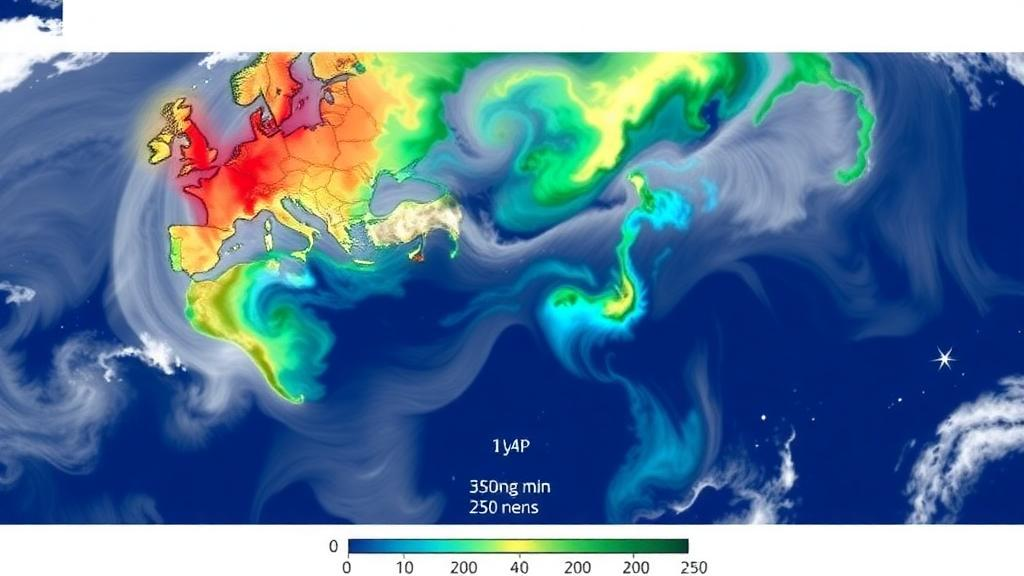
A systematic review of 50 peer-reviewed studies concludes that Sentinel-5P and its Tropospheric Monitoring Instrument, TROPOMI, can complement established air-quality monitoring systems by supporting broad surveillance, geospatial analysis and the detection of abrupt changes in emissions. The studies, published from 2018 through April 2026, used Sentinel-5P/TROPOMI as their primary atmospheric evidence source, with other sensors serving only as comparators or ancillary inputs. Nitrogen dioxide was the most consistently investigated pollutant, while individual studies reported reductions of 3.5% to 85% during mobility restrictions.
Those figures could not always be attributed causally to restrictions because meteorology and background pollution also influenced the observations. The review synthesized work across six domains: detecting abrupt emission changes, mapping pollution across space and time, developing open geospatial workflows, estimating conditions at the surface, validating products and supporting policy-oriented applications. Open workflows based on the Copernicus ecosystem, Google Earth Engine, Python and geographic information system software enabled scalable processing and mapping of satellite observations.
Machine-learning studies also extended column observations toward near-surface estimates of nitrogen dioxide and particulate matter. These outputs are model estimates rather than direct measurements, and the reviewed evidence indicates that their interpretation depends on the data and conditions represented in each study. Validation against multi-axis differential optical absorption spectroscopy instruments, Pandora instruments, airborne measurements and regulatory monitoring networks revealed study-specific biases and constraints of representativeness.
The reviewers did not apply a formal risk-of-bias tool because the eligible corpus combined heterogeneous observational and methodological designs. Instead, they assessed reporting completeness descriptively. The review followed PRISMA 2020 principles and identified records primarily through Scopus and the Web of Science Core Collection, with ScienceDirect, PubMed and SpringerLink used for complementary discovery or full-text access; Crossref and publishers’ official webpages were used only for bibliographic and DOI verification.
Across the reviewed literature, Sentinel-5P/TROPOMI emerged as a flexible decision-support system rather than a substitute for ground monitoring. Its applications included constructing spatiotemporal datasets, assessing changes in emissions and contributing evidence to policy questions, but satellite observations, model-derived surface estimates and ground measurements addressed different aspects of air quality. The findings therefore favor interpreting TROPOMI together with atmospheric information, validation data, estimation models and local measurements.
Subject of Research: Systematic review of Sentinel-5P/TROPOMI products, geospatial workflows, validation and policy applications for air-pollution monitoring
Article Title: Sentinel-5P/TROPOMI for air-pollution monitoring: a systematic review of satellite products, geospatial workflows, and policy-oriented applications
Article References: Canales-Manchuria, G., Canales-Gutiérrez, A., Miranda-Mamani, J., Mendoza, A. C., & Mullisaca-Torres, F. (2026). Sentinel-5P/TROPOMI for air-pollution monitoring: a systematic review of satellite products, geospatial workflows, and policy-oriented applications. Air Quality, Atmosphere & Health, 19(11), Article 243. https://doi.org/10.1007/s11869-026-02130-1
Image Credits: AI Generated
DOI: 10.1007/s11869-026-02130-1
Keywords: Sentinel-5P, TROPOMI, air pollution, nitrogen dioxide, satellite monitoring, geospatial workflows, product validation, machine learning, policy applications, environmental monitoring, air-pollution, monitoring
Cite Scienmag News
Russell Cooper. (October 22, 2026). Sentinel-5P/TROPOMI review maps air-pollution applications and limitations. Scienmag. https://scienmag.com/sentinel-5p-tropomi-review-maps-air-pollution-applications-and-limitations/
Russell Cooper. "Sentinel-5P/TROPOMI review maps air-pollution applications and limitations." Scienmag, 22 October 2026, https://scienmag.com/sentinel-5p-tropomi-review-maps-air-pollution-applications-and-limitations/. Accessed 22 October 2026.
Russell Cooper. "Sentinel-5P/TROPOMI review maps air-pollution applications and limitations." Scienmag. October 22, 2026. https://scienmag.com/sentinel-5p-tropomi-review-maps-air-pollution-applications-and-limitations/


