Luxembourg’s food system would need a fundamental restructuring—not merely a shift toward local or organic products—to approach the country’s 2050 climate-neutrality goal, according to a transdisciplinary modelling study. Researchers combined life-cycle accounting with a back-casting approach to assess a future food system in which farming becomes organic and more agroecological, livestock numbers fall, diets shift toward plant-based foods, food waste declines and agricultural land stores more carbon. Their modeled pathway reduced greenhouse-gas emissions from the food sector by 53%, but depended on coordinated changes in production, consumption, land management and governance.
The study formed part of the broader “Luxembourg in Transition” exercise, which examined how Luxembourg’s economy could reduce its consumption-based carbon footprint from 13.0 to an indicative 1.6 metric tons of carbon-dioxide equivalent per person per year by 2050. Food presented a particularly demanding problem: its estimated footprint was 2.4 metric tons per person per year, already 0.8 tons above the entire indicative 2050 allowance. The analysis also tracked nitrogen and phosphorus losses to water, particulate-matter emissions and material use, allowing researchers to test whether proposed interventions respected environmental boundaries beyond climate change.
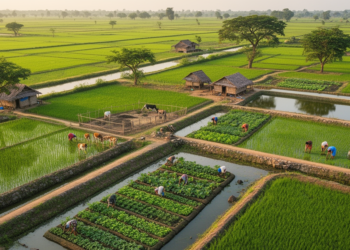
These are modeled pathways rather than observed outcomes, and the results depend on assumptions about population, yields, diets, land use and carbon sequestration. The study also used dietary data from Germany, Belgium and France because comparable food-group data for Luxembourg were unavailable. Luxembourg’s baseline agriculture was dominated by grassland and ruminant livestock.
In 2020, the country had 68,250 hectares of permanent grassland and 61,959 hectares of arable land, with about three-quarters of the arable area used for feed or energy production. Its cattle population numbered 191,360. Enteric fermentation was the largest agricultural source of emissions, producing an estimated 427.69 kilotons of carbon-dioxide equivalent, all attributed to methane, while manure management contributed 134.62 kilotons.
Agriculture as a whole emitted 630.68 kilotons and represented 6.6% of Luxembourg’s territorial greenhouse-gas emissions in Eurostat’s accounting. Across the modeled diet, meat accounted for about 51% of emissions and dairy and eggs for another 22%, meaning animal-source products generated roughly three-quarters of the food footprint. The modeled livestock system was designed around Luxembourg’s permanent grassland.
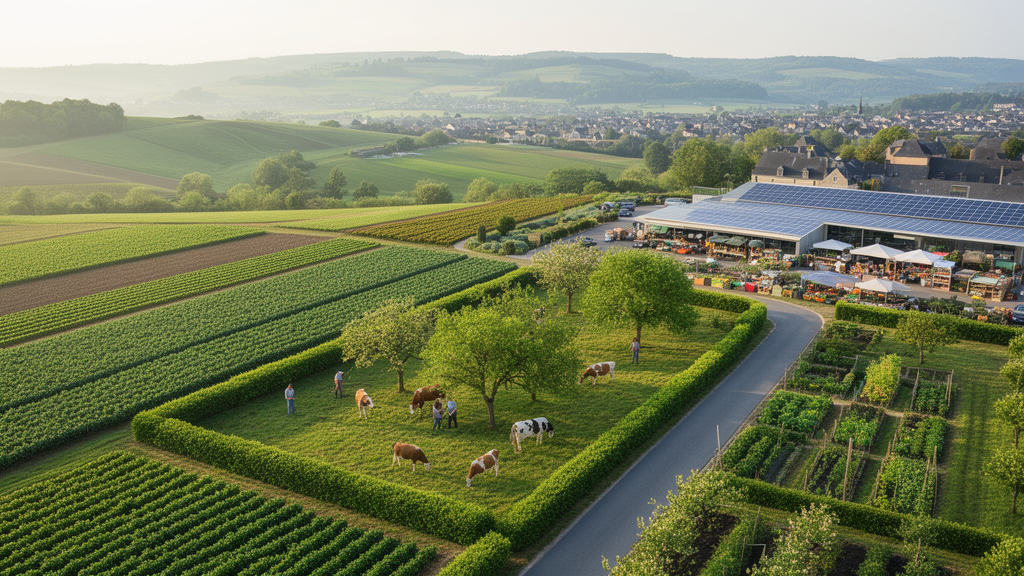
Researchers assumed organic production without mineral fertilisers or synthetic pesticides, combined with reduced tillage, cover crops, diversified rotations, closed nutrient cycling, hedgerows, agroforestry and grassland-based feeding for ruminants. Under these assumptions, Luxembourg could support about 64,000 productive cattle, or approximately 93,000 including breeding animals, compared with 191,360 cattle in 2020. Grass, field fodder and clover-grass leys would replace imported soybean and concentrated feed.
The resulting production of 6,590 tonnes of beef and 78,100 tonnes of raw milk was estimated to support a modeled 2050 population of 966,000 while reducing beef and dairy consumption by 83% and 88%, respectively, relative to the baseline. Reducing livestock and imported feed released substantial cropland for direct food production. The scenario reduced land devoted to feed and energy crops by 60% and increased the area used directly for human food by roughly threefold, with expanded cultivation of cereals, grain legumes, vegetables, potatoes and oil crops.
A seven-year crop rotation included two to three years of clover-grass and an additional grain legume, supplying nitrogen to subsequent crops and avoiding an estimated 13,300 tonnes of carbon-dioxide equivalent associated with synthetic fertiliser. Soybean imports for ruminants were eliminated in the scenario, while a smaller quantity for monogastric animals was expected to be produced domestically on freed land. Pork and poultry consumption was held constant, reflecting their relatively minor role in Luxembourg’s farm economy.
The proposed diet was flexitarian rather than fully vegetarian: six plant-based days and one omnivorous day each week. In the 2050 model, this included 4.8 kilograms of beef and 81 kilograms of dairy products per person annually. A separate calculation indicated that the domestically supported cattle population could provide just under two litres of milk per resident per day, enough to meet modeled low-fat milk and cheese consumption levels set out in German dietary guidance.
The authors described the broader reduction in animal-source foods as compatible with a predominantly plant-based diet containing small to moderate quantities of animal products. They also emphasized that affordability, habits, culture and Luxembourg’s multicultural population would influence whether consumers accepted such a pronounced change. Land management supplied another major share of the modeled reductions.
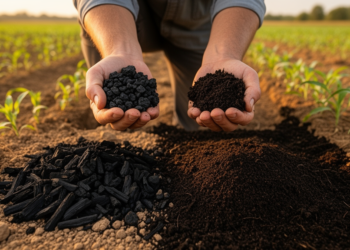
The assumptions placed silvopastoral agroforestry on 50% of pastureland and hedgerows around eligible cropland edges. Using sequestration rates from prior research, the researchers estimated potential annual uptake of 50,050 tonnes of carbon dioxide by the silvopastoral systems and 33,620 tonnes by hedgerows. Improved soil organic carbon under organic and agroecological cropland contributed a further estimated 55,107 tonnes per year.
These are modeled carbon-uptake estimates based on assumed rates and management arrangements, not direct measurements from newly established Luxembourgish hedges or agroforestry plots. The researchers also proposed agrivoltaic panels on 5% of cropland, capable of generating about 1,413 gigawatt-hours annually while leaving most of the underlying area in agricultural use. Changes on the consumption side completed the modeled pathway.
The estimated transition from the baseline diet to a flexitarian pattern saved 0.721 metric tons of carbon-dioxide equivalent per person per year, while reducing food waste from 25% to 5% of food consumption saved another 0.3 tons per person per year. The waste assumption required an 80% reduction and was associated with measures such as adjusting restaurant portions, weighing household and institutional waste bins, donating edible food and running awareness campaigns. Agrivoltaic electricity was estimated to displace electricity associated with 0.43 tons of carbon-dioxide equivalent per person per year.
Together, the production, land-use, diet and waste interventions reduced food-sector emissions by 53% in the scenario. The result arose from the combined package: the study did not model organic and agroecological farming as a stand-alone measure and did not establish that any one intervention could deliver the target on its own. Organic agriculture was central to the pathway because the model excluded mineral fertilisers and synthetic pesticides and incorporated diversified rotations, nutrient cycling and reduced soil disturbance.
The trade-off is that organic farming generally has lower yields per hectare, potentially making emissions per kilogram of product higher in some extensive systems. The scenario addressed that limitation by reducing livestock and imported feed, thereby freeing land for food eaten directly rather than trying to maintain current output through intensified production. The authors argued that focusing only on output efficiency could miss potential biodiversity benefits, lower pesticide use, improved soil quality and reduced eutrophication.
At the same time, Luxembourg’s small territory, dense population and projected growth make competition among agriculture, housing, conservation and energy production particularly consequential. Implementation would require support and changes beyond individual consumers. The study noted that organic and niche crops can face higher processing, packaging, marketing and transport costs, while farmers adopting new methods may bear part of the transition burden.
Luxembourg’s Food Policy Council, established in 2024, could help coordinate farmers, processors, consumers and public authorities. Because imported foods would remain important, the authors warned that improvements in domestic production could shift environmental burdens abroad unless food production and consumption changed together. The study presents a modeled vision rather than evidence that the pathway is already under way, and its numerical conclusions remain sensitive to land availability, adoption, yields, sequestration rates, dietary data and the capacity of farmers and consumers to accept major structural changes.
Subject of Research: Modeled decarbonisation pathways for Luxembourg’s agriculture and food system through 2050
Article Title: Sustainable diets and organic food production: The role of the agri-food sector in Luxembourg’s transition to net-zero GHG emissions by 2050
Article References: Keßler, S., Hitaj, C., Gibon, T., & Stoll, E. (2026). Sustainable diets and organic food production: The role of the agri-food sector in Luxembourg’s transition to net-zero GHG emissions by 2050. Environmental Challenges, 25, Article 101691. https://doi.org/10.1016/j.envc.2026.101691
Image Credits: AI Generated
DOI: 10.1016/j.envc.2026.101691
Keywords: Luxembourg, agri-food systems, decarbonisation, organic agriculture, agroecology, flexitarian diets, food waste, agroforestry, agrivoltaics, greenhouse-gas emissions, Sustainable, diets
Cite Scienmag News
Sloane Callahan. (October 22, 2026). Modeled 2050 Luxembourg food transition could cut sector emissions 53%. Scienmag. https://scienmag.com/modeled-2050-luxembourg-food-transition-could-cut-sector-emissions-53/
Sloane Callahan. "Modeled 2050 Luxembourg food transition could cut sector emissions 53%." Scienmag, 22 October 2026, https://scienmag.com/modeled-2050-luxembourg-food-transition-could-cut-sector-emissions-53/. Accessed 22 October 2026.
Sloane Callahan. "Modeled 2050 Luxembourg food transition could cut sector emissions 53%." Scienmag. October 22, 2026. https://scienmag.com/modeled-2050-luxembourg-food-transition-could-cut-sector-emissions-53/