


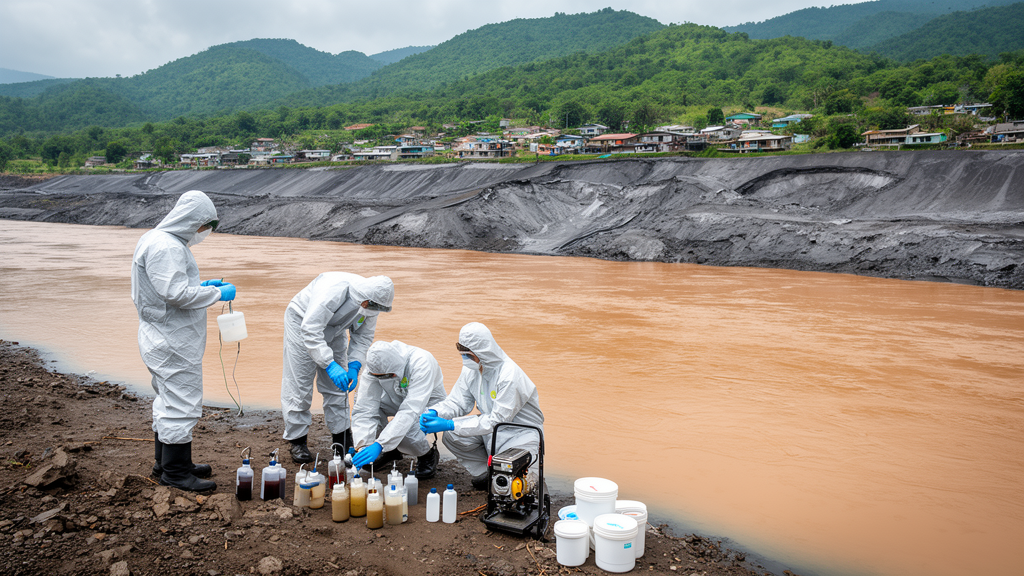
A global scoping review has identified 49 mining tailings dam disasters reported worldwide between 2015 and 2025, with 670 deaths and 112 injuries recorded in the available sources. Despite the scale of these releases, only two events—the Fundão dam failure in Mariana, Brazil, in 2015 and the Córrego do Feijão failure in Brumadinho, Brazil, in 2019—have been examined in population-based studies of human health. The findings reveal that potentially toxic elements and adverse health conditions have been documented, but they also expose a major gap in scientific evidence: most tailings disasters have not been followed by sustained research on the people living in affected communities.
The review combined searches of Web of Science, Scopus, MEDLINE and Google Scholar with event-specific searches and institutional information from the World Information Service on Energy, the United Nations Environment Programme, GRID-Arendal and the World Health Organization. It followed the Preferred Reporting Items for Systematic Reviews and Meta-Analyses extension for Scoping Reviews. The researchers built an inventory of disasters and their reported characteristics, then searched separately for studies measuring exposure, health outcomes or associations involving people directly affected by each event. Fourteen eligible studies assessed health consequences in Mariana and Brumadinho.
Forty-three of the 49 inventoried events were classified as dam failures, while six were categorized as overflows; these figures describe the review’s inventory and should not be interpreted as the proportion of every tailings disaster occurring worldwide. Asia accounted for 41% of the recorded events, South America for 33%, Africa for 14% and North America for 10%. The distribution may partly reflect where mining is intensive and where large numbers of tailings storage facilities operate, although the review did not systematically test this explanation. Clusters were reported in Minas Gerais in Brazil, Kachin State in Myanmar, Potosí in Bolivia, mining regions in China, and gold- and copper-producing areas in Peru and Mexico.
Gold was the commodity most frequently represented, appearing in 12 of the 49 events, followed by copper and jade with seven each and iron with five. Information on potentially toxic elements was available for only 10 disasters. Among those events, arsenic and lead were each reported in nine, while mercury, manganese and zinc appeared in six. These frequencies describe what investigators documented, not what was necessarily absent from other tailings. The results also show why treating mining waste as a single-contaminant problem would be misleading: tailings can contain mixtures of elements, and their movement and bioavailability can change with water conditions, oxidation-reduction reactions, pH and interactions among minerals.
Contamination does not automatically mean that people have been exposed at harmful levels, and the presence of an element in tailings is not itself evidence of a clinical disease. Human exposure may occur through ingestion, inhalation or skin contact as particles and contaminants move through water, sediment, soil, air, food and biota. The environmental persistence of the released material makes long-term surveillance important, but baseline conditions matter. In the upper Rio Doce basin, for example, soils and river sediments already contained elevated concentrations of several elements before the Mariana accident because of historical mining. Conversely, measurements after the disaster found higher concentrations in the estuary, far from that legacy source, showing why background conditions must be assessed across the full affected area rather than extrapolated from one locality.
Studies following Brumadinho provide the most extensive health evidence in the review. The Brumadinho Health Project enrolled 3,080 residents aged 12 or older, with baseline data collected in 2021, approximately two years after the failure. Hypertension, high cholesterol and depression were among the most frequently reported diagnoses. In an assessment of 2,740 adults, depressive symptoms affected 29.3%, post-traumatic stress symptoms 22.9% and anxiety symptoms 18.9%. Adjusted analyses linked several psychiatric outcomes with female sex and residence in mining areas, but the observational design does not establish that the disaster caused the conditions.
Other Brumadinho findings included multimorbidity in 53.8% of 2,777 adults. After adjustment, residents of directly affected areas had higher odds of multimorbidity than the reference group, with an adjusted odds ratio of 1.6 and a 95% confidence interval of 1.3–2.0. Respiratory assessments of 2,772 adults found asthma in 7.2% and chronic obstructive pulmonary disease in 3.5%; dry cough was reported by 23.6% and nasal irritation by 31.8%. In biomonitoring, concentrations above reference values were found for manganese in 38.08% of participants, arsenic in 33.37%, lead in 5.04%, mercury in 0.76% and cadmium in 0.17%. Such measurements document internal exposure, but the review stresses that they do not by themselves demonstrate toxic effects or disease.
Evidence from Mariana was similarly mixed in both type and strength. In an exploratory cross-sectional study of 507 residents, 37% reported worse health than before the disaster. Among spontaneously reported problems, respiratory conditions represented 40%, skin conditions 15.8% and behavioral disorders 11%. Blood testing of 300 participants from Regência, Povoação and Campo Grande identified elevated levels of aluminum, arsenic, mercury and nickel, while a subsequent study of 279 residents found urinary arsenic, cadmium and nickel positively associated with 8-OHdG, a biomarker of oxidative stress and DNA damage. No association was found for mercury or lead. The authors classified the latter result as evidence of an exposure-related biomarker association, not a clinical outcome or causal effect.
The review divided the literature into three descriptive levels: biomonitoring showing internal exposure; documented health outcomes and health-system indicators; and statistical analyses relating exposure variables to outcomes or biomarkers. The distinction was not a quality scale, and none of the included studies supplied evidence sufficient for causal inference. Cross-sectional designs, self-reported symptoms, geographic proxies and a lack of pre-disaster population baselines were recurring limitations. Toxicological literature provides context for potential effects of arsenic, cadmium, lead, mercury, manganese, aluminum and crystalline silica, but those general hazards cannot be treated as outcomes directly observed after these disasters. The review therefore calls for integrated, longitudinal surveillance combining environmental measurements, periodic biomonitoring and epidemiological follow-up, alongside safer tailings management, stronger monitoring and robust regulatory oversight.
Subject of Research: Global evidence on human exposure and health after mining tailings dam failures
Article Title: Mining tailings dam failures and human health: a scoping review of environmental exposure, potentially toxic elements, and epidemiological evidence, 2015–2025
Article References: Souza, T. P., Ferreira, A. D., Viana, D. G., de Sousa, J. E. S., & Ferreira, T. O. (2026). Mining tailings dam failures and human health: a scoping review of environmental exposure, potentially toxic elements, and epidemiological evidence, 2015–2025. Environmental Geochemistry and Health, 48(16), Article 651. https://doi.org/10.1007/s10653-026-03542-9
Image Credits: AI Generated
DOI: 10.1007/s10653-026-03542-9
Keywords: mining tailings, dam failures, public health, potentially toxic elements, epidemiology, biomonitoring, environmental contamination, Brumadinho, Mariana, risk assessment, Mining, tailings
Cite Scienmag News
Phoebe Ingram. (October 22, 2026). Most Tailings Dam Disasters Lack Population Health Studies. Scienmag. https://scienmag.com/most-tailings-dam-disasters-lack-population-health-studies/
Phoebe Ingram. "Most Tailings Dam Disasters Lack Population Health Studies." Scienmag, 22 October 2026, https://scienmag.com/most-tailings-dam-disasters-lack-population-health-studies/. Accessed 22 October 2026.
Phoebe Ingram. "Most Tailings Dam Disasters Lack Population Health Studies." Scienmag. October 22, 2026. https://scienmag.com/most-tailings-dam-disasters-lack-population-health-studies/


