


Sediment microbes from Kongsfjorden, a glacial fjord in the Arctic archipelago of Svalbard, carry DNA associated with a bacterial system for sensing and transporting mercury, according to a sequence-based study of environmental metagenomic DNA. Researchers screened the sediment for a compact genetic region containing the regulator gene merR, an operator-promoter region and two transporter genes, merT and merP. The recovered region, designated KG-mer1, provides molecular evidence that mercury-resistance-associated determinants occur in an Arctic fjord community, although the investigators did not demonstrate that the genes are expressed or that they confer resistance.
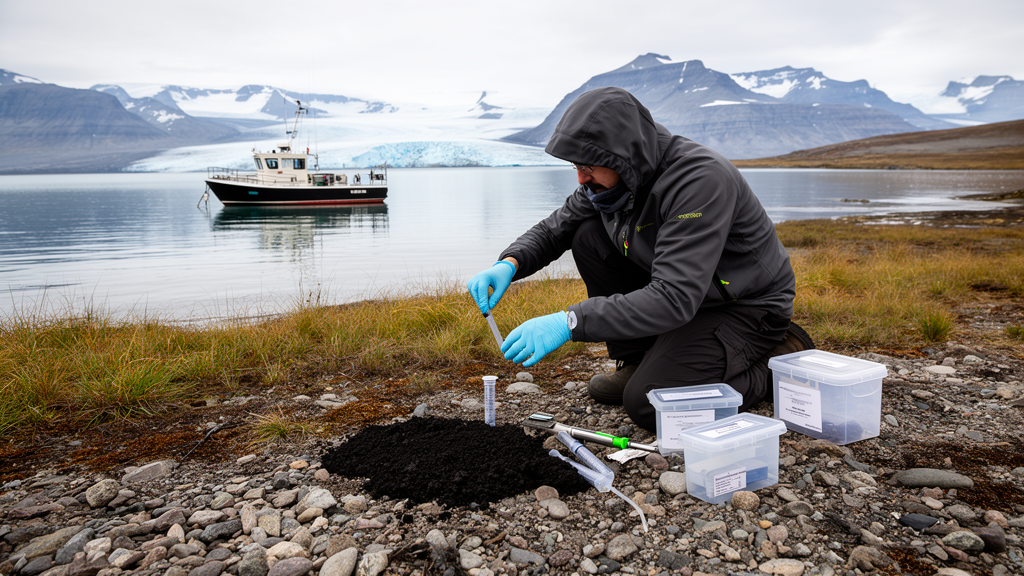
The samples were collected during the Summer Arctic Expedition in August 2019 from a site at 78° 58′ 526″ N, 11° 50′ 13″ E. The team used a Van Veen grab to collect about 5 kg of sediment, froze it at −80 °C at an Arctic station and then transported it to the School of Marine Sciences at Cochin University of Science and Technology for processing. Metagenomic DNA extracted from a 200 mg portion was subjected to a targeted polymerase chain reaction using primers designed to amplify a region containing merR, merT and merP. This targeted approach differs from a survey of the entire sediment metagenome: it can recover recognizable variants of the targeted region but may miss divergent or differently organized mercury-resistance determinants.
PCR produced an insert of approximately 1,158 base pairs, which was cloned into a plasmid, checked by colony and plasmid PCR, and sequenced by the Sanger method. Two representative positive clones yielded concordant sequences. The resulting DNA encoded 356 amino acids across three predicted proteins: KG-MerR1, a 144-residue transcriptional regulator; KG-MerT1, a 121-residue membrane transporter; and KG-MerP1, a 91-residue precursor of a periplasmic mercury-binding protein. A 69-nucleotide promoter-operator sequence separates the regulator from the transporter genes. The complete nucleotide sequence was deposited in GenBank under accession OQ918079, while the three protein sequences received accession numbers WLW16212.1, WLW16213.1 and WLW16214.1.
Sequence comparisons placed KG-MerR1 among Hg(II)-responsive MerR-family regulators. It showed 100% similarity in protein-level searches to a MerR sequence from Cupriavidus metallidurans CH34, while the predicted structure reproduced the three-part architecture characteristic of these proteins: a DNA-binding domain, a dimerization helix and a metal-binding domain. Three conserved cysteines, Cys82, Cys117 and Cys126, were positioned in the predicted model to coordinate Hg(II) in a trigonal-planar arrangement when the regulator forms a homodimer. In the model, Cys82 came from the dimerization helix of one monomer, while Cys117 and Cys126 came from the dimerization helix and metal-binding domain of the opposing monomer. The structural model placed 94.4% of its residues in the most favored regions of a Ramachandran plot and received an ERRAT quality factor of 100.000. These results support a MerR-like annotation, but they do not establish that the protein detects mercury or controls transcription in its native microbial host.
The regulatory region also carried recognizable sequence features associated with MerR-controlled promoters. Its −35 and −10 elements, TTGACT and TAAGGT, were separated by 19 base pairs, a spacing reported for many such systems. Between them lay a dyad-symmetrical operator containing the conserved GTACnnnnGTAC pattern and a seven-base palindrome, ATGAGTA. The merR and downstream merT-merP regions were oriented for divergent transcription. This compact arrangement is compatible with a feedback architecture in which a mercury-responsive regulator controls expression of neighboring transport genes, but the study did not test the binding of KG-MerR1 to the operator or measure changes in gene expression after mercury exposure. The operator-promoter region was described as 69 nucleotides in the sequence assembly, while the conserved promoter and operator features were mapped within that interval.
KG-MerT1, the predicted inner-membrane transporter, was closely related to MerT proteins associated with Pseudomonas aeruginosa and other bacteria. Its model contained three transmembrane helices, including two adjacent cysteines, Cys24 and Cys25, in the first helix. Another pair, Cys76 and Cys82, lay in the cytoplasmic region connecting the second and third helices, while charged residues Glu48 and Arg51 occurred within the second helix. Proline residues were also found near the cysteine and charged residues in the modeled transporter. These placements are consistent with the conserved cysteine architecture of MerT-family transporters involved in moving Hg(II) across a membrane. However, the study did not measure mercury binding, membrane transport or transfer to a downstream reductase, and the functional interpretation therefore remains based on sequence and computational modeling rather than direct experiments.
KG-MerP1 showed 98.90% protein-level similarity to a periplasmic MerP sequence from Pseudomonas aeruginosa. SignalP analysis predicted cleavage of a 19-residue signal peptide, leaving a mature protein of about 72 residues. Structural prediction produced the characteristic ferredoxin-like βαββαβ fold of MerP proteins and identified a conserved GMTCSAC motif containing Cys14 and Cys17 in the mature sequence. Cys14 was located in the longest loop, while Cys17 was positioned at the N-terminal region of the α1 helix; both were close to Phe38 and Tyr66 in adjacent loops, an arrangement associated with Hg(II)-binding and transfer in characterized MerP proteins. The model placed 89.1% of residues in the most favored Ramachandran regions and also received an ERRAT quality factor of 100.00. Even so, the predicted fold and motif demonstrate sequence-based compatibility with a mercury-binding role, not experimentally observed binding.
Neighbor-joining phylogenies, calculated with the Poisson model and 1,000 bootstrap replicates, placed KG-MerR1 with MerR proteins from beta- and gamma-proteobacteria, KG-MerT1 with transporters from the same broad groups, and KG-MerP1 with periplasmic MerP proteins from gamma-proteobacteria. None of the recovered sequences formed a distinctly Arctic lineage. Their affinities to sequences associated with marine, psychrophilic and geographically distant organisms are consistent with broad circulation of mercury-resistance-associated genes, potentially through mobile genetic elements, although the study did not establish that horizontal gene transfer occurred in Kongsfjorden. Because only one representative KG-mer1 sequence was recovered with a single primer pair, the region should not be interpreted as the complete mercury-resistance repertoire of the fjord sediments. The researchers also noted that transporter genes can occur on mobile elements and may have distinct evolutionary histories, but they did not determine the genomic context of KG-mer1.
The central result is therefore a genetic discovery rather than a demonstration of ecosystem cleanup or detoxification. Mercury-resistance systems are relevant in Arctic environments because mercury has been detected in Arctic air, aquatic systems and terrestrial landscapes, often above natural background levels, yet this study did not measure the mercury concentration or contamination history of the sampled sediment. Nor did it connect KG-mer1 to a particular cultured organism, quantify its abundance across the microbial community, examine whether the genes sit on plasmids or other mobile elements, or show that local microbes transcribe them. The strongest supported conclusion is that recognizable merR, merT and merP components occur in Kongsfjorden sediment DNA and possess conserved features associated with mercury sensing and transport. Because the work was based on a single targeted screen, it cannot establish how common these determinants are or whether other forms of mercury resistance are present.
Functional experiments will be needed to determine whether the recovered genes can be expressed, whether KG-MerR1 responds specifically to Hg(II), and whether KG-MerT1 and KG-MerP1 bind and move mercury as their sequence similarities predict. Testing at low temperatures could determine whether cold-adapted microbial hosts use these components under Arctic conditions. Broader sequencing with multiple primers or whole-metagenome analysis could reveal additional, more divergent determinants, while genomic context could test for associations with plasmids and other mobile elements. The study expands the sparse sequence record for merR, merT and merP in polar sediments and provides specific molecular candidates for that work, without establishing that Kongsfjorden microbes actively resist mercury or that the recovered region can be used for bioremediation.
Subject of Research: Sequence-based identification of putative merR, merT and merP genes in Kongsfjorden Arctic sediment metagenomic DNA
Article Title: Sequence-based identification and characterization of mer operon-related genes from Kongsfjorden sediments
Article References: Kachiprath, B., Surendran, N., Puthiyedathu, S. T., Ramachandran, C. E., & Philip, R. (2026). Sequence-based identification and characterization of mer operon-related genes from Kongsfjorden sediments. Discover Oceans, 3(1), Article 70. https://doi.org/10.1007/s44289-026-00184-8
Image Credits: AI Generated
DOI: 10.1007/s44289-026-00184-8
Keywords: Kongsfjorden, Arctic sediments, mercury resistance, mer operon, metagenomics, merR, merT, merP, Svalbard, environmental DNA, Sequence-based, identification
Cite Scienmag News
Juliet Wilcox. (October 22, 2026). Arctic Fjord Sediments Yield Putative Mercury-Resistance DNA. Scienmag. https://scienmag.com/arctic-fjord-sediments-yield-putative-mercury-resistance-dna/
Juliet Wilcox. "Arctic Fjord Sediments Yield Putative Mercury-Resistance DNA." Scienmag, 22 October 2026, https://scienmag.com/arctic-fjord-sediments-yield-putative-mercury-resistance-dna/. Accessed 22 October 2026.
Juliet Wilcox. "Arctic Fjord Sediments Yield Putative Mercury-Resistance DNA." Scienmag. October 22, 2026. https://scienmag.com/arctic-fjord-sediments-yield-putative-mercury-resistance-dna/


