


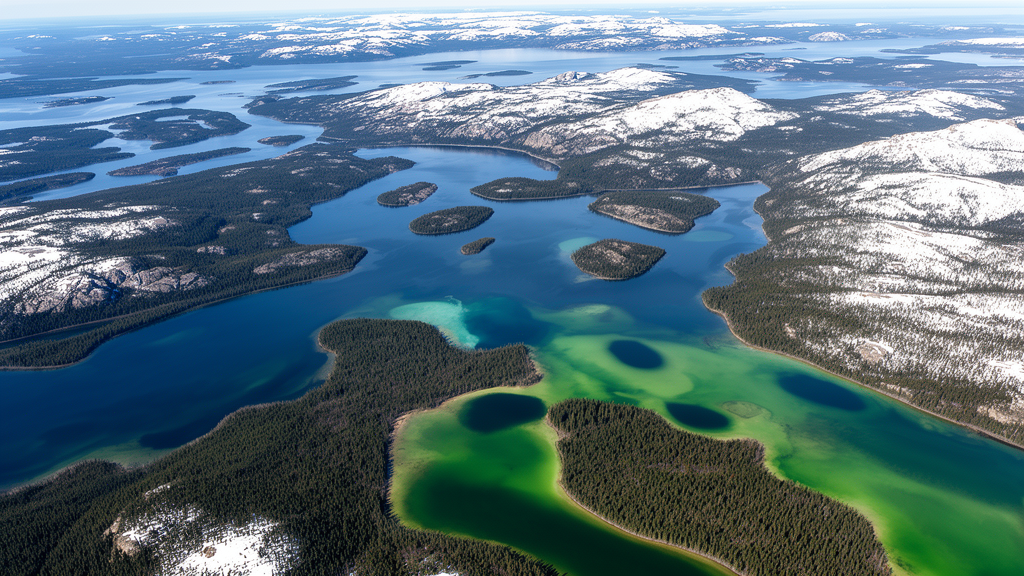
A continental analysis of 15,240 Canadian lakes larger than 5 km² found contrasting phosphorus trends between 1984 and 2025: concentrations increased in Arctic tundra watersheds but declined in boreal forest, temperate forest, agricultural and urban watersheds. The study used a deep neural network trained with 35,452 field measurements and applied to 386,727 Landsat images to reconstruct changes in lake-water total phosphorus across Canada. Arctic tundra lakes showed the strongest reported increase, at an estimated 0.15 micrograms per litre per year.
Estimated annual declines were 0.07 micrograms per litre in boreal forest watersheds, 0.11 in temperate forest watersheds, 0.16 in agricultural watersheds and 0.12 in urban watersheds. These estimates describe changes in concentration within each watershed category rather than comparisons of absolute phosphorus levels between regions. Path analyses associated the Arctic increases with ground warming and soil erosion, findings consistent with permafrost-related phosphorus mobilization.
The analysis did not directly quantify the contribution of every possible process, so it does not establish a single cause for the observed rise. It nevertheless identifies warming-associated changes in northern soils and catchments as relevant pathways in the reconstructed trends. In the boreal, temperate, agricultural and urban watersheds, declining phosphorus concentrations were associated with vegetation greening, hydrological change and reduced human phosphorus inputs.
Surface runoff remained an important influence in agricultural and urban systems. The study demonstrates how field observations and long-term satellite records can be combined to estimate subtle, continent-scale changes in remote lake systems. Its conclusions depend on the deep-neural-network reconstruction and statistical path analyses rather than direct measurements of phosphorus changes at every lake and year.
The reported results indicate that climate change may reinforce or counteract nutrient-management gains, making region-specific climate adaptation relevant to lake management.
Subject of Research: Regional lake phosphorus trends and climatic drivers across Canada
Article Title: Canadian lakes show contrasting phosphorus trends across climatic regions
Article References: Guo, H., Huang, J. J., Zhang, Y., Smol, J. P., Zhu, X., Jiang, L., Li, L., Lin, W., Zhang, H., & Wang, L. (2026). Canadian lakes show contrasting phosphorus trends across climatic regions. Communications Earth & Environment. https://doi.org/10.1038/s43247-026-04113-7
Image Credits: AI Generated
DOI: 10.1038/s43247-026-04113-7
Keywords: Canadian lakes, phosphorus, Arctic tundra, climate change, permafrost, water quality, Landsat, nutrient management, neural networks, watershed runoff, Canadian, lakes
Cite Scienmag News
Violet Maxwell. (October 22, 2026). Satellite analysis reveals divergent phosphorus trends across 15,240 Canadian lakes. Scienmag. https://scienmag.com/satellite-analysis-reveals-divergent-phosphorus-trends-across-15240-canadian-lakes/
Violet Maxwell. "Satellite analysis reveals divergent phosphorus trends across 15,240 Canadian lakes." Scienmag, 22 October 2026, https://scienmag.com/satellite-analysis-reveals-divergent-phosphorus-trends-across-15240-canadian-lakes/. Accessed 22 October 2026.
Violet Maxwell. "Satellite analysis reveals divergent phosphorus trends across 15,240 Canadian lakes." Scienmag. October 22, 2026. https://scienmag.com/satellite-analysis-reveals-divergent-phosphorus-trends-across-15240-canadian-lakes/


