


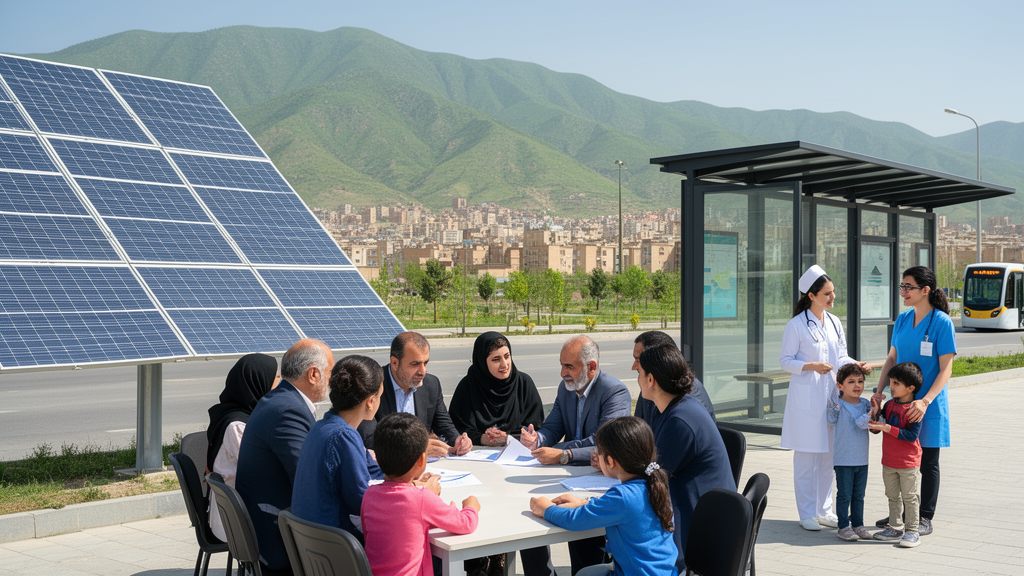
A dynamic spatial analysis of 28 Iranian provinces found that human capital, social capital, and their interaction were associated with lower carbon dioxide emissions from 2005 to 2020. Both forms of intangible capital had statistically significant negative relationships with emissions, with human capital showing the relatively stronger overall effect. The study also estimated that spatial spillovers were substantially larger than the direct provincial effects, indicating that the modeled relationships extended across provincial boundaries.
The researchers used a dynamic Spatial Durbin Model within an extended STIRPAT framework to distinguish direct effects from cross-provincial spillover effects and to estimate the combined influence of human and social capital. This approach accounts for temporal persistence, spatial interdependence, and the interaction between the two types of capital. The negative, significant interaction term suggested that the estimated relationships were complementary rather than independent, although the observational model does not by itself establish that increasing one form of capital would cause a reduction in emissions.
The study attributes the large spatial components of the results to possible processes such as knowledge diffusion, social norms, and institutional learning, but its reported evidence does not isolate which mechanism generated each spillover. Conditional marginal effects showed that the emissions-reducing relationships were consistently stronger in the long run than in the short run. Together, the findings suggest that the influence of human and social capital was neither confined to the province in which it was measured nor constant over time.
These results come from province-level observational data covering Iran’s 28 provinces over 16 years. The spatial model captures relationships among neighboring provincial units, persistent conditions, direct effects, and spillovers, but it cannot establish that the estimated factors caused the observed differences in emissions. The study therefore provides evidence of modeled associations rather than a tested intervention or a quantified forecast of how emissions would change under a specific education, trust, or regional-development program. Its central contribution is to show that human and social capital can be examined together within a dynamic spatial framework and decomposed into provincial and cross-provincial components.
Subject of Research: Spatial relationships among human capital, social capital, and provincial CO₂ emissions in Iran
Article Title: The spatial synergy of human and social capital mitigating CO2 emissions in Iranian provinces
Article References: Tabiee, M., Ghazali, S., & Dehghan Shabani, Z. (2026). The spatial synergy of human and social capital mitigating CO2 emissions in Iranian provinces. Discover Sustainability. https://doi.org/10.1007/s43621-026-05027-2
Image Credits: AI Generated
DOI: 10.1007/s43621-026-05027-2
Keywords: CO₂ emissions, Iranian provinces, human capital, social capital, spatial spillovers, Spatial Durbin Model, STIRPAT, regional development, complementarity, observational modeling, spatial, synergy
Cite Scienmag News
Sloane Callahan. (October 22, 2026). Human and social capital linked to lower provincial CO₂ emissions in Iran. Scienmag. https://scienmag.com/human-and-social-capital-linked-to-lower-provincial-co%e2%82%82-emissions-in-iran/
Sloane Callahan. "Human and social capital linked to lower provincial CO₂ emissions in Iran." Scienmag, 22 October 2026, https://scienmag.com/human-and-social-capital-linked-to-lower-provincial-co%e2%82%82-emissions-in-iran/. Accessed 22 October 2026.
Sloane Callahan. "Human and social capital linked to lower provincial CO₂ emissions in Iran." Scienmag. October 22, 2026. https://scienmag.com/human-and-social-capital-linked-to-lower-provincial-co%e2%82%82-emissions-in-iran/


