

Thursday, October 22, 2026
Science
No Result
View All Result
  • Login
  • HOME
  • SCIENCE NEWS
  • CONTACT US
  • HOME
  • SCIENCE NEWS
  • CONTACT US
No Result
View All Result
Scienmag
No Result
View All Result
Home Science News Chemistry

Suspended Silicon Metasurfaces Tune Mid-Infrared Light Rapidly

October 22, 2026
in Chemistry
Katie Riggs
By Katie Riggs Scienmag Editorial Profile - Quantum Physics
Reading Time: 2 mins read
0
Suspended Silicon Metasurfaces Tune Mid-Infrared Light Rapidly

Suspended Silicon Metasurfaces Tune Mid-Infrared Light Rapidly

65
SHARES
587
VIEWS
Share on FacebookShare on Twitter
ADVERTISEMENT

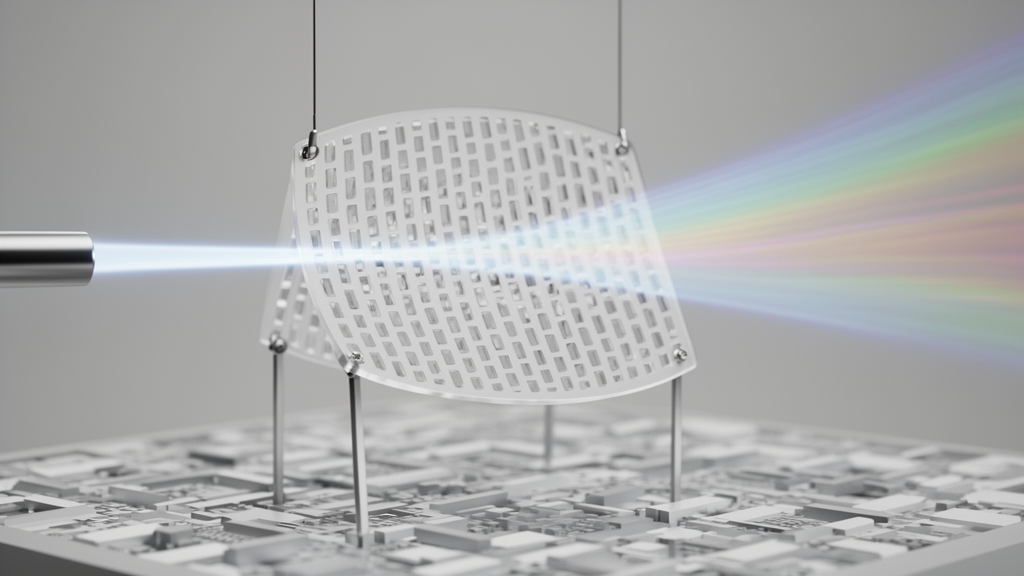
EPFL researchers have developed ultra-thin crystalline-silicon metasurfaces that can rapidly tune their interaction with mid-infrared light without changing their physical nanostructure. The peer-reviewed study, published in Nature Communications, demonstrates two tuning methods: integrated electrodes acting as micro-heaters that alter the silicon’s optical properties thousands of times per second and ultrafast laser pulses that induce changes on nanosecond timescales. The researchers report more than an order-of-magnitude improvement in key optical-performance metrics compared with previous mid-infrared platforms based on similar materials.

Metasurfaces are ultra-thin structures containing nanoscale patterns that can shape and direct light waves. Most metasurfaces developed thus far are static, meaning their optical properties remain fixed after fabrication and limiting their use in adaptable photonic systems. The EPFL team instead created suspended membranes of crystalline silicon, with the nanostructured layer separated from the surrounding environment by air.

Hatice Altug, who led the work in EPFL’s Bionanophotonic Systems Laboratory within the School of Engineering, said this configuration greatly reduced optical losses that typically limit conventional mid-infrared platforms. Two distinct approaches allowed the researchers to tune the devices without altering their nanostructures. In the electrical approach, integrated electrodes serve as micro-heaters.

Electrical current passing through the electrodes induces changes in the silicon’s optical properties, allowing the metasurface response to be adjusted thousands of times per second. In the optical approach, ultrafast laser pulses induce mobile electrical charges within the silicon, enabling the structures to respond on timescales of billionths of a second, or nanoseconds. The researchers say the combination of high optical performance and rapid tunability could help communication systems transmit information more efficiently and enable sensors that adapt quickly to changing conditions.

Mid-infrared light is relevant to these applications because molecules interact with it in characteristic ways, allowing spectroscopy to identify biological materials, drugs and pollutants. The same light can also carry information in free-space optical communications, where data travel through air rather than through cables or fibers. These potential uses build on the demonstrated tuning performance but remain prospective applications rather than tested clinical or commercial outcomes.

Other proposed directions include compact, low-power devices for free-space optical communications, highly selective and adaptive chemical and biological sensing, and active radiative cooling systems designed to help surfaces release heat in applications such as refrigeration or satellite thermal management. Looking further ahead, the researchers say rapid tunability combined with high optical performance could support advanced photonics applications that require precise control of light, including quantum spectroscopy. The work does not establish performance for any of those individual future systems, but it provides a versatile basis for developing them.

First author Felix Brikh said the platform’s reported optical performance does not come at the expense of scalability because the devices are made using techniques already compatible with large-scale semiconductor production.

Subject of Research: Real-time tuning of suspended crystalline-silicon metasurfaces for mid-infrared photonics

Article Title: A new way to control infrared light in real time

Article References: A new way to control infrared light in real time. Original publication (Bibliographic details unavailable.)

Image Credits: AI Generated

DOI: Not provided

Keywords: mid-infrared light, silicon metasurfaces, real-time modulation, nanosecond tuning, optical communications, infrared spectroscopy, photonic sensing, radiative cooling, quantum photonics, EPFL, control, infrared

Cite Scienmag News

Katie Riggs. (October 22, 2026). Suspended Silicon Metasurfaces Tune Mid-Infrared Light Rapidly. Scienmag. https://scienmag.com/suspended-silicon-metasurfaces-tune-mid-infrared-light-rapidly/

Katie Riggs. "Suspended Silicon Metasurfaces Tune Mid-Infrared Light Rapidly." Scienmag, 22 October 2026, https://scienmag.com/suspended-silicon-metasurfaces-tune-mid-infrared-light-rapidly/. Accessed 22 October 2026.

Katie Riggs. "Suspended Silicon Metasurfaces Tune Mid-Infrared Light Rapidly." Scienmag. October 22, 2026. https://scienmag.com/suspended-silicon-metasurfaces-tune-mid-infrared-light-rapidly/


Tags: advanced photonic systems developmentair-separated nanostructuresControlcrystalline silicon photonicsdynamic metasurface tuningEPFLinfraredinfrared spectroscopyintegrated micro-heaters for light controllaser-induced optical property changesmid-infrared lightmid-infrared light tuningnanosecond tuningnanostructured metasurfacesoptical communicationsphotonic sensingQuantum photonicsradiative coolingreal-time modulationreal-time optical property manipulationreduction of optical losses in mid-infrared devicessilicon metasurfacesSuspended silicon metasurfacesultrafast optical modulation
Share26Tweet16
Previous Post

Integrated application of CBDP, iPBS, and SCoT markers with DNA barcoding enables effective classification of Chinese prickly ash (Huajiao)

Next Post

Human and social capital linked to lower provincial CO₂ emissions in Iran

Related Posts

Research report: Self-stabilizing electrocatalyst for seawater oxidation: Repelling chloride and sustaining over 1000 hours of operation
Chemistry

Research report: Self-stabilizing electrocatalyst for seawater oxidation: Repelling chloride and sustaining over 1000 hours of operation

October 22, 2026
Supercomputer simulations reveal how kinesin steers its steps
Chemistry

Supercomputer simulations reveal how kinesin steers its steps

October 22, 2026
Electric fields reverse magnetization in 190-nanometer multiferroic nanodots
Chemistry

Electric fields reverse magnetization in 190-nanometer multiferroic nanodots

October 22, 2026
Sulfuric acid leads early particle formation, methanesulfonic acid favors later growth
Athmospheric

Sulfuric acid leads early particle formation, methanesulfonic acid favors later growth

October 22, 2026
Water Extraction of Cryogenically Prepared Cascabela Leaves Shows In Vitro Activity
Chemistry

Water Extraction of Cryogenically Prepared Cascabela Leaves Shows In Vitro Activity

October 22, 2026
UJI funds chiral materials and switchable bio-inspired catalysts
Chemistry

UJI funds chiral materials and switchable bio-inspired catalysts

October 22, 2026
Next Post
Human and social capital linked to lower provincial CO₂ emissions in Iran

Human and social capital linked to lower provincial CO₂ emissions in Iran

  • Mothers who receive childcare support from maternal grandparents show more optimized

    Mothers who receive childcare support from maternal grandparents show more parental warmth, finds NTU Singapore study

    27656 shares
    Share 11059 Tweet 6912
  • University of Seville Breaks 120-Year-Old Mystery, Revises a Key Einstein Concept

    1061 shares
    Share 424 Tweet 265
  • Bee body mass, pathogens and local climate influence heat tolerance

    682 shares
    Share 273 Tweet 171
  • Researchers record first-ever images and data of a shark experiencing a boat strike

    546 shares
    Share 218 Tweet 137
  • Groundbreaking Clinical Trial Reveals Lubiprostone Enhances Kidney Function

    531 shares
    Share 212 Tweet 133
Science

Embark on a thrilling journey of discovery with Scienmag.com—your ultimate source for cutting-edge breakthroughs. Immerse yourself in a world where curiosity knows no limits and tomorrow’s possibilities become today’s reality!

RECENT NEWS

  • Human and social capital linked to lower provincial CO₂ emissions in Iran
  • Suspended Silicon Metasurfaces Tune Mid-Infrared Light Rapidly
  • Integrated application of CBDP, iPBS, and SCoT markers with DNA barcoding enables effective classification of Chinese prickly ash (Huajiao)
  • Pragmatic taxonomy streamlines constructive alignment in learning

Categories

  • Agriculture
  • Anthropology
  • Archaeology
  • Athmospheric
  • Biology
  • Biotechnology
  • Blog
  • Bussines
  • Cancer
  • Chemistry
  • Climate
  • Earth Science
  • Editorial Policy
  • Marine
  • Mathematics
  • Medicine
  • Pediatry
  • Policy
  • Psychology & Psychiatry
  • Science Education
  • Science News
  • Social Science
  • Space
  • Technology and Engineering

Subscribe to Blog via Email

Enter your email address to subscribe to this blog and receive notifications of new posts by email.

Join 5,151 other subscribers

© 2025 Scienmag - Science Magazine

Welcome Back!

Login to your account below

Forgotten Password?

Retrieve your password

Please enter your username or email address to reset your password.

Log In
No Result
View All Result
  • HOME
  • SCIENCE NEWS
  • CONTACT US

© 2025 Scienmag - Science Magazine

Discover more from Science

Subscribe now to keep reading and get access to the full archive.

Continue reading