

Thursday, October 22, 2026
Science
No Result
View All Result
  • Login
  • HOME
  • SCIENCE NEWS
  • CONTACT US
  • HOME
  • SCIENCE NEWS
  • CONTACT US
No Result
View All Result
Scienmag
No Result
View All Result
Home Science News Chemistry

Supercomputer simulations reveal how kinesin steers its steps

October 22, 2026
in Chemistry
Bethany Barker
By Bethany Barker Scienmag Editorial Profile - Catalysis
Reading Time: 3 mins read
0
Supercomputer simulations reveal how kinesin steers its steps

Supercomputer simulations reveal how kinesin steers its steps

65
SHARES
587
VIEWS
Share on FacebookShare on Twitter
ADVERTISEMENT

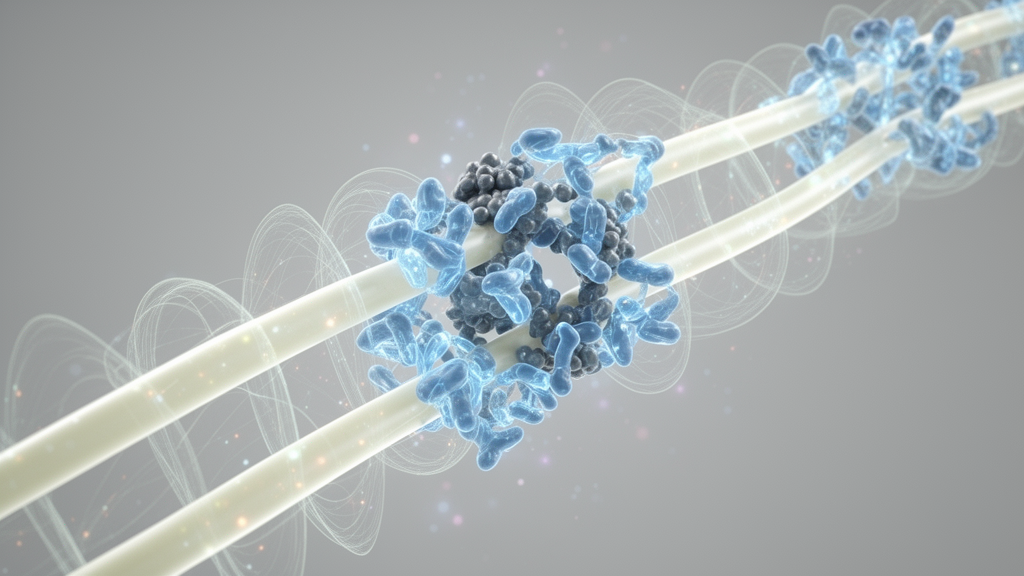
Atomic-level supercomputer simulations have identified a physical interaction that helps direct the cellular motor kinesin as it walks along microtubule tracks. Researchers modeled kinesin bound to a microtubule and found that the motor’s flexible neck region remains close to the track surface, biasing the trailing foot to swing around the right side of the leading foot in a counterclockwise arc. This contact between the neck and microtubule was required for forward stepping in the simulations, offering a structural explanation for how kinesin controls the direction of intracellular transport.

Kinesin is a molecular motor that carries cargo through cells by moving in discrete steps along filamentous tracks called microtubules. Its two “feet,” or motor domains, must coordinate their movement so that the protein advances efficiently without leaving the track. Previous work established that a connecting segment known as the neck region is important for coordinating the feet, but its three-dimensional structure and its direct interaction with microtubules had remained unresolved because current imaging methods could not capture the relevant atomic dynamics. The new findings, published in Biophysical Journal, address that gap through all-atom molecular dynamics modeling rather than direct observation in cells.

To overcome the limitations of imaging, the team constructed an atomic model of a kinesin motor attached to a microtubule, a system containing approximately three million atoms. The simulations were performed on the Fugaku supercomputer. Using an enhanced sampling method called generalized replica exchange with solute tempering, abbreviated gREST, the researchers examined the neck region across two independently constructed computational physics models, or force fields. This approach allowed them to sample the region’s flexible conformations and determine a high-confidence structure for its most stable state. The resulting model showed that the neck contains a twisted, two-strand coiled coil positioned perpendicular to the microtubule, with part of the neck remaining in contact with the track surface.

The researchers next simulated the motor’s initial step using a simplified detachment model in which some underlying microtubule subunits were removed to trigger movement. Under these conditions, the trailing foot did not move directly over the leading foot. Instead, interactions between the neck region and the microtubule surface biased its trajectory around the right side of the forward foot, producing a counterclockwise stepping path. Control simulations supported the importance of this interaction: alternative neck configurations with weak contact against the track failed to generate forward movement. The work therefore identifies a local atomic mechanism that can connect the conformation of kinesin’s neck region with the direction of its motion. It does not demonstrate a corresponding behavior in living cells, however, because the evidence comes from computational models of a simplified motor-track system.

The study also highlights three important simplifications that constrain the model. It uses a truncated kinesin construct rather than the complete protein, artificially removes microtubule subunits to initiate stepping, and omits the flexible E-hook elements extending from the microtubule surface. The authors note that future simulations incorporating full-length kinesin and more realistic track elements could refine the proposed structural framework. Even with those limitations, the simulations provide a testable physical explanation for one of the motor’s essential functions: steering its steps. By showing how contact between a flexible molecular structure and a cellular track can bias movement, the research adds a detailed structural basis to the mechanics of intracellular cargo transport.

Subject of Research: Atomic simulations of neck–microtubule interactions that bias kinesin stepping direction

Article Title: Supercomputer simulations reveal how the molecular motor kinesin steers itself along tracks

Article References: Supercomputer simulations reveal how the molecular motor kinesin steers itself along tracks. Original publication (Bibliographic details unavailable.)

Image Credits: AI Generated

DOI: Not provided

Keywords: kinesin, microtubules, molecular motors, supercomputing, molecular dynamics, Fugaku, intracellular transport, coiled coil, cell biology, Supercomputer, simulations, reveal

Cite Scienmag News

Bethany Barker. (October 22, 2026). Supercomputer simulations reveal how kinesin steers its steps. Scienmag. https://scienmag.com/supercomputer-simulations-reveal-how-kinesin-steers-its-steps/

Bethany Barker. "Supercomputer simulations reveal how kinesin steers its steps." Scienmag, 22 October 2026, https://scienmag.com/supercomputer-simulations-reveal-how-kinesin-steers-its-steps/. Accessed 22 October 2026.

Bethany Barker. "Supercomputer simulations reveal how kinesin steers its steps." Scienmag. October 22, 2026. https://scienmag.com/supercomputer-simulations-reveal-how-kinesin-steers-its-steps/


Tags: all-atom simulation of molecular motorsatomic-level modeling of motor proteinscell biologycoiled coilFugakuhow kinesin steps along microtubulesintracellular cargo transport mechanismsintracellular transportkinesinkinesin coordination of motor domainskinesin neck region role in cellular transportkinesin stepping mechanism revealed by supercomputerskinesin- microtubule interactionmicrotubule-binding interactions of kinesinmicrotubulesmolecular dynamicsmolecular motorsrevealsimulationsstructural basis of kinesin directional movementstructural insights into kinesin-microtSupercomputerSupercomputer molecular dynamics simulations of kinesinsupercomputing
Share26Tweet16
Previous Post

MD Anderson Names 2026 Oncology Nursing Award Winners

Next Post

Bael genotype NB 16 shows strong antioxidant response to winter low temperatures

Related Posts

Electric fields reverse magnetization in 190-nanometer multiferroic nanodots
Chemistry

Electric fields reverse magnetization in 190-nanometer multiferroic nanodots

October 22, 2026
Sulfuric acid leads early particle formation, methanesulfonic acid favors later growth
Athmospheric

Sulfuric acid leads early particle formation, methanesulfonic acid favors later growth

October 22, 2026
Water Extraction of Cryogenically Prepared Cascabela Leaves Shows In Vitro Activity
Chemistry

Water Extraction of Cryogenically Prepared Cascabela Leaves Shows In Vitro Activity

October 22, 2026
UJI funds chiral materials and switchable bio-inspired catalysts
Chemistry

UJI funds chiral materials and switchable bio-inspired catalysts

October 22, 2026
Experimental study links graphene wrinkle sharpness to strong flexoelectric response
Chemistry

Experimental study links graphene wrinkle sharpness to strong flexoelectric response

October 22, 2026
Quantum sensors sharpen X-ray measurements for nuclear monitoring
Chemistry

Quantum sensors sharpen X-ray measurements for nuclear monitoring

October 22, 2026
Next Post
Bael genotype NB 16 shows strong antioxidant response to winter low temperatures

Bael genotype NB 16 shows strong antioxidant response to winter low temperatures

  • Mothers who receive childcare support from maternal grandparents show more optimized

    Mothers who receive childcare support from maternal grandparents show more parental warmth, finds NTU Singapore study

    27656 shares
    Share 11059 Tweet 6912
  • University of Seville Breaks 120-Year-Old Mystery, Revises a Key Einstein Concept

    1061 shares
    Share 424 Tweet 265
  • Bee body mass, pathogens and local climate influence heat tolerance

    682 shares
    Share 273 Tweet 171
  • Researchers record first-ever images and data of a shark experiencing a boat strike

    546 shares
    Share 218 Tweet 137
  • Groundbreaking Clinical Trial Reveals Lubiprostone Enhances Kidney Function

    531 shares
    Share 212 Tweet 133
Science

Embark on a thrilling journey of discovery with Scienmag.com—your ultimate source for cutting-edge breakthroughs. Immerse yourself in a world where curiosity knows no limits and tomorrow’s possibilities become today’s reality!

RECENT NEWS

  • Bael genotype NB 16 shows strong antioxidant response to winter low temperatures
  • Supercomputer simulations reveal how kinesin steers its steps
  • MD Anderson Names 2026 Oncology Nursing Award Winners
  • Research report: PF chemotherapy combined with a PD-1/CTLA-4 bispecific antibody as first-line treatment in patients with recurrent/metastatic head and neck squamous cell carcinoma: a prospective, single-arm, phase II clinical study

Categories

  • Agriculture
  • Anthropology
  • Archaeology
  • Athmospheric
  • Biology
  • Biotechnology
  • Blog
  • Bussines
  • Cancer
  • Chemistry
  • Climate
  • Earth Science
  • Editorial Policy
  • Marine
  • Mathematics
  • Medicine
  • Pediatry
  • Policy
  • Psychology & Psychiatry
  • Science Education
  • Science News
  • Social Science
  • Space
  • Technology and Engineering

Subscribe to Blog via Email

Enter your email address to subscribe to this blog and receive notifications of new posts by email.

Join 5,151 other subscribers

© 2025 Scienmag - Science Magazine

Welcome Back!

Login to your account below

Forgotten Password?

Retrieve your password

Please enter your username or email address to reset your password.

Log In
No Result
View All Result
  • HOME
  • SCIENCE NEWS
  • CONTACT US

© 2025 Scienmag - Science Magazine

Discover more from Science

Subscribe now to keep reading and get access to the full archive.

Continue reading