


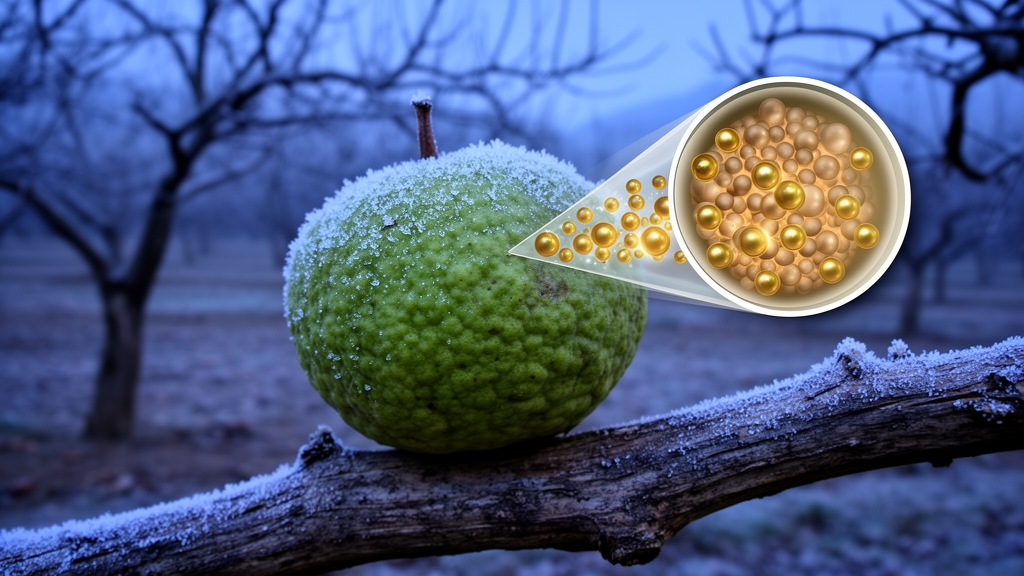
A seasonal field study of eight bael genotypes found that NB 16 recorded the highest winter activities for four antioxidant enzymes, along with the highest ascorbic acid and proline contents among the tested genotypes. The result, reported for plants growing at Chaudhary Charan Singh Haryana Agricultural University’s Regional Research Station in Bawal, identifies NB 16 as a candidate for further evaluation in breeding programs seeking genotypes with favorable low-temperature responses. The study measured leaf traits rather than demonstrating improvements in yield, fruit quality or survival.
Researchers evaluated NB 9, NB 5, NB 17, NB 16, CISHB 1, CISHB 2, Pant Aparna and Pant Sujata across three seasonal sampling periods in 2024–2025. The first sampling, on August 4, 2024, represented autumn conditions and normal growth. The second, on January 2, 2025, represented winter low-temperature conditions, while the third, on April 7, 2025, represented summer high-temperature conditions. Each seasonal comparison included measurements of antioxidant enzymes, biochemical compounds, water-related traits and photosynthetic pigments.
The researchers assessed superoxide dismutase, peroxidase, ascorbate peroxidase and catalase as indicators of leaf antioxidant activity. They also quantified ascorbic acid and proline, measured relative water content and membrane stability index, and determined concentrations of chlorophyll a, chlorophyll b, total chlorophyll and carotenoids. The study compared responses among genotypes and seasons and used a p-value threshold of 0.05 to identify statistically significant differences. The reported results describe associations between sampling season, genotype and the measured leaf characteristics.
Across the genotype set, the highest seasonal values for all four antioxidant enzymes occurred in winter. Superoxide dismutase reached 211.4 units per gram fresh weight, catalase 3.079 units per minute per gram fresh weight, ascorbate peroxidase 0.570 units per minute per gram fresh weight and peroxidase 3.67 units per minute per gram fresh weight. Winter also recorded the highest seasonal ascorbic acid content, at 24.2 milligrams per 100 grams fresh weight, and proline content, at 5.42 nanomoles per gram fresh weight.
Several photosynthetic and water-status measurements followed the opposite seasonal pattern. The lowest seasonal values reported for winter were chlorophyll a at 0.943 milligrams per gram fresh weight, chlorophyll b at 0.238 milligrams per gram fresh weight and total chlorophyll at 1.180 milligrams per gram fresh weight. Carotenoids reached their seasonal minimum at 0.234 micrograms per gram fresh weight. The winter membrane stability index was 28.58%, and relative water content was 79.3%. The study reports that these values exhibited the opposite trend under autumn normal-growth conditions, without establishing the mechanism or cause of the seasonal differences.
Genotype-by-season analysis distinguished NB 16 during the winter low-temperature period. The genotype had superoxide dismutase activity of 264.4 units per gram fresh weight, catalase activity of 3.735 units per minute per gram fresh weight, peroxidase activity of 4.10 units per minute per gram fresh weight and ascorbate peroxidase activity of 0.678 units per minute per gram fresh weight. NB 16 also had ascorbic acid content of 28.3 milligrams per 100 grams fresh weight and proline content of 5.94 nanomoles per gram fresh weight. These results specifically establish its leading values for the listed antioxidant and biochemical measures, not for every physiological trait included in the experiment.
Principal-component analysis summarized how the combined measurements varied. The first three components accounted for 87.72% of the total variability: PC1 represented 62.24%, PC2 17.14% and PC3 8.33%. In combination with the seasonal and genotype-level results, this multivariate pattern was interpreted as showing comparatively favorable physiological and biochemical responses for NB 16 under winter low-temperature conditions. The analysis identifies patterns in the measured dataset, but it does not by itself establish a molecular mechanism, a causal effect of temperature or a downstream improvement in crop performance.
The research was limited to a seasonal comparison of eight bael genotypes at one research station, with each season represented by one stated sampling date. Its conclusions concern enzyme activities, non-enzymatic compounds, water-status indicators and photosynthetic pigments measured in leaves. Although the results support NB 16 as a candidate for future breeding work, further testing would be needed to establish its usefulness under additional sites, years and low-temperature exposures. The research was shared as an accepted version subject to further edits and replacement by the final version of record.
Subject of Research: Seasonal antioxidant, physiological and photosynthetic responses of eight bael genotypes
Article Title: Dynamics of leaf antioxidant enzymes, physiological traits, and photosynthetic pigments for climate-resilient bael [Aegle marmelos (L.) Correa] genotypes in response to seasonal variation in temperature
Article References: Tinnu, Kumar, M., Mandhania, S., Prince, Bishnoi, A., Bhola, A., & Singh, N. (2026). Dynamics of leaf antioxidant enzymes, physiological traits, and photosynthetic pigments for climate-resilient bael [Aegle marmelos (L.) Correa] genotypes in response to seasonal variation in temperature. BMC Plant Biology. https://doi.org/10.1186/s12870-026-10058-y
Image Credits: AI Generated
DOI: 10.1186/s12870-026-10058-y
Keywords: bael, Aegle marmelos, NB 16, low-temperature stress, antioxidant enzymes, proline, ascorbic acid, photosynthetic pigments, plant breeding, seasonal variation, Dynamics, leaf
Cite Scienmag News
Alan Morgan. (October 22, 2026). Bael genotype NB 16 shows strong antioxidant response to winter low temperatures. Scienmag. https://scienmag.com/bael-genotype-nb-16-shows-strong-antioxidant-response-to-winter-low-temperatures/
Alan Morgan. "Bael genotype NB 16 shows strong antioxidant response to winter low temperatures." Scienmag, 22 October 2026, https://scienmag.com/bael-genotype-nb-16-shows-strong-antioxidant-response-to-winter-low-temperatures/. Accessed 22 October 2026.
Alan Morgan. "Bael genotype NB 16 shows strong antioxidant response to winter low temperatures." Scienmag. October 22, 2026. https://scienmag.com/bael-genotype-nb-16-shows-strong-antioxidant-response-to-winter-low-temperatures/


