


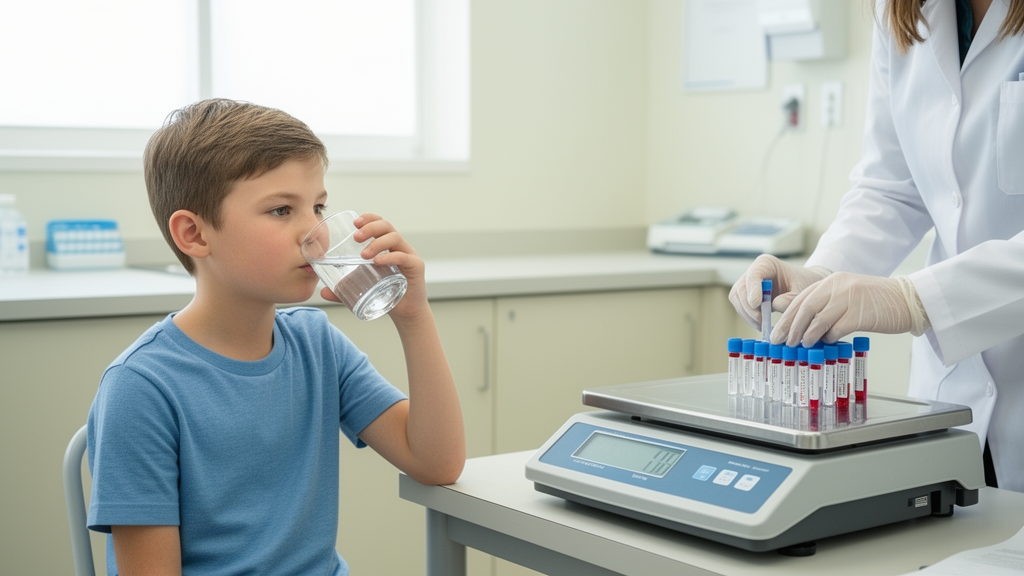
Drinking a 500-milliliter serving of tap water produced significantly different changes in children’s saliva metabolome than either a 200-milliliter serving of apple juice or no drink, according to a randomized controlled trial of 105 healthy children aged 5 to 10. The significant contrasts depended on baseline weight: water differed from apple juice among children with normal weight, while water differed from no drink among children with overweight or obesity. The corresponding comparisons were not significant in the other weight group. Data were collected at one pediatric dental clinic in San Francisco in 2022–2023, and saliva was analyzed before treatment and 45–60 minutes afterward using untargeted gas chromatography–time-of-flight mass spectrometry. The results reveal rapid, weight-specific metabolic responses, but they do not show that drinking water prevents obesity, diabetes or other chronic diseases.
Researchers randomly assigned children within weight categories to receive 500 mL of room-temperature tap water, 200 mL of 100% apple juice or no drink. Children remained sedentary for the following hour while completing a questionnaire with a parent or caregiver, and investigators collected unstimulated saliva at baseline and again 45–60 minutes after the assigned treatment. The analysis included 60 children classified as having normal weight, based on an age- and sex-specific body mass index percentile from the 5th through 85th percentile, and 45 classified as having overweight or obesity, above the 85th percentile. All participants were healthy, 91% attended public school and all had Denti-Cal insurance, which the investigators used as a proxy for low income. Although randomization was stratified by weight category, the trial did not reach its original enrollment target of 60 children in each category.
For the main metabolomic comparisons, investigators used orthogonal partial least squares discriminant analysis, or OPLS-DA, to distinguish changes in salivary metabolite profiles after each treatment. They also used permutational multivariate analysis of variance, or PERMANOVA, to test whether the overall treatment-related patterns differed. Among children with normal weight, the change after apple juice differed significantly from the change after water: the validated OPLS-DA model had a predictive Q2 of 0.30 and a permutation p-value of 0.007, while PERMANOVA returned p = 0.04. Among children with overweight or obesity, the change after no drink differed significantly from the change after water, with Q2 = 0.29, a permutation p-value of 0.04 and PERMANOVA p = 0.02. Both significant models explained 94% of the between-group variance, although their predictive performance was described as modest. Baseline metabolomic profiles did not differ significantly among the randomized treatment groups, and the comparison between apple juice and water in children with overweight or obesity and the comparison between no drink and water in children with normal weight were not statistically significant.
The trial detected broad changes extending across hundreds of salivary features. Among children with normal weight, 86 features increased and 46 decreased by at least 1.5-fold after apple juice relative to water, while 111 increased and 61 decreased after no drink relative to water. In the group with overweight or obesity, apple juice was associated with 57 increases and 69 decreases, and no drink with 56 increases and 62 decreases. Identified compounds included amino acids, organic acids, sugars and sugar phosphates, fatty acids, purines, pyrimidines and other small molecules. For example, salivary lactic acid was about 900 times higher after apple juice than after water in the normal-weight group. Some relative changes were also substantial in the other groups, but the study did not establish a statistically significant overall treatment contrast for those comparisons. Because the values describe relative changes in measured abundance rather than whole-body metabolic flux, the researchers treated the pathway findings as hypotheses rather than proof that particular biochemical routes were activated or suppressed.
The metabolomic contrasts coincided with weight-specific patterns in saliva insulin, a marker previously reported to track blood insulin. Following water, 75% of children with normal weight and 47% of those with overweight or obesity had saliva insulin below 170 pg/mL. By comparison, at least 70% in either weight group remained above that threshold after apple juice or no drink. The relative odds of lower insulin after water instead of either comparator were about 10 times greater in the normal-weight group, with an odds ratio of 10.3 and 95% confidence interval of 2.9–36.2, compared with an odds ratio of 4.4 and 95% confidence interval of 1.1–17.7 in the group with overweight or obesity. These findings indicate that baseline weight modified some acute responses, while also showing that the insulin associations were weaker among children with overweight or obesity.
Hydration measurements likewise suggested that weight status may influence the response to water. After water, saliva osmolality was below 70 mmol/kg in 80% of normal-weight children, compared with 50% after apple juice and 45% after no drink. Among children with overweight or obesity, the corresponding proportions were 53%, 80% and 33%. In the normal-weight group, the relative odds of osmolality below 70 mmol/kg after water were significantly higher than after no drink, with an odds ratio of 4.83, 95% confidence interval of 1.05–22.09 and p = 0.042, but the water-versus-apple-juice estimate was not significant. Estimates for children with overweight or obesity were also not statistically significant. At baseline, the overall difference in saliva osmolality between the weight groups was not statistically significant, despite a median of 74 mmol/kg for normal-weight children and 79 mmol/kg for those with overweight or obesity. The trial was not designed to establish insulin or hydration as the mechanism behind every metabolomic difference.
Pathway mapping pointed to several domains that might merit targeted testing in future intervention trials. In both weight groups, metabolites that increased after apple juice or no drink relative to water were associated with starch and sucrose metabolism and with pathways involving bacterial production of aminoglycosides. Metabolites that decreased were linked to alanine, aspartate and glutamate metabolism. In normal-weight children, the results also implicated inositol phosphate metabolism, histidine metabolism, butanoate metabolism and amino-acid pathways, including arginine, proline and phenylalanine metabolism. In children with overweight or obesity, potential effects included the citrate cycle, glycolysis or gluconeogenesis, the pentose phosphate pathway, glycine, serine and threonine metabolism, and galactose metabolism. These descriptive overlaps and differences show that the metabolomic response cannot be summarized as a single universal “water effect”; the detectable contrast depended on what was consumed and on the child’s baseline weight category.
Some differences may reflect the highly concentrated nature of the comparison beverages. The apple juice had an osmolality of 754 mmol/kg and supplied 94 kilocalories and 23 grams of carbohydrate per serving, while water provided no calories and the no-drink group received no fluid. Salivary changes in compounds such as myo-inositol, sorbitol and trehalose could therefore reflect local osmotic responses in the mouth as well as systemic metabolism. The appearance of bacterial aminoglycosides and the large shift in lactic acid also point to possible effects on oral microbial fermentation, particularly after exposure to fructose, glucose and sucrose. Saliva contains both human metabolites and products of oral organisms, making it useful for noninvasive sampling but difficult to interpret as a direct readout of metabolism elsewhere in the body. The investigators therefore proposed that the results might help identify candidate process measures or targets for more focused future studies, rather than establish a biological mechanism on their own.
Several limitations constrain the conclusions. The study followed children for only 45–60 minutes, so it could not determine whether the observed changes persisted, accumulated with repeated exposure or influenced long-term health. The sample was smaller than the researchers’ original enrollment target, and the weight-stratified comparisons had limited power for identifying individual metabolites or pathways. Participants and staff collecting saliva were not blinded to treatment, although the laboratory and epidemiologist analysts were. One child assigned to apple juice declined to drink it, and investigators used an imputed follow-up value in the intention-to-treat analysis. Salivary abundance was reported as relative mass-spectral peak height rather than absolute concentration, and the assay covered mainly hydrophilic, low-molecular-weight compounds rather than the full range of lipids. The trial also did not independently measure pathway flux, so an increased metabolite could reflect greater synthesis, less breakdown or both. Between-batch assay differences and unmeasured influences such as recent oral hygiene, diet, medications and oral microbiota could also affect the metabolomic patterns.
The results do not establish a clinical benefit from replacing juice with water or from drinking water at school, and the researchers did not test weight loss, diabetes prevention or long-term cardiometabolic outcomes. Their immediate contribution is evidence that three specific drink exposures can cause distinct short-term changes in saliva metabolism, with the statistically detectable contrast varying according to the child’s weight status. For public-health researchers, the study offers candidate metabolites and pathways for hypothesis testing in larger, longer trials. It also shows why an intervention’s beverage substitution, dose, baseline weight and hydration status need to be defined precisely rather than treating all drinking-water opportunities as interchangeable. Replication with absolute metabolite measurements, targeted pathway assays, serial samples and repeated exposure will be needed before these acute signatures can be connected to meaningful health outcomes.
Subject of Research: Acute effects of water, apple juice and no drink on salivary metabolomes and insulin in healthy children, stratified by baseline weight status.
Article Title: Acute changes in saliva metabolomic profile after drinking water instead of apple juice or no drink signal improved insulin-related metabolism in healthy children: a randomized controlled trial
Article References: Stookey, J. D., Cholera, M., & Cape, R. (2026). Acute changes in saliva metabolomic profile after drinking water instead of apple juice or no drink signal improved insulin-related metabolism in healthy children: a randomized controlled trial. Frontiers in Nutrition, 13, Article 1812940. https://doi.org/10.3389/fnut.2026.1812940
Image Credits: AI Generated
DOI: 10.3389/fnut.2026.1812940
Keywords: children, drinking water, apple juice, saliva, metabolomics, insulin, randomized trial, weight status, hydration, oral microbiome, Acute, changes
Cite Scienmag News
Daisy Hatcher. (October 22, 2026). Water changes child saliva metabolism in weight-stratified randomized trial. Scienmag. https://scienmag.com/water-changes-child-saliva-metabolism-in-weight-stratified-randomized-trial/
Daisy Hatcher. "Water changes child saliva metabolism in weight-stratified randomized trial." Scienmag, 22 October 2026, https://scienmag.com/water-changes-child-saliva-metabolism-in-weight-stratified-randomized-trial/. Accessed 22 October 2026.
Daisy Hatcher. "Water changes child saliva metabolism in weight-stratified randomized trial." Scienmag. October 22, 2026. https://scienmag.com/water-changes-child-saliva-metabolism-in-weight-stratified-randomized-trial/


