


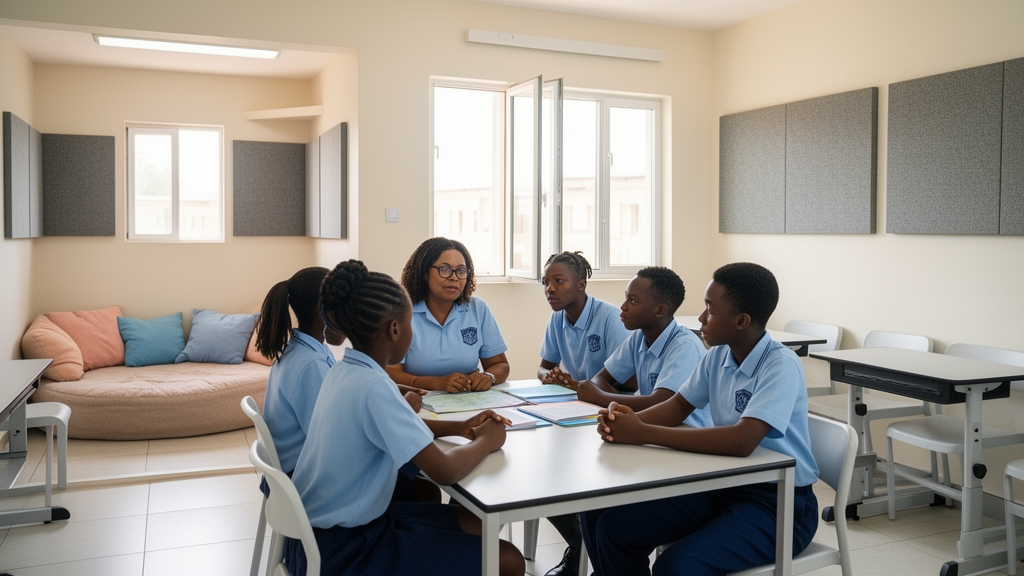
A qualitative study of seven multidisciplinary professionals identifies noise, unstable lighting, crowded transitions and limited access to calm spaces as prominent sensory and spatial barriers affecting neurodivergent learners in Nigerian secondary-school environments. The interviews, conducted with practitioners in physiotherapy, occupational therapy, special-needs coordination, mental-health support, counselling and institutional leadership, suggest that schools can begin addressing neuro-inclusion by controlling sound and light, creating lower-stimulation retreat areas and reorganizing classrooms without waiting for major construction. The findings provide professional perspectives rather than direct measurements of school environments or proof that particular retrofits improve learning, attendance or wellbeing.
The researchers used purposive sampling and virtual, semi-structured interviews lasting approximately 15 to 30 minutes. Seventeen professionals were approached, seven agreed to participate and ten declined. Four participants reported direct experience with secondary-school-aged learners, while the others drew on therapeutic, special-needs, rehabilitation or care and support settings.
Professional experience ranged from one to 20 years, and contact with neurodivergent children and young people ranged from daily to once a fortnight. Exact practice locations and standardized learner ages were not collected, and diagnostic categories were inconsistently reported across caseloads. The authors therefore describe the results as mixed-context professional proxy evidence relevant to Nigerian secondary-school design rather than observations from one defined school or a representative sample of Nigerian schools.
Open-ended interview accounts were analyzed inductively through reflexive thematic analysis, yielding four themes: sensory environmental stressors; environmental distress and spatial dysregulation; restorative and regulatory features; and spatial configuration, transitions and classroom ergonomics. In a separate analytical strand, participants appraised nine researcher-predefined features—acoustics, lighting, colour and visual complexity, sensory zoning, withdrawal spaces, flexible furniture, wayfinding, biophilic elements, and temperature and ventilation—for relevance, functional influence, feasibility and priority. The separation matters because agreement with a named design feature does not show that the issue emerged independently from the interviews.
The second author conducted the primary coding, while the first author provided supervisory review; there was no independent parallel coding, formal member checking or positionality diary, and the primary analyst’s architectural training may have influenced interpretation. Visual and lighting-related problems appeared in all seven open-ended accounts. Participants described glare, distracting windows, abrupt changes in light, fluorescent flicker and excessive visual stimulation.
Six raised auditory overload, citing echoey corridors, loud conversations, alarms, scraping chairs and chalkboard noise. Five described crowding or reduced personal space, especially in assembly halls and busy corridors, while four reported olfactory or tactile sensitivities involving smells, food, cleaning products, textures or touch. Rather than treating noise or light as isolated variables, several professionals distinguished persistent background conditions from abrupt, unpredictable events.
That distinction points to different responses: persistent reverberation may require absorptive surfaces or quieter finishes, while sudden alarms and other events may require predictable signaling, transition buffers and better management of movement through shared spaces. The accounts also depict distress arising when several demands converge. One mental-health professional described a 14-year-old autistic student who became non-verbal, covered their ears and could not follow the usual evacuation procedure during a fire drill involving an alarm, flashing lights and a crowded route.
A special-needs coordinator described a Year 9 autistic student becoming highly agitated after a class was moved into a room containing traffic noise, glare, fresh-paint odor and nearby sports activity. A guidance counsellor reported that chalkboard noise was severe enough to contribute to one learner changing schools. These are professional reports of person-environment interaction, not evidence that a single feature caused each outcome, yet they illustrate how intense or unpredictable environments can combine with an individual’s sensory profile during high-demand situations.
Corridors, doorways, playgrounds and assembly areas were described as places where crowding, reverberation, movement and uncertainty accumulated. Participants reported freezing at thresholds, difficulty processing signs in chaotic corridors, reluctance to enter an unadapted route and withdrawal during transitions. Advance notice of journeys, visual or verbal prompts, straightforward routes and escorting were associated in the accounts with easier movement.
At the same time, all seven professionals discussed seating, orientation or classroom layout, suggesting that neuro-inclusive adaptation need not be confined to specialist rooms or expensive equipment. Strategies included positioning learners away from windows or high-traffic areas, preserving sightlines to the teacher, varying seating arrangements and avoiding tightly clustered desks. Lower-stimulation environments were the clearest consistently emerging supportive feature.
Participants described sensory rooms, quiet rooms, dimly lit areas, classroom focus corners and simply the quietest available space, together with blinds, dividers, soft seating, headphones, fidget items, textured surfaces and reduced visual clutter. The transferable principle appears to be access to control over stimulation rather than one prescribed room type. Professionals also considered organization itself a form of control: separating quieter and more active areas, reducing visual clutter, controlling crowding and adjusting furniture could produce benefits without major building work.
Participants suggested portable and locally feasible measures such as fabric panels, soft floor coverings, blinds, local textiles, furniture-based zoning, picture or color-coded signs, painted navigation paths and small retreat nooks. These examples establish perceived feasibility, not measured effectiveness. Integrating the open-ended findings with the prompted appraisals produced a preliminary three-tier retrofit framework.
Tier 1 comprises acoustic control, lighting control, withdrawal or escape spaces, and sensory zoning, because these features showed the strongest convergence between spontaneous accounts, resource-limited priorities, functional importance and practical implementation. Tier 2 contains flexible furniture and wayfinding or predictability, which were judged useful and implementable but less consistently selected as immediate priorities. Tier 3 includes biophilic respite, visual simplification or color, and temperature or ventilation, which participants generally considered relevant when prompted but less often prioritized for immediate action or, particularly for ventilation, potentially more capital-intensive.
Tier placement was interpretive rather than based on numerical scores, and prompted relevance alone did not determine ranking. The framework is therefore a practice-informed proposal for testing, not a validated design standard or universal ranking for every school. Implementation was consistently constrained by more than construction costs.
All seven professionals mentioned financial limitations, while space shortages, ageing infrastructure, fixed building footprints and poor original planning also shaped what was possible. Institutional readiness mattered as well: incomplete staff buy-in, competing school priorities, limited decision-maker awareness and a lack of practical know-how could impede change even when a retrofit was technically possible. The findings support a staged logic in which low-cost reorganisation and targeted improvements precede expensive replacement of lighting, ventilation, acoustic systems or entire spaces.
The most promising options must still be tested building by building because sensory preferences vary, and no single environmental prescription will suit every learner. Staff engagement, maintenance capacity, climate, available space, institutional culture and user priorities all affect whether an intervention can be implemented and sustained. The study has important boundaries.
It did not directly involve neurodivergent students, observe classrooms, measure acoustics, lighting, temperature or ventilation, or test student outcomes before and after a retrofit. It also did not establish statistical generalisability, thematic saturation, or identical design needs for autistic learners and people with ADHD, dyslexia, learning disabilities or other sensory processing differences. The autism-specific ASPECTSS framework was applied only after the themes had been developed, as a post hoc interpretive lens, and Attention Restoration Theory provided another conceptual lens for discussion of retreat and nature-based spaces; neither was tested as an instrument in this study.
Future work should combine direct student participation and co-design with clearly defined demographics, multiple school sites and objective environmental assessment. Until then, the study offers a locally grounded map of professional concerns and a testable retrofit sequence: control sound and light first, preserve somewhere to withdraw, organize space for predictability, and evaluate the results with the learners who will use them.
Subject of Research: Professional-identified sensory and spatial barriers and retrofit priorities for neuro-inclusive Nigerian secondary schools
Article Title: Professional perspectives on sensory and spatial barriers relevant to neuro-inclusive secondary school environments in Nigeria
Article References: Olagunju, O. O., & Ogundele, A. T. (2026). Professional perspectives on sensory and spatial barriers relevant to neuro-inclusive secondary school environments in Nigeria. Frontiers in Built Environment, 12, 1965117. https://doi.org/10.3389/fbuil.2026.1965117
Image Credits: AI Generated
DOI: 10.3389/fbuil.2026.1965117
Keywords: neuro-inclusive design, sensory environment, school architecture, Nigeria, autistic learners, acoustics, lighting control, sensory zoning, retreat spaces, qualitative research, Professional, perspectives
Cite Scienmag News
Violet Maxwell. (October 22, 2026). Professional perspectives identify sensory priorities for neuro-inclusive Nigerian secondary schools. Scienmag. https://scienmag.com/professional-perspectives-identify-sensory-priorities-for-neuro-inclusive-nigerian-secondary-schools/
Violet Maxwell. "Professional perspectives identify sensory priorities for neuro-inclusive Nigerian secondary schools." Scienmag, 22 October 2026, https://scienmag.com/professional-perspectives-identify-sensory-priorities-for-neuro-inclusive-nigerian-secondary-schools/. Accessed 22 October 2026.
Violet Maxwell. "Professional perspectives identify sensory priorities for neuro-inclusive Nigerian secondary schools." Scienmag. October 22, 2026. https://scienmag.com/professional-perspectives-identify-sensory-priorities-for-neuro-inclusive-nigerian-secondary-schools/


